Facebook
 Google
 GitHub
 Linkedin
AI and Robotics Reshape Textiles and the Performing Arts
Researchers use AI to reverse-engineer fabrics and preserve performing arts, fusing creativity, robotics, and machine learning for global impact.
Pioneering researchers from Sudbury’s Laurentian University and Shanghai’s International Fashion Education Centre are blazing a new path, employing AI to reverse-engineer fabric material patterns, making machine-readable information for instructing robots in creating textiles. Other game-changing research involves using AI to create, record, and preserve dance and performing arts, aiding artists' personal development and providing accessible materials for archives and cultural institutions across the globe.
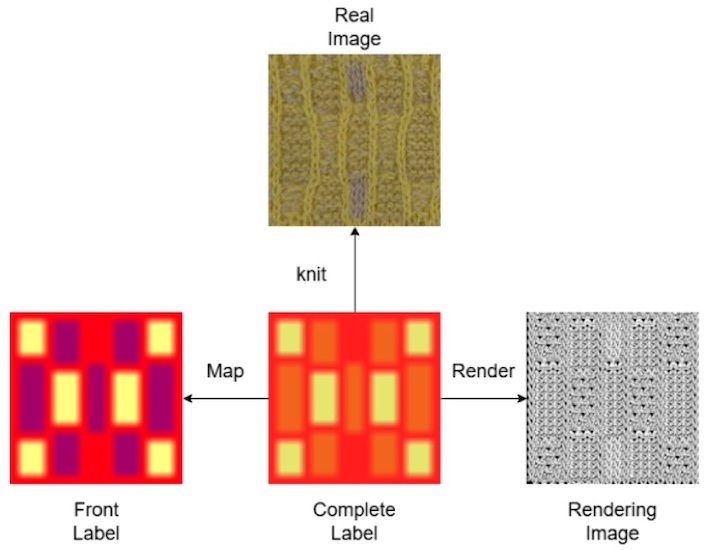
Researchers have formulated a deep learning framework for working out stitch patterns in complex fabrics, which robots can use to reproduce them. Image used courtesy of Sheng H, Cai S, Zheng X, Lau M., 2025.
“An Emerging Paradigm in Textile Generation”
In a special issue of Electronics, “Bridging the Gap between Deep Learning and Probabilistic Inference for Advancements in Robotics,” intrepid scientists detail their exploration into a new realm of design possibilities, merging robotics, AI, and textile creation. The researchers intended to develop a two-stage pipeline for deconstructing physical knitting to create complete machine-readable stitch labels for robots to use for creating fabrics. The first stage (generation phase) is used to predict front labels (using images of knitting to capture patterns at the front) and an inference phase to discern the pattern of the knitted fabric at the back. The approach involved the creation of a deep learning architecture that combines these two phases to create a complete stitch label.
The researchers focused on architecture optimization, evaluating more stringent loss function implementations, which provide a measure of how effective a machine learning model is at generating predictions (for front and complete labels) against target values. The researchers also incorporated different model frameworks and yarn-specific training in their model evaluation. The investigators sought to remove the production barrier of manual labor-intensive stritch labeling and promote greater scalability.
The new fabric pattern development model is capable of handling rare stitches, producing knitting designs for both single and multi-yarn knitting, and effortlessly adjusting to new fabric styles. During tests on 5,000 textile samples, it outperformed current techniques with an accuracy of over 97% in translating images into knitting instructions. When combined with knitting robots, the technology facilitates automated production of textiles, reduces labor and time costs, supports rapid prototyping, and facilitates tailored mass production by successfully handling complex stitches and those of a variety of colors.
The team intends to strengthen their model by balancing data for unusual stitches and integrating color perception to increase accuracy and aesthetics. Additionally, they want to improve the system's flexibility to accommodate various fabric varieties and sizes. They intend to develop it further to produce intricate 3D knitted clothing and investigate its application in other textile fields, such as weaving and embroidery.
Using AI for Creating and Archiving Performing Arts
Other cross-collaborative and pioneering research concerns an infusion of AI, robotics, and performing arts, bringing together the efforts and focus of Coventry University’s Centre for Dance Research and the University of Nottingham with funding provided by the Arts and Humanities Research Council’s Bridging Responsible Artificial Intelligence Divides (BRAID) program.
Video used courtesy of Coventry University Research
This research project explores the responsible use of AI to conserve, reimagine, and inventively repurpose performance-oriented art, especially dance and live media. Important objectives include making sure AI technologies prioritize the care of archival materials and diversity, as well as creating open, accessible techniques for preserving performances, including human-machine interaction. The intent is to help develop artistic practice for dancers, including those with disabilities.
A key area of focus for the project is the development of a first-of-its-kind digital archive for dance devoted to the work of choreographer Dame Siobhan Davies, Siobhan Davies RePlay. The study investigates how AI may improve this archive's sustainability, longevity, and inventive reuse. The archive will allow students, teachers, professors, and other expert practitioners of performing arts to find, reimagine, and expand upon earlier dance pieces. Another goal of this case study is to offer a scalable approach for reviving and expanding the accessibility of other performing arts archives, creating a palpable impact on culture, education, and society as a whole.
Featured image used courtesy of Adobe Stock