Facebook
 Google
 GitHub
 Linkedin
AI-Powered xCognition from Xaba Pushes Robotic Automation Forward
Xaba raises $8 million in seed funding to scale its xCognition platform, using generative AI and digital twin technology to transform robotic programming.
Xaba is growing its seed funding, procuring a $2 million seed fund extension and securing a further $6 million in a founding round led by Hitachi Ventures (rounding off to a current fund value of $8 million) to advance its xCognition software. This software uses digital twin technology and generative AI to allow robotics machinery to adapt dynamically to its environment, learn from legacy data and human experience to write its own code, reducing development labor costs, saving time, optimizing operational efficiencies, and boosting overall productivity in industrial environments. This article will also cover some of the latest industry partnerships concerning haptic robot teleoperation and expanding automation in the warehousing and logistics sectors.
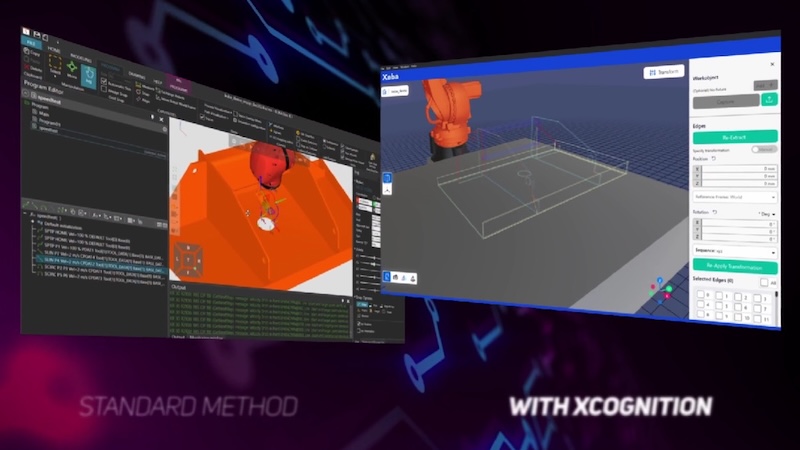
Detailed simulation of real-world settings provides more comprehensive teaching and machine learning, enhancing robotic process capacities. Image used courtesy of Xaba
Advancing Synthetic Cognition
In January last year, Hitachi Ventures announced Xaba’s receipt of a $2 million investment, supporting continued development of the latter company’s pioneering xCognition software. The solution allows industrial robots to generate programs independently using generative AI without human intervention, adapt to changing process needs, and enhance overall operational performance. By removing the need for time-consuming human-guided programming and setup, businesses can reduce downtime and maintain/boost throughput. BDC Capital’s Deep Tech Venture Fund led the funding round and was backed by Hitachi Ventures and Hazelview Ventures.
Traditional modes of setting up and running automated robotic systems require labor-intensive programming, continual oversight by operators, and a lack of adaptive AI-powered robot learning. Xaba’s xCognition Cognitive Control leverages the data compiling and mining capacity of generative AI for the self-creation of code (complete end-to-end programming) for CNC machines, robots, and other integrated systems. This new hands-off automated robotics approach frees up employee time, speeds up deployment, reduces setup and development costs, and reduces labor efforts that can otherwise be spent on higher-value tasks and skills development.
xCognition facilitates integration with newly developed and legacy systems and hardware, with the ability to re-jig workflows and scale up production to meet key output targets commensurate with market demand. The ability to integrate with old and outdated machinery and control hardware reduces initial setup costs and lowers customer inertia in the context of taking initial steps in onboarding and updating automated robotics equipment and systems.
According to Xaba, their innovative xCognition software improves the repeatability and accuracy of robotic systems by 10 times, advances deployment by 40 times compared with traditional software, reduces downtime by 90% (using real-world point cloud data), and enhances production by 30 times through the coordinated operation of multi-robot fleets.
Xaba Secures a Further $6 million
A recent round of investment, Xaba secured a further seed fund extension of $6 million (bringing the total to $8 million) led by Hitachi Ventures, with other participating investors including Hazelview Ventures, Impact Venture Capital, BDC, and Exposition Ventures. Xaba will be using the investment to funnel into its xCognition software.
XCognition and a proprietary AI Cognitive Control, PLCfy, take in functional specifications and text detailing manufacturer goals, key performance indicators, workflow processes, and tasks, and then generate tailored PLC code in a matter of minutes.
xCognition leverages digital twin technology to generate simulated real-world settings, informing machine learning models to adapt to automated machinery and workflows.
Two main components make up this system. In order to continuously adapt and enhance operations, the Real-Time Process Learning Module first learns and maps the intricate interactions between devices, sensors, and workflows using intelligent data analysis and networked systems. Second, any kind of robots, CNC machines, and controllers—both new and old—can be readily connected to the Cognitive Control Framework, a global AI system.
PickNik and Haply
PickNik has joined forces with Haply, a designer of haptic sensory devices used for robotic and medical equipment control, to invigorate its MoveIt Pro developer platform with the Inverse3 precision haptic controller.
Inverse3 makes remote control more natural by enabling operators to physically operate robots while obtaining force feedback. With the help of MoveIt Pro software, programmers can now record high-quality human motion data and make adjustments to teach robots to perform intricate jobs. This combo intends to increase human-robot interaction in a variety of difficult contexts by offering haptic teleoperation and hybrid autonomy via an intuitive online interface.
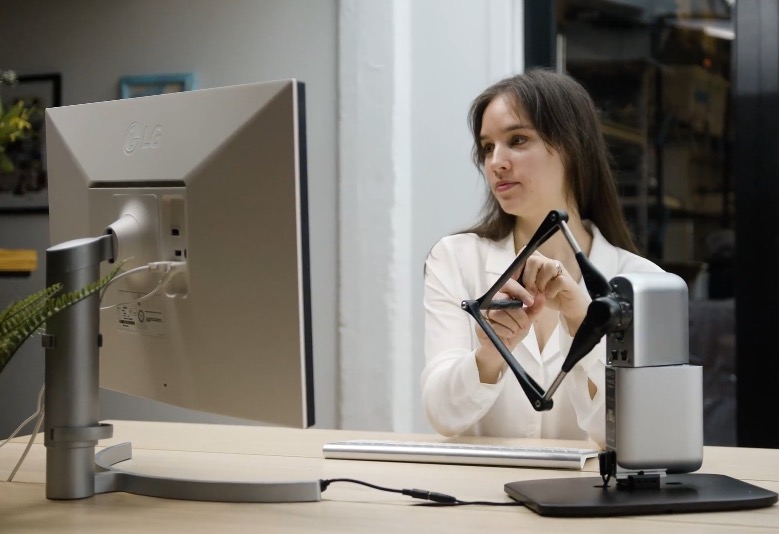
The dextrous nature of the Inverse3 provides highly sensitive haptic control of robotic machinery, with simulation of robotic systems aiding more precise control and collaboration. Image used courtesy of Haply
Comau Set to Take Over Automha
Comau has reached an agreement to take over Automha, an Italian automation company for warehouses and intralogistics, from Trasma. Subject to approval from regulatory authorities, the transaction is anticipated to occur in the second quarter of 2025 to leverage synergies across the two businesses and create an Italian automation hub. In addition to its CEO and other important individuals joining Comau's executive committee, Automha will continue to function with its current management, framework, and strategic approach. While Automha is anticipated to gain from Comau's size and technological prowess, this move is consistent with Comau's objective as a stand-alone business to broaden its capabilities and global reach.
Featured image used courtesy of Xaba