Facebook
 Google
 GitHub
 Linkedin
Amazon’s Vulcan Robot is Set to Revolutionize Order Fulfillment
Amazon announced that its Vulcan pick-and-stow robots have progressed to beta testing after completing a pilot trial at one of Amazon’s fulfillment centers in Spokane, Washington.
Amazon’s warehouse and logistics facility stow-and-pick robot, Vulcan, has now graduated to beta testing. The initial pilot trial for the Vulcan bots has progressed from a trial involving six bots to one involving 30 bots at Amazon’s fulfillment center in Spokane, Washington. This progressive testing signifies the evolution of simple to intelligent automated warehousing and logistics operations. The Vulcan robot is the first of Amazon’s lineup to incorporate human-like touch sensitivity, combining artificial intelligence, advanced control, machine vision, and end-of-arm tooling (EOAT) with 3D force sensors to pick and stow warehouse items with precision, safety awareness, and efficiency.
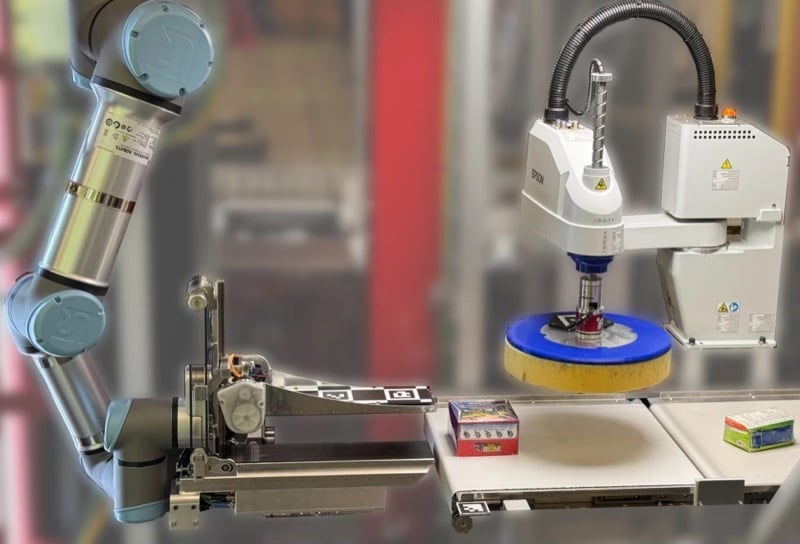
The Vulcan robot’s stow EOAT receives an item from a conveyor belt for downstream storage. Image used courtesy of Amazon
Evolving Robotic Systems
True vision in robotics machinery, as we know it today, was extremely limited during the 1990s. The robotic technologies in warehousing and logistics settings, which were predominantly autonomous guided vehicles, were designed to follow fixed paths and used basic sensor technologies, such as ultrasonic and/or infrared, to detect obstructions and avoid collisions.
The intricate path planning, recalculation, and navigation we see in modern mobile robots and picking and storage robots is led by technological convergence. This convergence includes multisensor fusion (light detection and ranging, acoustic detection and ranging, force sensors, cameras, inertial measurement units), SLAM (simultaneous localization and mapping), advanced deep learning and machine learning algorithms, advanced robotic end effectors, central controllers, RFID (radio-frequency identification) integration, and more.
A Fundamental Leap
Amazon’s new storage and picking robots are designed to incorporate the sense of touch, akin to human touch, along with AI and vision, to sense, grasp, and manipulate objects more accurately.
Vulcan is the first of Amazon’s diverse robotic fleet to incorporate a human-like sense of touch when manipulating objects. The robot stands at 9 feet tall with one system employing 10 robot arms within an area measuring 350 square feet.
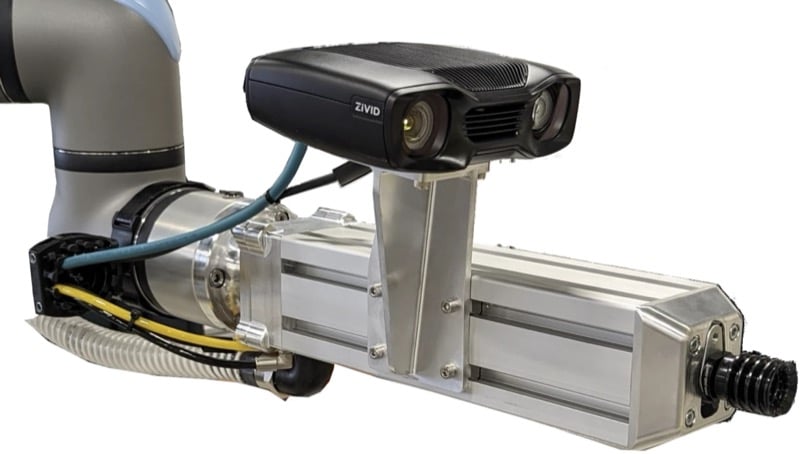
The pick EOAT uses a depth-sensing camera to identify the right objects for picking. Image used courtesy of Amazon
Picking and Stowing
The pick operation begins with an eligibility check: up-to-date imaging systems and metadata evaluate whether the Vulcan bot can pick objects from the fabric-based, deformable pods (storage bins) or pass on the complex task to a human worker. For qualified products, the EOAT uses a structured light camera for 3D depth mapping. The bot uses the camera while it suctions target objects to make sure it is picking the right object to satisfy the incoming order.
A unified, neural framework, Mask DINO, is used to partition camera images, labeling bin objects as obstructed or blocked. The DINO-based framework’s unified architecture enables the simultaneous execution of segmentation and object detection tasks.
The segmented sensory data enables the generation of a 3D point cloud, which is further distinguished by a signed distance function, which differentiates between free and filled bins. Object recognition is performed dynamically, without the use of barcodes, using a contrastive learning model that matches items under different situations.
Vulcan can pick and stow items within high and low-ground storage pods, preventing worker overexertion, falls, and product damage. Workers can work within a safe and comfortable range, conserve energy, and dedicate themselves to higher-value tasks. Vulcan can help augment human workers’ capabilities, easing storage and picking effort and enhancing the efficiency of order fulfillment processes.
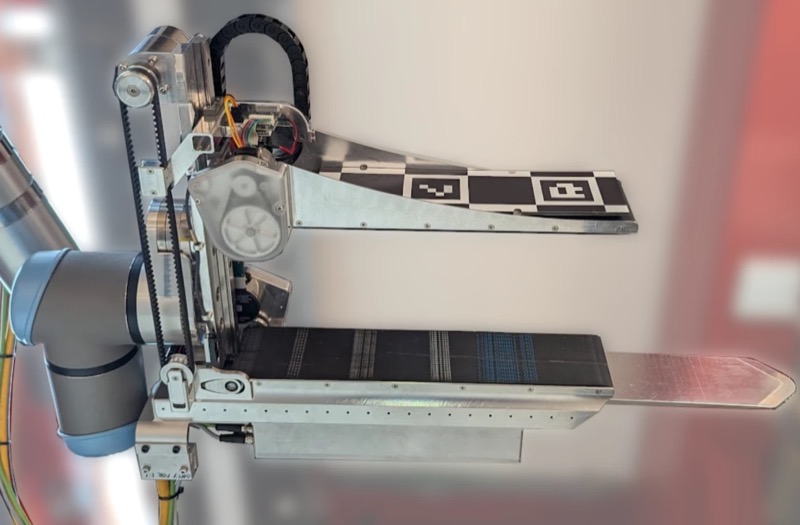
The stow EOAT employs touch-sensitive grasping and a spatula-like tool for rearranging items in storage pods to make space for incoming items. Image used courtesy of Amazon
The Vulcan robot’s stow EAOT looks a little like the mouth of an animal, with the upper and lower jaws opened to receive an object to be stowed. The stow EAOT is equipped with a conveyor belt that remains stationary until it has assessed available space in a given pod, after which the conveyor belt is initiated to slide an item into place. The Vulcan robot employs what has been described as an aluminium spatula, extending from the lower jaw, which is used to push pod items to one side or another to make space to stow the gripped item.
The stowing process involves three pairs of stereo cameras to generate a precise 3D representation of a storage pod. To tackle problems such as elastic bands that might obscure accessibility, the robot's imaging algorithm was trained on synthetic photos containing AI-generated elastic bands. The system uses three distinct deep-learning models to segment the bin, the bands, and the things inside. These segments are then combined into a 3D point cloud to provide a realistic representation of the bin.
After building the 3D model, the algorithm creates bounding boxes inside the bin to determine the amount of free space that is accessible. The robot chooses the bin to store the item in if there is sufficient space. The robot adjusts existing objects to create space. After scanning the 2D image using convolution to find potential places for the object to be inserted, the program projects this information onto the 3D model. When necessary, a machine learning algorithm directs the robot's spatula-like blade to rearrange objects and assists in identifying the optimal insertion places.
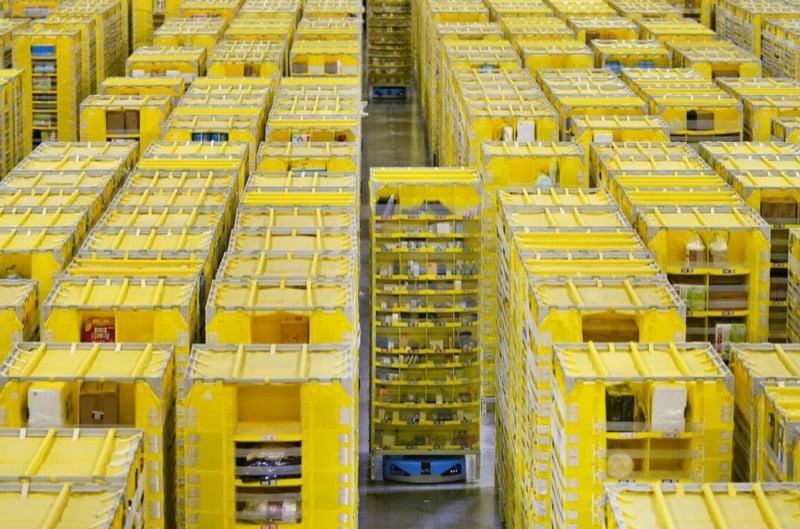
The Vulcan robot will not eliminate jobs for human workers but augment their work. Image used courtesy of Amazon
Vulcan Supports Order Fulfillment Staff
Vulcan is intended to reduce labor costs, but not eliminate the human workforce behind picking, storing, and handling operations. The robot is assistive, helping to reach hard-to-reach places and minimizing effort and potential injuries. The bot is designed to handle goods efficiently to promote the expediency of the order fulfillment process, to keep up with changing warehouse and logistics center output requirements.
Amazon offers upskilling programs for its employees, such as Amazon’s Reliability and Maintenance Engineering (RME) Mechatronics and Robotics Apprenticeship (MRA) program, to boost their skills and help them transition into new, challenging roles.