Facebook
 Google
 GitHub
 Linkedin
AutomationDirect Expands ProSense Linear Potentiometer Catalog
AutomationDirect has added new models to its ProSense linear potentiometer catalog. Customers now have a wider range of linear sensing options for greater flexibility in mounting and data collection.
AutomationDirect has expanded its catalog to include a number of new linear potentiometers in various mounting styles. The newest members of the ProSense line are already available for purchase at a reasonable price point, complete with a one-year warranty. All sensors are RoHS-compliant and CE-certified.
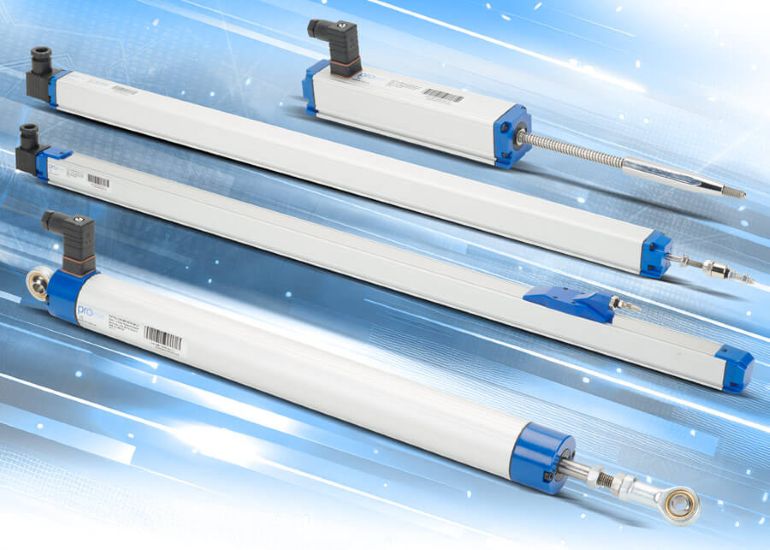
AutomationDirect has expanded its ProSense linear potentiometer offerings. Image used courtesy of Automation Direct
Linear Position Sensors
Linear potentiometers serve as sensors in motion feedback loops. For example, consider a carriage that is being pushed by a pneumatic ram. The position of the carriage could be approximated based on air pressure, which could change over time due to leaks, friction, and other factors. With a linear potentiometer, the position of the carriage is known, and it can be fed back into the pneumatic control valve to more quickly, efficiently, and accurately control the final position of the carriage.
In order for this to happen, linear potentiometers convert a mechanical position along their length into an electrical signal. While there are several ways to accomplish this, many linear potentiometers (as the name implies) convert this signal into an electrical resistance. They use a 10 V DC signal and some signal conditioning to feed an analog signal into a PLC that can be used in the control loop.
ProSense Linear Potentiometer Styles
AutomationDirect’s newest ProSense potentiometers are available in several mounting arrangements. There are fixed-slide (LSR-33P), rodless-slide (LSRS-33P), spring-loaded-slide (LSSR-33P), and pivoting-slide (LCR-38P and LCR-18P) models, each with different purposes in manufacturing.
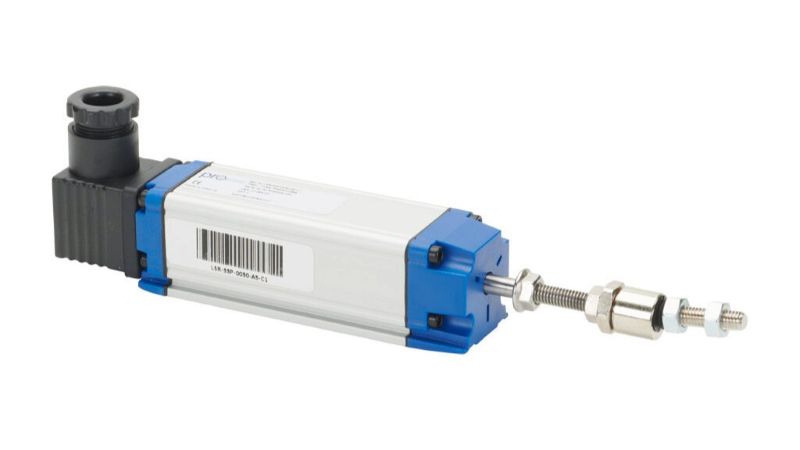
AutomationDirect’s ProSense LSR-33P fixed-slide linear potentiometers are available in round and rectangular housings. Image used courtesy of AutomationDirect
Fixed Slide
The LSR-33P fixed-slide models are available in round and rectangular housings. These are particularly useful for applications that will experience heavy vibrations. The ProSense line has models that range from 30 mm to 1000 mm in stroke length.
Rodless Slide
The LSRS-33P rodless-slide linear potentiometers are used in tight spaces, such as in plastic injection molding production lines. The ProSense line has models that can reach 50 mm to 1250 mm stroke lengths.
Spring-Loaded Slide
The LSSR-33P series sensors are designed for other measurements besides position. Instead of being fixed on both ends (one to a moving object), the rod is connected to a spring-loaded ball. The ball can be rolled over the surface of an object to find flatness, parallelism, and other such quality control quantities.
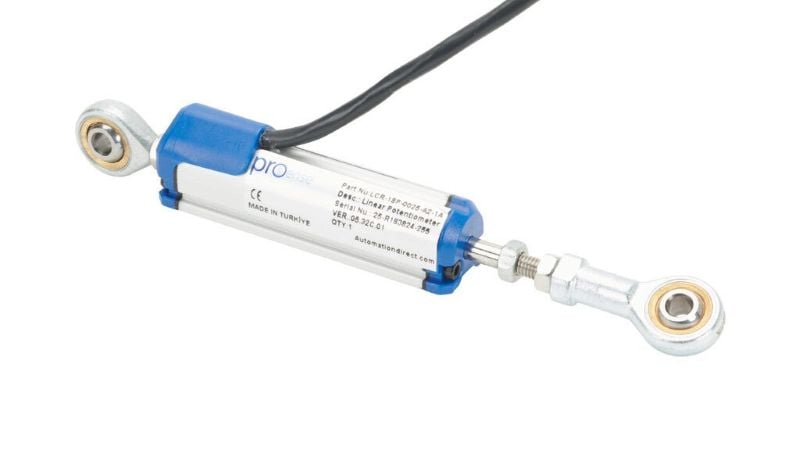
Automation Direct’s ProSense pivoting-slide linear position sensors are available in 10 mm to 450 mm stroke lengths. Image used courtesy of AutomationDirect
Pivoting Slide
Pivoting-slide linear position sensors allow for more free movement than other models. They use a rod-eye mounting system so that they can pivot out of another assembly to perform measurements. These are available in standard-duty models (LCR-38P) for easy installation and heavy-duty models (LCR-18P) for demanding applications like metalworking.
Linear Sensing
Linear potentiometers can be used for numerous applications. When combined with actuators, they form the feedback necessary for accurate part positioning. They provide a way to quantify movement and ensure repeatability across a process. In automation, they can ensure equipment and devices maintain the proper standoff distance or clearances. Spring-loaded slide models offer a mechanism to measure quantities such as flatness, parallelism, curvature, and others that can be difficult to measure using conventional means.
With AutomationDirect’s newest linear potentiometer offerings, customers have more models to choose from so that they can find a linear potentiometer that best fits their application needs.