Facebook
 Google
 GitHub
 Linkedin
Baumer Introduces EB260 Encoders for Compact, Precise Motion Control
Baumer has released the EB260 bearingless rotary encoder with proprietary LowHarmonics signal processing technology, which enables auto calibration to eliminate signal errors caused by physical inconsistencies.
Baumer’s new EB260 is a compact, bearingless rotary encoder designed to meet the needs of manufacturers and integrators seeking durable, space-saving solutions for motion control and motor drive technology. With a shallow installation depth of 11 mm and compatibility with various shaft diameters, the EB260 supports straightforward integration into space-constrained designs.
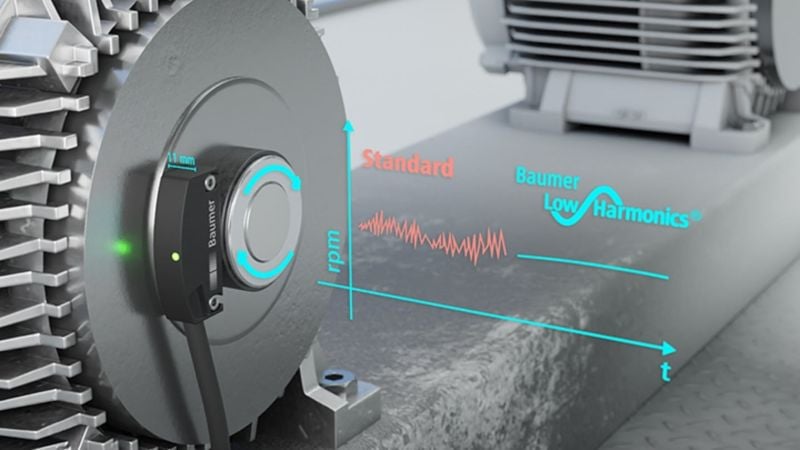
The EB260 encoder from Baumer fits into an area of only 11 mm, benefiting installations where space is limited. Image used courtesy of Baumer
EB260 RotaryEncoders
The new EB260 rotary encoders combine magnetic sensing with Baumer’s proprietary signal processing method known as LowHarmonics. This technology corrects common sources of signal error, such as thermal drift, aging, mechanical tolerance, and alignment deviations, without requiring manual recalibration. The encoder’s automatic correction capabilities help maintain consistent output quality over time. This is particularly important in high-performance closed-loop systems where accurate speed and position feedback are required.
Baumer has designed its EB260 to be compact and bearingless to offer several practical benefits for users. The lack of internal bearings eliminates mechanical wear, which helps reduce maintenance requirements and extends product life. Additionally, the encoder's encapsulated electronics are more resistant to dust, humidity, and shaft currents.
This makes it well suited for industrial environments where vibration, temperature variation, or electrical interference might otherwise degrade sensor performance. A high resilience level makes the EB260 a good candidate for use in automated systems such as conveyor systems, robotics, packaging equipment, and material handling machinery. Since the unit is frictionless and does not generate internal heat during operation, it is also beneficial for thermally sensitive applications.
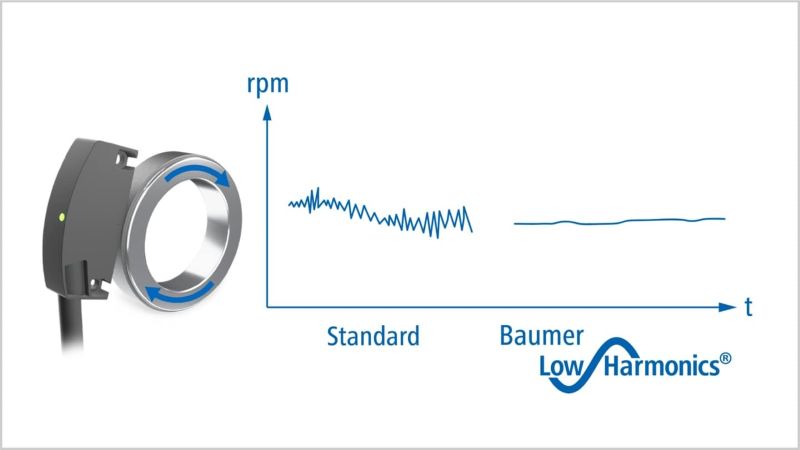
A comparison of Baumer LowHarmonics with a standard encoder’s output signal. Image used courtesy of Baumer
Air Gap Monitoring for Predictive Maintenance
The EB260 is equipped with an integrated air gap monitor that continuously measures the distance between the magnetic rotor and the sensor. Any deviation, such as misalignment due to mechanical wear or shaft displacement, is automatically detected and can be communicated to a higher-level control system for intervention.
This feature enables manufacturers to implement predictive maintenance strategies more effectively. Rather than reacting to encoder failure or degraded signal output, maintenance teams can be alerted in advance of mechanical issues. After the alert, they can promptly address any issues.
Flexible Output and Configurability
Baumer supports the EB260 with its Sensor Suite software, allowing users to adjust parameters such as resolution, output type, and switching thresholds. The encoder is compatible with a range of output signals, including square-wave (HTL/TTL), sine/cosine, and IO-Link. This versatility enables the encoder to integrate into both legacy and modern control architectures. For machine builders, the flexibility offered by the EB260 can simplify procurement and reduce the need to stock multiple encoder variants.
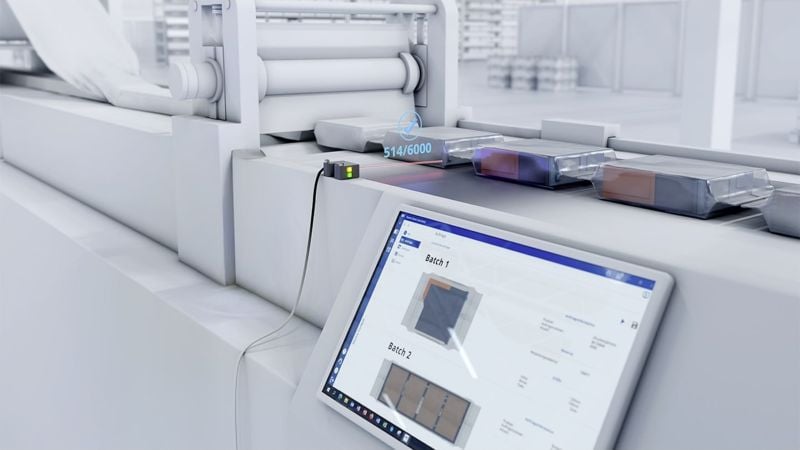
The EB60 encoder is suitable for motion control in intralogistics applications like packaging. Image used courtesy of Baumer
A single model can be configured to suit different applications with minimal engineering costs. The EB260 is designed for use in a wide range of motion control applications, and manufacturers in sectors such as automotive assembly, packaging, and intralogistics may find the encoder particularly useful.
Precision Motion Control
The EB260 presents users with a practical solution that looks to provide them with better encoder versatility. A bearingless, wear-free design contributes to long-term reliability. At the same time, the compact 11 mm installation depth and adaptable shaft compatibility make it easy to incorporate into tight spaces or fit into legacy equipment. By minimizing some of the issues associated with magnetic encoders, the EB260 positions itself as a practical option for applications where both size constraints and precision matter.