Facebook
 Google
 GitHub
 Linkedin
B&R Releases a Smart Camera with Hybrid AI-Vision for Real-Time Processing
Designed for high-speed automated environments, this smart camera offers on-the-fly model switching, advanced vision functions, and rapid decision-making.
B&R has announced the release of its innovative, plug-and-play Smart Camera with AI directly integrated into the control loop. Advanced edge computing and integrated AI capabilities provide system operators with real-time vision, data processing, and rapid model switching to cater to different products, detecting faults, and responding to them rapidly for process optimization. The culmination of all these capabilities helps customers to save time during inspection, enhance throughput, and minimize waste.
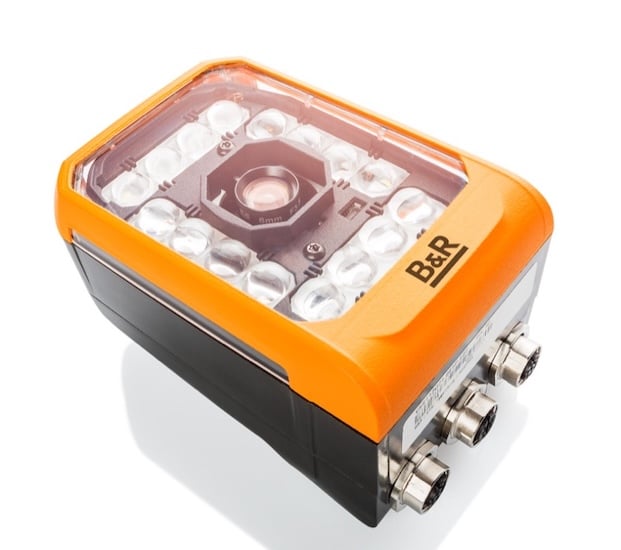
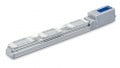
B&R’s latest plug-and-play smart camera allows users to combine rule-based AI models and vision functions in one device, catering to complex, multi-layered inspection tasks. Image used courtesy of B&R
Hybrid AI-Vision Inspection
Users can benefit from uninterrupted downtime with the ability to change models, other search parameters, and code types during device operation, adapting to varied object recognition tasks while keeping on the go. Customers benefit from a selection of AI-grounded vision functions from the machine vision software company, MVTec Software GmbH, including anomaly detection, classification, optical character recognition, semantic segmentation, and object detection.
Users can connect the B&R camera to the machine network, and it will automatically configure the required control settings. Users can set up their smart camera with three image sensors that provide 1.3 to 5 megapixels in resolution. The large pixel size offers high light sensitivity and high-quality image capture even with more speed-critical inspection applications. S- and C-mount cameras are available, with the latter supporting B&R lenses and those from third parties (including but not limited to telecentric lenses.
Factory calibration of the lens and sensor means no setup or programming is required in the field, advancing commissioning times and reducing downtime. The smart camera is powered by 24 VDC and is connected to the machine network using a single M12 hybrid connection. Using a second hybrid port, you can connect more lighting components in a daisy-chain configuration.
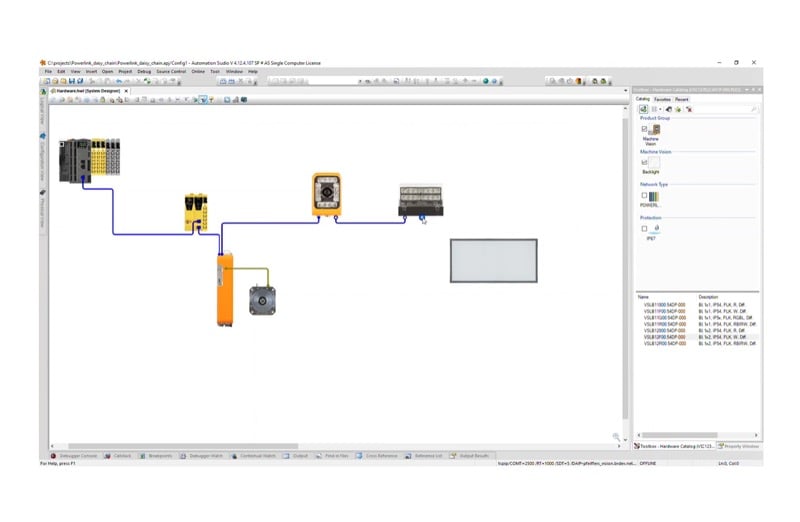
The M12 hybrid connector greatly simplifies wiring by providing both power and data via a single wire. Image used courtesy of B&R
Broad Applicability and Multifunctional Vision
Thanks to integrated FPGA (Field Programmable Gate Array) technology, B&R's smart sensors and cameras can now offer sophisticated image processing functions such as shape from shading and subtraction. Shape from shading is perfect for activities needing great precision because it takes pictures under various lighting conditions to emphasize minute 3D surface characteristics like microscopic scratches or embossed writing. Subtraction, on the other hand, is ideal for quality surveillance because it compares the current images with an earlier version to identify even the smallest variations. These characteristics increase productivity by decreasing development time, increasing inspection accuracy, and freeing up processor capacity for other imaging duties.
The adaptability of B&R's vision system defines what makes it unique. The Automation Studio software allows users to configure a single smart sensor, eliminating the need for many sensors for various applications. Software makes saving and switching between up to 255 models simple without requiring hardware modifications. This reduces complexity in project planning and minimizes the requirement for extra parts. By employing intelligent triangulation techniques, even 3D activities can be performed with conventional 2D sensors, allowing for features like volume estimation and profile mapping without the significant costs associated with conventional 3D systems. The result is an efficient, reasonably priced solution with inherent adaptability.
Advancing Intelligent Automation Systems
Launching the Smart Camera marks an evolutionary step forward in automated visual inspection within intelligent industrial environments. Integrating AI into the control loop and powerful edge computing come together in this system to provide rapid, real-time decision-making during the inspection process. This agility, coupled with flexible model switching, is required to maximise uptime, maintain and increase throughput, and diversify part inspection.
Related Content