Facebook
 Google
 GitHub
 Linkedin
Building the Future: Robotics Engineering Education & Careers
Leading companies and schools are shaping the next generation of robotics engineers through hands-on training, competitions, and industry partnerships.
FANUC and Spartan Controls are teaming up with schools and higher academic institutions, including Northwestern Polytechnic (NWP), to train young learners seeking to pursue a career in robotics engineering, whether on the software and programming side or the design and assembly of innovative hardware. Part of our educational overview will highlight Spartan Controls and NWP’s 15-year partnership and the $16 million Spartan Controls Northwestern Centre for Industrial Automation & Innovation.
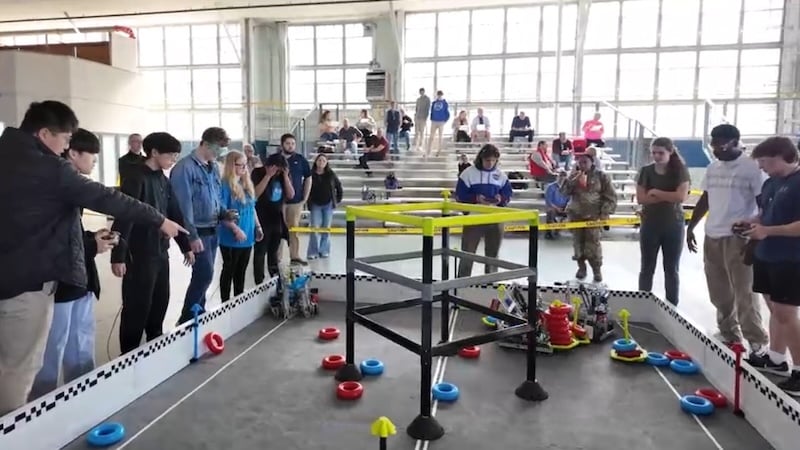
Students taking part in Maxwell’s robotics competition engage in physical robotics-led stacking tasks. Image used courtesy of U.S. Air Force
What Could You be Working on?
As a robotics systems engineer, one can expect to combine multiple disciplines and skills, such as computer science or mechanical and electrical engineering, to design, construct, and operate industrial robots. Specialist areas include programming, manipulators, and effectors (tools that robots manipulate to execute specific tasks), designing operator interfaces, sensing and machine perception/vision, and/or mobility.
Diving deeper, other specialist areas can extend to AI-embedded robotics, automated robotics farming machinery, bio-cybernetics, control systems, computer software development, control systems, and micro-robotics.
Some engineers spend a large proportion of their time creating new CAD models or robot designs for specific applications or piercing together prototypes for testing and evaluation. Robotics engineers can also work on-site to monitor and maintain the daily operational running of robotic machinery on assembly lines and those configured in other application-specific setups.
You could also work in a laboratory setting within a university, investigating human-machine interactions between collaborative robots and human workers to advance safety and optimize performance. In a previous article from Control Automation, we explored research concerning a new type of dextrous robotic gripping technology involving finger-to-palm and palm-to-finger manipulation. Robotics engineers in this field can advance robotics systems by improving the dynamism and efficiency with which industrial, medical, and other service robots complete tasks, which can have knock-on effects on overall facility operational efficiency.
Desired Skills and Qualifications
Are you an imaginative builder and creative problem solver? Do you have a practical mindset and ability to focus? If so, then a career as a robotics systems engineer would be a great fit. You’ll also need to possess mathematical knowledge (calculus, trigonometry, algebra, geometry, statistics), good communication skills to work in a team, and analytical and decision-making skills. One of the most important qualities to hold is an avid interest in robotics and an inquiring mind.
A bachelor's or master's degree in a related discipline is required to become a robotics engineer. Knowledge of computer science is required if you want to work in robotics software, whereas mechanical or electrical engineering courses are required for designing robotic hardware. Many colleges offer robotics-related degrees, such as mechanical engineering, electrical engineering, computer science, artificial intelligence, and mathematics. Physics, programming, and mechanical design are typical course topics. While a formal degree is not always required, businesses may prefer candidates with good technical abilities and understanding. Getting work experience through technician positions, apprenticeships, or company internships might boost job opportunities. Professional certificates such as Chartered Engineer (CEng) might increase job chances, although they are not required. A master's or PhD, may further develop knowledge and test one's dedication in pursuing a life-long career in engineering robotics systems.
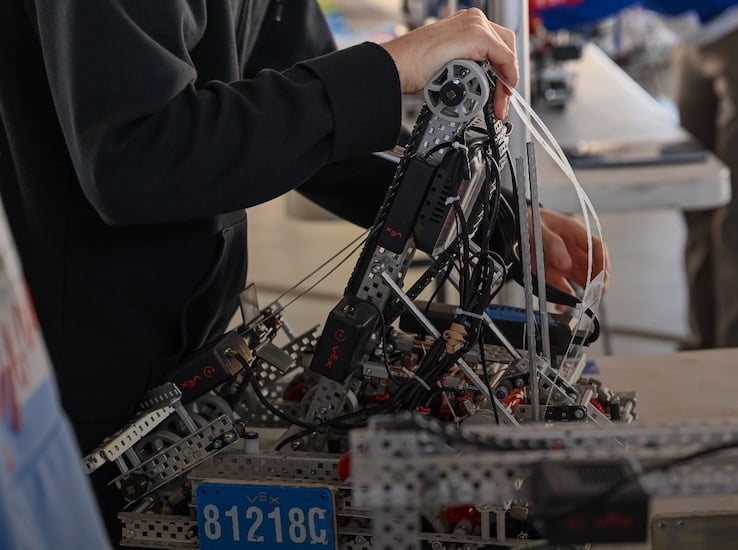
Robotics systems engineering covers multiple disciplines, and young learners are encouraged to explore educational offerings and competitions to enhance their knowledge and employability. Image used courtesy of U.S. Air Force
Spartan Controls
Spartan Controls announced its entry into a 15-year partnership with NWP, a publicly-funded academic institution providing educational offerings such as degree, diploma, and university transfer programs. The institution also offers apprenticeships and pre-employment training. Spartan Controls will serve as NWP’s exclusive naming partner for its new $16 million training center. The center will be a space for students studying the Instrumentation and Control Technician Apprenticeship and Power Engineering to gain hands-on, industry-relevant training. This is intended to enrich the pool of skilled workers in the Alberta community.
The Spartan Controls Northwestern Centre for Industrial Automation & Innovation is planned to open in the summer of 2025. Spartan Controls began its partnership with NWP in 2022 and has since nurtured the development of NWP apprenticeship students through visits to its sites for training on the latest technologies.
Maxwell Air Force Base
In other news, Maxwell Air Force Base (Maxwell) hosted a robotics competition at its Honor Guard Hangar with participation from local schools, including Montgomery Public Schools. This was a STEM-focused event, inviting attendees to engage with Air Force base machinery amidst the robotics competition and gain insight into future careers in the military and within the field of engineering.
FANUC
FANUC UK is once again partnering with WorldSkills UK to help find the country's top young robotics talent. In its fifth year, the annual Industrial Robotics competition allows ambitious engineers to program robots, hone their technological abilities, and cultivate professional competencies like time management and teamwork. The tournament is open to two-person teams with suitable Level 3 certifications or apprenticeships, and it encourages both beginners and those more experienced with robotics. The competition begins online in April 2025, which is followed by in-person stages in Birmingham and Coventry, with the grand prize of a berth in the worldwide finals in Tokyo.
In addition to developing forthcoming talent, FANUC UK is tackling industry skill gaps through its training partnership with Sierra 57. Their 2025 injection molding and robotics lessons hosted at the FANUC Academy in Coventry, allow students to interact with the latest automation technology. The courses aim to enhance the skills of the staff by improving their awareness of plastic processing, machinery, and the role of automated production. With strong industry support, these educational programs provide essential insights for professionals striving to remain abreast of the competition in the rapidly changing field of smart manufacturing.
Closing the Skills Gap
The expanding partnership between industrial leaders in robotics and control and educational institutions demonstrates a strong commitment to preparing future robotics engineers. Students obtain firsthand knowledge in automation, software, and hardware design thanks to substantial investments such as the Spartan Controls training facility and exciting competitions at Maxwell Air Force Base. FANUC's continuous support for robotics contests and industry training emphasizes the necessity for qualified individuals in a changing labor market. These programs not only close the skills gap but also pave the road for young people to succeed in careers in robotics and automation.