Facebook
 Google
 GitHub
 Linkedin
Inside Formula E: Exclusive Interview With a Systems and Controls Engineer
Andrew Holmes provides insights into Envision Racing's pursuit of efficiency and performance. He discusses his responsibilities, cutting-edge technologies, Arduinos, and recommendations for others interested in a similar career.
When you think of automobile racing, legendary names like Andretti, Penske, McLaren, Jaguar, and Maserati certainly come to mind. Envision Racing may not have the storied history of these brands, but they have been part of Formula E racing since its inception in 2014. It is the highest points-scoring team, with more than 1700 points earned from 16 race wins and 53 podiums.
In Formula E, several major systems components of the electric race cars are standardized, including the battery, front powertrain, DC-DC converter, chassis, and bodywork. Some of the differences across the teams arise from the manufacturers who supply the rear inverter, rear powertrain, electronic control unit (ECU), and low-voltage power box.
Another important differentiator for these teams is the engineers and technicians who work long hours before, during, and after the races to try to maximize the performance of these high-performance vehicles. Control.com sat down with Andrew Holmes, Systems and Controls Engineer for Envision Racing to learn more about the cars, his responsibilities, and the control systems engineering employed. The following interview has been edited for clarity and readability.
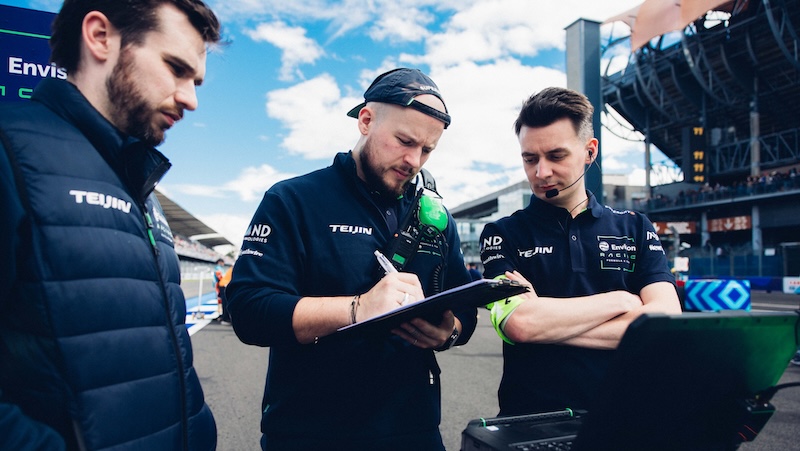
Andrew Holmes, right, is a Systems and Controls Engineer for Formula-E Envision Racing
Duties of a Formula-E Systems and Controls Engineer
Control.com: Where does Envision Racing have the opportunity to innovate and gain a competitive edge in terms of control systems?
Andrew Holmes: As a customer team, we purchase our powertrain hardware from Jaguar, so we have limited flexibility in hardware selection. Our focus is on tuning and optimizing the control systems through software.
Control: Can you walk us through your typical responsibilities when you arrive at a new track and prepare for a new race?
AH: Certainly. The first thing we do is handle software updates. Updates can come from various suppliers for components like the DC-DC converter, brake-by-wire system, and engine control unit. We also receive software updates from Jaguar for the engine control unit, which includes new features and bug fixes.
After that, it's all about tuning. We have about ten different employees who send me files to tune various parts of the car for performance, reliability, and functionality.
Control: What happens after the car leaves the garage?
AH: Once the car is on track, my job involves uploading data, checking all the channels, ensuring the electronics are working correctly, and bleeding the cooling circuits.
Control: Can you give us a specific example of a key control system and the tuning you do?
AH: One of the most critical systems is the braking system. The driver applies the brake pedal, and a brake pressure sensor sends a signal to the ECU. The ECU then decides where to distribute the braking across three components:
- The front motor.
- Front-wheel hydraulic calibers.
- Rear-wheel Motor Generator Unit (MGU).
We have numerous settings to control the torque split between these three components. A key parameter is the brake bias, which is the difference in torque between the front axle and the rear. Typically, 60% of the braking is done on the front and 40% on the rear, but this is tunable.
The split between the calipers and the front motor is also adjustable, and each has a different effect on how the car rotates. The ideal split changes throughout the braking phase. Initially, more braking is needed on the front axle due to weight shift, and as you approach the corner's apex, you want more braking on the rear to help the car rotate.
We have ten different settings and are constantly fine-tuning these settings throughout the race weekend.
Control: That makes sense. When you're "chasing" the optimal settings, what factors are you considering?
AH: We do a lot of simulator work before arriving at the track to get the initial settings as close as possible, but they're never perfect. Track conditions vary, and some corners require different braking characteristics than others. For example, tighter corners might benefit from more rear braking to enhance rotation, while bumpy sections might require a different braking behavior.
We analyze the data after each session to determine the necessary adjustments. The driver can also make some tuning adjustments from the steering wheel while driving.
Control: So, are you monitoring where you are on the track and relaying that information to the control systems?
AH: Yes, that's correct. The ECU uses the distance covered in each lap to determine the car's location on the track and applies the appropriate settings for each corner. So, it knows that between 2000 and 2200 meters, the car is at turn 10, for example.
We also utilize autonomous driving to maximize efficiency in the race, particularly for energy-saving. In Formula E, the hydraulic brakes rarely get used because that energy is wasted as heat. We prioritize regenerative braking to recover energy.
To optimize efficiency, we use a series of beeps to signal to the driver when to lift off the throttle and coast, and when to apply regen. This is all tuned to achieve the most efficient driving strategy.
Control: Is the energy-saving strategy to avoid running out of energy or to minimize battery degradation?
AH: The primary concern is running out of energy. The battery's energy capacity isn't sufficient to complete the entire 45-minute race at full throttle and braking. Therefore, drivers must lift and coast to conserve energy, which involves coming off the throttle on the straights for maximum lap time gained per energy used.
Control: Are you currently using any AI or machine learning in your control systems, or is it something you're considering for the future?
AH: We're not currently using AI or machine learning, but we're starting to explore its potential.
Control: So, it's primarily traditional control systems like PID controllers at the moment?
AH: Yes, we use a lot of PID controllers.
Complexity of the Performance Management
Control: What are the key differences in control systems between a Formula E car and a road-going electric car like a Tesla?
AH: The main difference lies in the complexity of performance management. To illustrate this, I can show you our steering wheel.
Control: That would be great!
AH: So, this is our steering wheel.
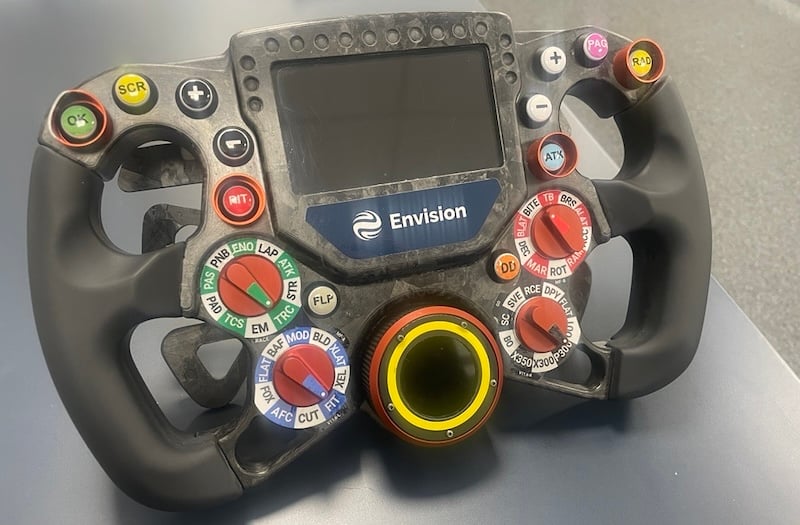
The Envision-Racing Formula E steering wheel.
It has multiple rotary controls with 10 settings each:
- The red one is for the front brake settings.
- The black one controls power settings, including modes for warming up the brakes, 100 kW, 350 kW, and race modes.
- The green one is for race settings like traction, energy management, and paddle strength.
- The blue one adjusts rear MGU performance settings, primarily related to traction.
On the back, we have six paddles. The bottom two are used for regen during the race—you lift off the throttle and then use the paddles for regen.
The other paddles select drive modes and subsets of settings, such as a wet mode that changes all the steering wheel settings for easier driving in wet conditions. The fact that we have 40 different performance and race-based controls on the steering wheel highlights the complexity compared to road cars.
Control: It’s incredible how many options you have at your fingertips. As an engineering team, where do you focus your efforts to improve and gain a competitive edge?
AH: One key area is simulator preparation. Teams spend significant time in the simulator before each race event, and the accuracy of these simulations is crucial. A more accurate tire model, for example, allows for better prediction of the car's behavior and leads to better initial settings.
We also invest a lot of time in tuning energy management in the simulator, particularly those beeps that guide the drivers for optimal efficiency. We might do four full-race simulations to fine-tune the energy management and maximize efficiency. Additionally, while we have the same control systems as Jaguar, there might be subtle differences in steering wheel settings or control software that give us an advantage at certain tracks.
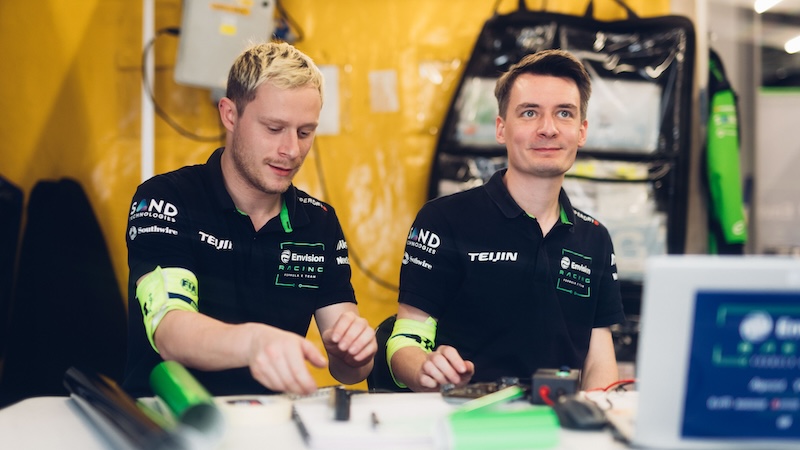
For Andrew Holmes, right, a lot of the race work is done away from the track.
Control: Are there any other potential applications of AI that you're exploring?
AH: Yes, we're looking at a few potential AI applications. One is to automate my job of analyzing data for reliability. I've started using Python to automate some of this, but AI could take it further.
The challenge is training the AI to differentiate between acceptable data and potential issues. We're also investigating AI's potential to analyze performance data and assist our performance engineers.
Control: It seems like AI has the potential to revolutionize many aspects of racing.
AH: Definitely. Hopefully, I’ll be one of the people developing the AI, so my job remains secure!
Arduinos in Formula-E?
Control: You've been in this role for seven years now, and this was your first job after university. What did your education not prepare you for? What skills did you have to learn on the job?
AH: I always followed Formula One, and then I did a few motorsport projects at university. So, I half knew what to expect. However, I'd say the mechanical and hands-on aspects of the job were something I had to learn more about. As an engineer, I don't do a lot of mechanical work, but we use a lot of Arduinos for various applications.
Control: Arduinos in Formula E? That's fascinating! What are they used for?
AH: We use them for a variety of things. For example, we have smart cooling fans that use Arduinos to read coolant temperatures and control the flow of dry ice through the radiators. We also have temperature sensor devices inside our tire tents, track temperature IR reading devices, and an LED lollypop system for the pit lane.
I’ve also installed LEDs around the garage to indicate when the car is ready to be released. When I've done all my programming on the car, I switch the light to blue, which tells people to disconnect the data cable from the car. It then switches white, which tells the driver to turn the engine on. Finally, it turns green to let the driver know that he can go. We have to purge the battery with nitrogen.
We also have a purge kit that cycles between vacuum pumping and filling the battery enclosure with nitrogen. It can tell us the humidity from inside the battery to know when that cycling is done.
Finally, we've got a few voltage alarms around the garage to let me know if there's been a power issue to the car. So yeah, I got quite a few Arduinos around. It’s more the building Arduino electronics sides that took me a while to get used to after university rather than sitting in lecture halls for six hours a day.
Preparing for a Career in Motorsports
Control: What do you enjoy most about your job?
AH: Traveling is a blessing and a curse at the same time. We were in Miami last week where we were able to watch a Miami Heat basketball game. We also had a little trip to the beach with a bit of free time and enjoyed some nice restaurants. Some of our other destinations are less luxurious and a bit more hard work.
The jet lag can be a bit of a killer. Soon, we will go to Tokyo for a week, fly back to the UK for one week to do some simulator work, and then we fly back to Shanghai. The jet lag switching—eight hours back and forth—is a struggle.
Control: For engineering students who might be interested in following a similar career path to yours, do you have any recommendations?
AH: Well, I knew I liked motorsport and electric cars. So, when it came to choosing projects for my third year at university, I made a model of an electric power train. I would always try to focus any optional projects I had on motorsport or power trains.
And in my free time, I did Formula Student, which is where university teams make cars to compete in motorsports. It is quite popular across the world. If a university has that and you can get into it, that's definitely the best step I have taken. That was a lot of fun making a car with university friends. I did all the wiring for that, which was a good first step.
Additionally, there are options, certainly in the UK, to complete a one-year degree in motorsport after you finish your engineering degree. Maybe 50% of the people in our Envision Racing engineering office worked on their mechanical engineering degree for three or four years and then did a one-year master's in motorsport at some universities. That's what I was missing from my university experience—I had never studied all the complex vehicle dynamics that everyone was talking about when I first started.
Control: Last question…is there one particular technology that you see in motorsports that you find most fascinating?
AH: It's all of it! I know that sounds very generic, but there are so many different interesting parts in motorsport. Whether it's using titanium or 3D printed metals in certain areas of the suspension or the complexity of the steering wheel, which has a little screen inside a rotary. Everything is cutting edge and pushes the limits.
It's just a lot of different, interesting things that you wouldn't see anywhere outside of motorsports. It's hard for me to put my finger on just one technology…everything from materials to lightweight design to electronics.