Facebook
 Google
 GitHub
 Linkedin
CES 2025 Highlights: Toyota, NVIDIA, and Siemens Startup Program
NVIDIA delivers digital twin technology for robotic fleet optimization, Siemens launches its supportive startup program, and Toyota introduces its Woven City for the future of mobility.
The year 2025 kicked off with hundreds of technology highlights at the Consumer Electronics Show (CES), including advances in digital twin technology for industrial robotics through NVIDIA’s Mega Omniverse framework, Siemens startup support program, and Toyota Motor Corporation’s (Toyota) Toyota Woven City for the future of mobility. CES 2025—brought to attendees from the Consumer Technology Association (CTA)—celebrates the latest pioneering technologies and systems across the global technology stage.
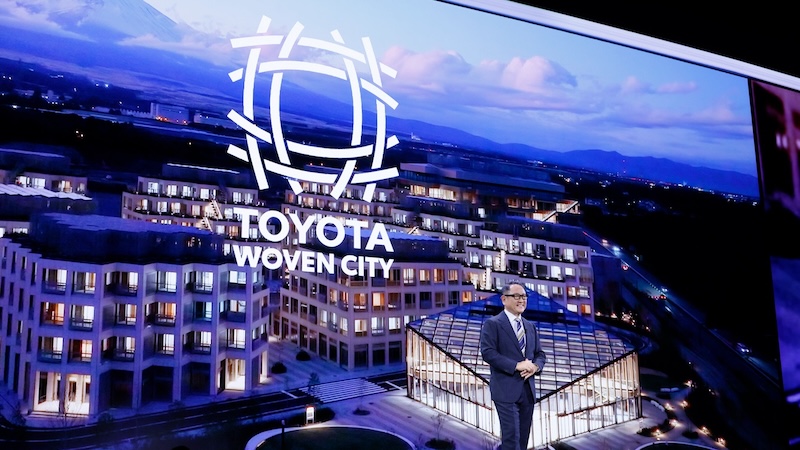
Chairman and Master Driver of Toyota, Akio Toyoda, introduces the Woven City, a test course for its transition towards becoming a mobility company. Image used courtesy of the CTA
Toyota Woven City
Imagine a place that weaves innovation and sustainability into the future of mobility in society. The Woven City is being developed in partnership with Woven by Toyota, advancing the transformation of Toyota Motor East Japan’s Higashi-Fuji Plant (Susono City, Shizuoka Prefecture, Japan) into a manufacturing hub.
The in-development Woven City is built upon three core values: human-centered, a living laboratory, and an ever-evolving city. The innovative city places the collaboration between inventors and weavers (the city’s visitors and residents at its heart), offering a truly human-centric pathway towards advanced mobility. Inventors comprise Toyota, Toyota Group businesses, academic partners, third-party companies, and start-ups. Together, inventors and weavers will fabricate the future of mobility, focusing on energy, information, goods, and people. The Woven City will embed sustainability and well-being into its infrastructure, which is hoped to permeate into society as we know it.
Weavers work alongside inventors to create the fabric of the future of mobility for society. Video used courtesy of Woven City
With Phase 1 of the Toyota Woven City complete, its launch is planned for the fall of this year. Phase 2 site preparation is currently underway.
Next-gen Warehouse Automation
NVIDIA's newly announced Mega Omniverse framework addresses the expanding complexity of sophisticated autonomous manufacturing plants and warehouses that depend on a robotic workforce and human workers to run operations. These environments necessitate significant modeling to assure safety, enhance procedures, and reduce disruptions. Mega provides a reference architecture based on NVIDIA's accelerated computing, AI, and Omniverse innovations, allowing businesses to produce digital twins—virtual reproductions of physical assets. These digital twins serve as a testing and refining platform for AI-driven robot control systems and the orchestration of sensor data, allowing large-scale robotic fleets to learn, adapt, and optimize operations.
NVIDIA's new framework provides software-focused features that enable continuous creation, evaluation, and implementation of AI-based factory automation solutions. Robots may learn and undergo evaluation in numerous scenarios thanks to developers' ability to create a simulated environment with pooled sensor data for numerous machinery using Omniverse Cloud Sensor RTX APIs. Leading supply chain solutions provider KION and professional services company Accenture are working with NVIDIA to deploy Mega in practical applications. KION uses the framework to create virtual replicas for automated warehouses, and Accenture offers services like robotics optimization and AI-powered simulation to improve logistics and manufacturing. These collaborations seek to revolutionize warehouse operations by allowing intelligent, flexible systems that satisfy changing supply chain needs.
KION and Accenture have adopted the Mega Omniverse framework to simulate, test, optimize, scale, and deploy complex robot fleets. Video used courtesy of NVIDIA
Siemens for Startups
Siemens announced its Siemens for Startups program at CES, a collaborative support network delivered alongside Amazon Web Services’ (AWS) startup program to foster innovation and bring ground-breaking ideas from bench to market.
The Siemens for Startup program operates across three core pillars:
- Connect, linking startups with Siemens Xcelerator marketplace for international market exposure.
- Collaborate, bringing startups together with Siemens partners and early customers to accelerate technology development and generate revenue.
- Empower, offering access to Siemens Xcelerator tools for product and software development.
Siemens and AWS collaborate to combine AWS's scalable cloud infrastructure and startup programs with Siemens' Xcelerator industrial software. Through this partnership, startups can use cloud services, generative AI, and advanced resources to accelerate their time to market. Qualifying startups will also have access to the AWS Activate program, technical support, and AWS credits. Siemens and AWS want to help startups take advantage of market possibilities and provide innovative solutions that revolutionize entire industry segments by encouraging entrepreneurship and accelerating digital transformation.
Towards the Future of Tech
CES has highlighted the key innovations spanning manufacturing, warehouse automation, digital twin technology, mobility, and the underlying collaborative nature behind them. As with Siemens and AWS startup programs, the centering foundation stone for innovations in robotics and automation lies in sharing knowledge and resources. For Toyota and Woven, the Woven City and the fabric for the future of mobility it is poised to create is founded on the collaboration between inventors and weavers. For NVIDIA, its Mega Omniverse framework is hoped to empower and grow its customers, optimizing robot fleet operations through advanced digital twin technology.