Facebook
 Google
 GitHub
 Linkedin
CES 2026 Highlights AI Robots, Sensors, and Key Collaborations
From humanoid robot strategies to next-generation touch sensors, CES 2026 highlighted major advances in automation and robotics.
CES 2026 in Las Vegas spotlighted new collaborations and technologies shaping the future of automation and robotics. Major announcements ranged from Hyundai Motor Group’s plan to scale humanoid robot production to XELA Robotics’ tactile sensing technology designed to give robots a human-like sense of touch. Partnerships between Siemens, Universal Robots, and Robotiq also demonstrated how digital twins and automation are converging to improve safety, efficiency, and reliability in industrial applications.
Hyundai Motor Group’s AI Robotics Strategy
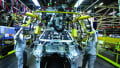
Hyundai Motor Group has announced its game plan for implementing AI in automation over the coming years. This strategy involves several major components, all geared towards increasing production of humanoid robots, starting in their own factories. The plan calls for an annual output of 30,000 humanoid robots by 2028.
Part of this strategy is combining Boston Dynamics' research and development work and its new Atlas robot with Hyundai's mass production and numerous factories. The Atlas robot is designed to lift and sequence heavy components and perform repetitive tasks in existing factories. By adopting a humanoid form, these robots can operate in human workplaces, serving as assistants or replacing human workers on dangerous or repetitive tasks.
XELA Robotics uSkin
XELA Robotics has advanced humanoid robotics with its newest sensing mechanism, uSkin. This uSkin combines advanced pressure sensors with software to give robots a human-like sense of touch. A human hand can pick up a rock or an egg and know how much pressure is required to grip the object without damaging it. This is quite challenging for robots.
To aid in robotic sensitivity, uSkin has three layers. The innermost layer is a suite of pressure sensor chips and onboard signal processing. Above it, an elastomer layer provides strength and resilience, while a smooth outer shell protects the entire system.
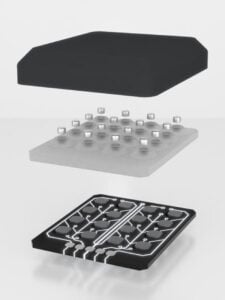
The uSkin schematic illustrates the three layers to provide robots with a humanlike sense of touch. Image used courtesy of XELA Robotics
Next Generation Palletization Robot
A three-way collaboration between Siemens, Universal Robots, and Robotiq has led to the development of a new palletization robot designed to optimize this process. Palletization is often where products are damaged due to improper handling and, if performed by hand, is a source of many workplace injuries. By automating this step, injuries and shrinkage will be reduced.
The collaboration uses a Universal Robots UR-20 robotic arm, combined with a Robotiq’s PAL Ready palletization cell. Both of these components are well-established in the palletization world, where the UR-20 can handle payloads of 25 kg, and the standard PAL cell uses a Robotiq vacuum gripper.
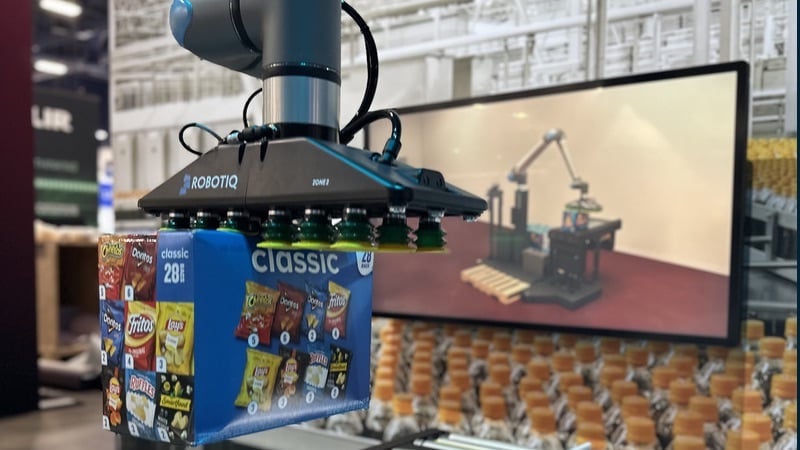
Palletization of boxes of chips is challenging; the boxes are fragile and thin. Image used courtesy of Universal Robots
What makes this system unique is the addition of Siemens Digital Twin Composer, which was recently released. The Twin Composer brings together physical AI and simulation, enabling programming in a virtual environment before implementation in the physical world. By doing so, the automation engineers can see potential issues before the system is physically constructed.
CES 2027
While it may be too late to see CES 2026, CES 2027 will take place in Las Vegas, NV, from January 6-9, 2027. It will feature the latest in AI, semiconductors, automation, robotics, and other relevant topics.