Facebook
 Google
 GitHub
 Linkedin
Detect Non-Metallic Materials with Gavazzi’s Smart Capacitive Sensors
Carlo Gavazzi’s new capacitive proximity sensors feature LED bar graphs for easy alignment, real-time diagnostics, and IO-Link for advanced automation control.
Carlo Gavazzi has introduced a new line of capacitive proximity sensors—the CA18CB and CA30CB—designed to simplify alignment, improve accuracy, and streamline maintenance in industrial automation environments. Equipped with a built-in LED bar graph, these sensors offer immediate visual feedback to help technicians quickly position the sensor and monitor performance. Ideal for detecting non-metallic materials such as plastic, rubber, and liquids, they’re particularly well-suited for dusty or harsh environments where traditional optical sensors struggle.
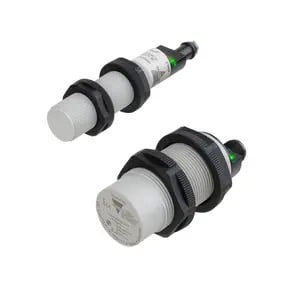
The CA18CB and the CA30CB capacitive proximity sensor. Image used courtesy of Gavazzi Automation
Detecting Objects In Automation
There are many different sensors on the market for detecting objects in many different applications within automated equipment, but some situations call for specific sensors. The capacitive proximity sensor can detect non-ferrous and non-metallic materials such as plastic, rubber, and even liquids. Other sensors capable of detecting these materials rely on optical components, which do not perform well in dusty environments. A caveat of the proximity sensor is getting the sensor in the correct range and knowing when the sensor is too dirty to accurately detect objects. Carlo Gavazzi, a component manufacturer out of Buffalo Grove, Illinois, has recently released a capacitive sensor with an LED bar graph to help alleviate alignment and maintenance cycles.
The CA18CB and CA30CB Proximity Sensor
When your detecting application requires sensing non-metallic materials, a capacitive proximity sensor might be your solution. The CA18CB and CA30CB are 18 mm and 30 mm diameter sensors with an integrated LED bar to facilitate quick alignment in the field. The LED indicators can also alert maintenance staff that the sensor is getting too dirty and the sensing range is being affected. Both sensors can be ordered with a cable or connector and in flush mount or non-flush mount. The flush mount has a sensing range of 8 mm, while the non-flush has a 12 mm sensing range. Each version also has two outputs that can be configured as NPN or PNP and three different switching modes: single point, window, and 2-point mode. Either the CA18CB or CA30CB can be ordered with IO-Link, which provides parameter setting, real-time monitoring, and diagnostic monitoring.
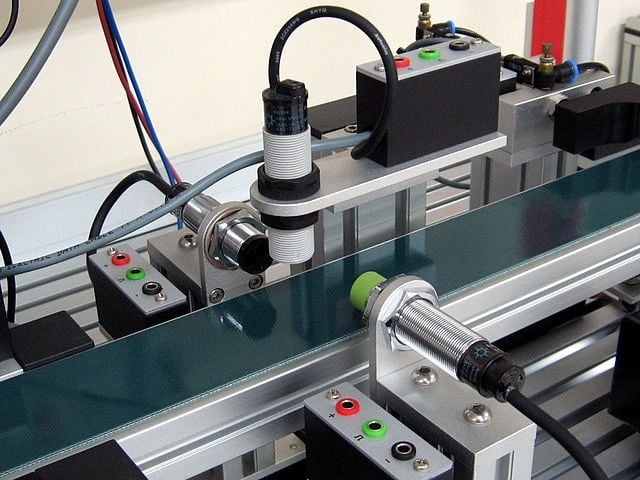
Proximity sensors detecting film. Image used courtesy of Wikimedia Commons
How A Capacitive Sensor Works
A Capacitive proximity sensor will detect the presence of an object without physically touching it. When the sensor is powered, it will emit an electrical field from the sensing face. As objects disrupt this electric field, the sensor will detect the disruption and output an electronic signal. The sensing range of the sensor dictates how far away an object can be detected, and it can be used to filter out unwanted objects in the sensing range. These sensors can be used to detect liquids within a non-metallic container by adjusting the sensing range. The range needs to be adjusted so that the container is not detected, but the fluid in the container is.
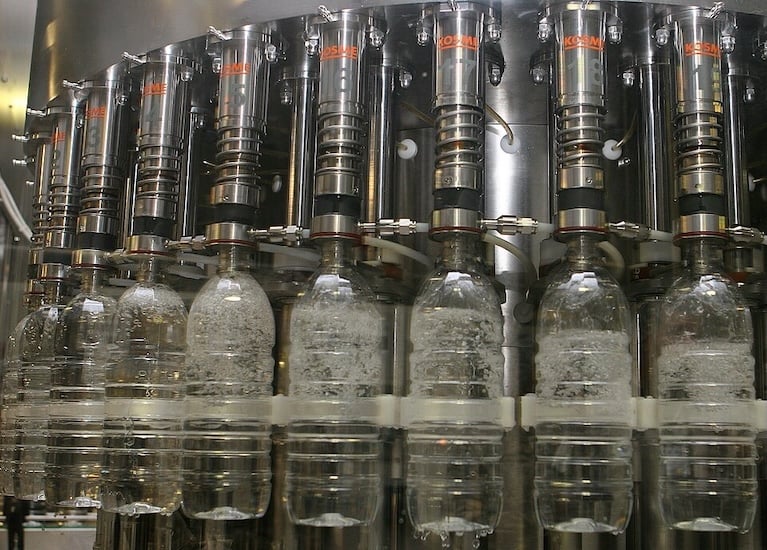
Bottling line that would use a proximity sensor to detect the fill level. Image used courtesy of Wikimedia Commons
Object Detection
In automated equipment, the proximity sensor is widely used to tell the control system where parts or objects are within the physical world. Without these sensors, the control system would have no idea where pallets are on conveyors or if parts are located in nests. The capacitive proximity sensor is a great solution when you need to detect objects in dusty environments or non-metallic objects.