Facebook
 Google
 GitHub
 Linkedin
Dobot Levels Up Human-Robot Collaboration With Power and Precision
Dobot's new CR 30H, Nova 2s, and Dobot Atom robots feature high payloads, precision, and human-like dexterity, expanding the company's portfolio of smart, flexible automation.
From heavy-duty palletizing to high-precision assembly and even humanoid tasks like fruit picking, collaborative robots are evolving fast. While collaborative robotics has always prioritized safety, much of the field's focus is now on speed, intelligence, and versatility. Dobot has recently introduced two new cobots built to meet these evolving demands, including the high-payload CR 30H and the compact and precise Nova 2s. The company also announced the global launch of its humanoid Dobot Atom robot.
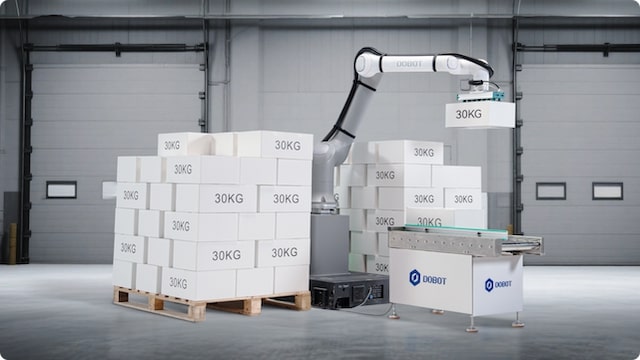
Dobot’s new CR 30H cobots feature a 30 kg payload capacity and a 1,800 mm reach. Image used courtesy of Dobot
CR 30H Collaborative Robots
Dobot has designed the CR 30H cobot to be one of the "fastest in its class." The CR 30H offers a 30 kg payload with a 300°/s joint speed on J4/J5/J6, up to 150°/s on J1/J2, and 200°/s on J3. Dobot's HyperMove algorithm fine-tunes acceleration to keep motion fast and stable, making the CR 30H a serious contender for high-throughput automation.
The CR 30H is designed to meet the needs of applications that require both heavy lifting and rapid motion. Under full load, the CR 30H maintains vibration displacement under 0.3 mm, thanks to built-in vibration suppression and optimized joint mechanics. These capabilities make it a strong fit for palletizing, material handling, metal processing, and semiconductor loading.
For added flexibility, Dobot offers two variants. The CR 30HT features drag-to-teach and real-time collision detection via integrated torque sensors. The CR 30H-Food is NSF-certified, using food-safe materials and hygienic surfaces for dairy and frozen food production.

Dobot’s new Nova 2s cobots feature high-precision 6-axis motion in a compact build. Image used courtesy of Dobot
Nova 2s Collaborative Robots
Dobot’s new Nova 2s cobots are built for compact environments where precision matters. It offers the same 6-axis performance as Dobot’s larger cobots while featuring a 40% reduced footprint, making it easier to integrate into applications with limited spaces or mobile platforms.
The Nova 2s delivers 6-axis motion with a ±0.05 mm repeatability and supports both wired and wireless connectivity for easier line reconfiguration. Its short-arm design improves structural rigidity, which helps maintain accuracy during high-speed or delicate tasks, making it an ideal fit for roles like electronics assembly, small-part packaging, and lab automation.
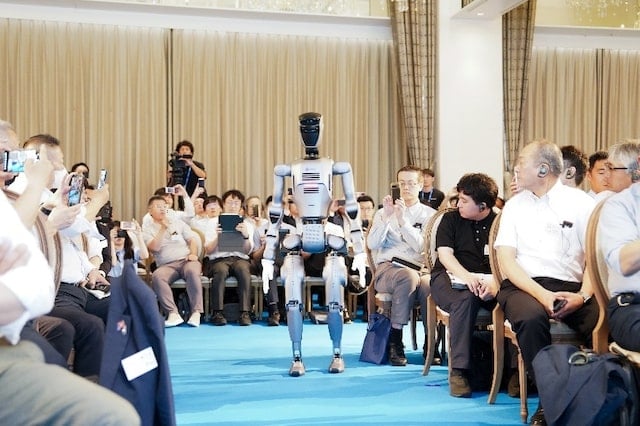
The Dobot Atom humanoid robot announced plans for global delivery late last month in Nagoya, Japan. Image used courtesy of Dobot
Dobot Atom Humanoid Robot
While most collaborative robots stick to arms, Dobot Atom walks into new territory (literally) as a full-sized humanoid robot with straight-knee walking and fine motor capabilities. Atom pairs mobility with industrial-grade repeatability (± 0.05 mm) and is powered by Dobot’s Neuro-Driven System (NDS). The robot achieves coordinated movement across upper and lower limbs, enabling tasks like electronic soldering or fruit picking. It’s designed not just for research, but for real deployment.
Having completed production verification, Atom is now in mass production, with deliveries underway in partnership with Japanese integrator ASKA Corporation. Atom’s global launch signals Dobot’s commitment to embodied AI and the expansion of humanoid platforms into real-world roles.
Enhancing Robotics
Dobot’s latest robots handle different ends of the automation spectrum, with the company expanding its robot product lines in various ways. The CR 30H is designed for speed and payload, hitting 300°/s joint speeds while lifting up to 30 kg. The Nova 2s brings space-efficient precision to crowded manufacturing floors, and the Dobot Atom blends dexterous manipulation with bipedal mobility for advanced human-machine collaboration. Together, Dobot’s newest solutions show how collaborative robotics is pushing beyond safety into high-performance, multi-role systems.
Related Content