Facebook
 Google
 GitHub
 Linkedin
Epson Introduces Six-Axis Robot Built for Safe, Intuitive Human Interaction
The Epson AX6 offers compact six-axis automation with no-code or Python programming and integrated safety features for collaborative applications.
Robots designed for close collaboration with humans offer an accessible path for companies looking to adopt automation without the need for specialized personnel or advanced safety systems.
Epson Robots, a leading manufacturer known for its SCARA models, has introduced the AX6 six-axis robot. Featuring a 900 mm reach, a 6 kg payload capacity, an acceptable supply voltage of 100 VAC to 240 VAC, and versatile mounting options (tabletop, ceiling, or wall), the AX6 suits a wide range of collaborative automation applications.
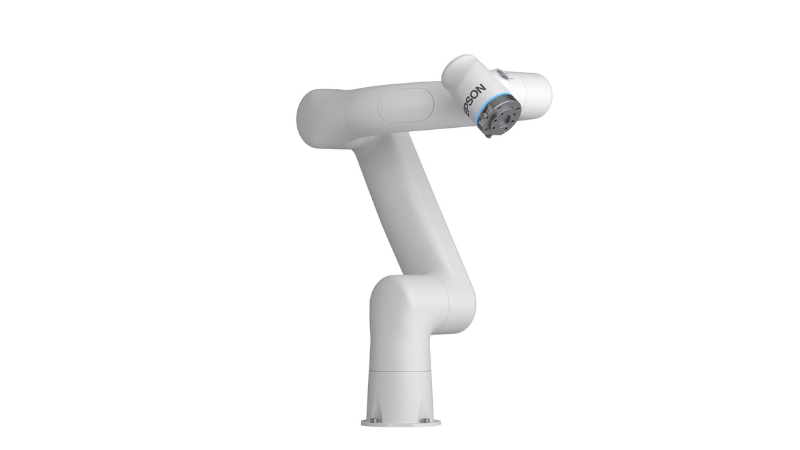
Epson’s AX6 six-axis robot features a 900 mm reach and 6 kg payload capacity. Image courtesy of Epson
Introducing the Epson AX6
Driven by high industry demand, virtually every robot manufacturer now offers robots that safely operate alongside human workers. Epson’s AX6 robot has now joined the lineup.
The AX6 can be quickly deployed and redeployed thanks to its intuitive no-code approach to building dynamic robot application programs. Because power and force limiting ensure operational safety, physical safety fences and guarding are unnecessary, allowing installation in open-concept work cells.
Weighing just 17 kg, the AX6 features a carbon-fiber arm structure, power and force limiting, no-code programming software, a customizable Python development environment, industrial kinematics, end-of-arm user buttons, end-of-arm Ethernet and pneumatic ports, and an end-of-arm multicolor status LED ring.
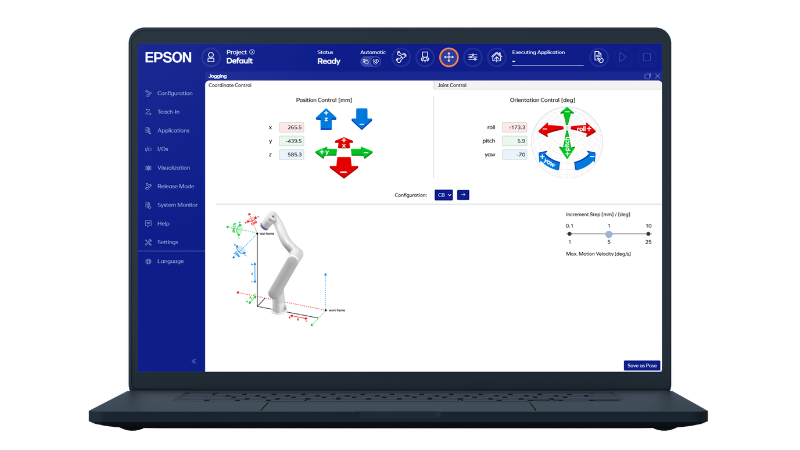
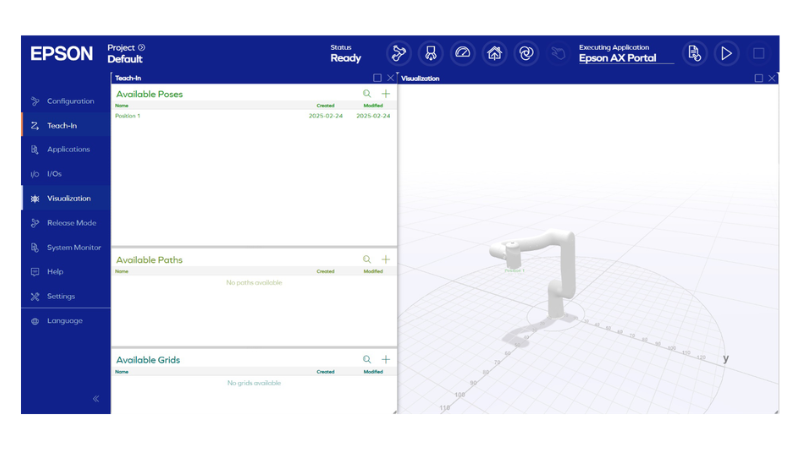
The Epson AX Portal web interface simplifies setup, operation, and application development through intuitive programming tools. Image courtesy of Epson
Easy-to-Use No-Code Programming
Unlike traditional industrial robots, the AX6 is programmed through a web interface. The robot can be configured for operation, programmed using the block programming language, or programmed using the Python scripting language.
Most programs consist of a collection of robot poses, which can be created, modified, and deleted through the web interface. To teach the pose, users can simply press the hand-guided control button and move the robot to where they would like to teach the pose.
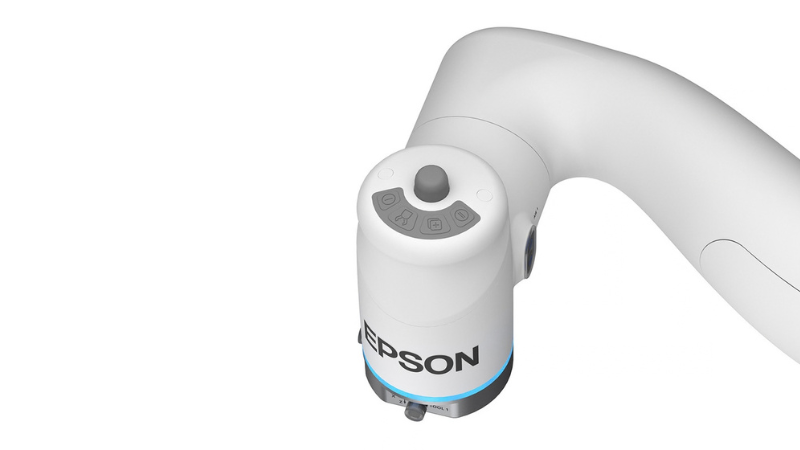
The AX6 operator interface used for pose teaching and gripper manipulation. Image courtesy of Epson
End-of-Arm Tooling
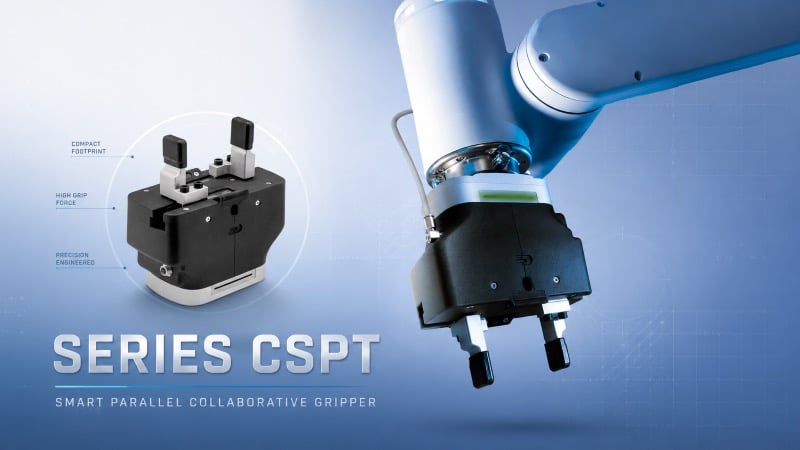
Attaching tools to the end of a robot arm is just as important as developing robot programs. The AX6 has integrated communication, pneumatic, and electrical I/O connections at the end of the arm. This allows for standard grippers to be attached or custom end-effectors to be developed. An M8 8-pin connection is provided on J6, which provides electrical connections for two analog I/O, two digital inputs, two digital outputs, and dedicated 24 VDC and ground.
Epson's 3D simulator enables risk-free offline programming and motion testing before physical deployment. Image courtesy of Epson
Integrated 3D Simulation
Offline simulation is essential for validating automated processes prior to installation, saving time while preventing costly layout mistakes. The latest AX6 is fully integrated into Epson’s RC+ development software. The RC+ software enables users to upload CAD models of existing or future work cells and drop an Epson robot where designers expect it to be.
Once the work cell is imported, users can then begin developing robot applications, debug, and investigate robot reach limitations. Once the development is completed, the simulated code can be downloaded to the robot on the factory floor.
Robots for collaborative applications offer smaller factories the ability to enter the automation world without the overhead of dedicated programmers or safety systems. With flexible models like the AX6, facilities can intuitively install the arm, teach points via hand guidance, and quickly deploy functional programs.