 Facebook
 Google
 GitHub
 Linkedin
Festo CECC-AX Combines PLC Control and Python for Lab Automation
Designed for life sciences, Festo’s compact CECC-AX controllers automate liquid dispensing, sample transfer, and preparation while supporting Python and PLC control.
Festo’s CECC-AX controller series combines traditional PLC programming with Python to automate liquid handling and sample preparation in life sciences laboratories and production environments. The compact controllers are designed for applications such as precise reagent dispensing, sample transfers, dilutions, and pre-analytical processes. Ethernet, EtherCAT, serial interfaces, and digital and analog I/O provide connectivity to a range of laboratory and automation equipment. By letting researchers use Python alongside PLC control, the CECC-AX can bridge the gap between laboratory workflows and industrial automation. Its design also meets cybersecurity requirements under the EU Cyber Resilience Act.
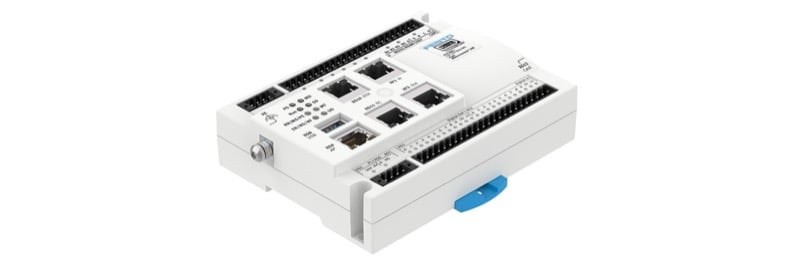
Festo CECC-AX controller. Image used courtesy of Festo
Life Sciences and Automation
The case for automation is obvious in heavy industry and manufacturing. Less obvious are the numerous repetitive tasks in life sciences laboratory work. Still, any task that is boring, repetitive, potentially dangerous, or error-prone is a candidate for automation.
As it turns out, the life sciences are filled with such applications. For example, consider a dosing pump that dispenses a small amount of reagent (in the microliter range) for drug development. Consistency between samples is vital, and hand pipetting can become burdensome and less accurate. The CECC-AX controller can be programmed to run the pump and ensure it dispenses the correct amount of liquid each time.
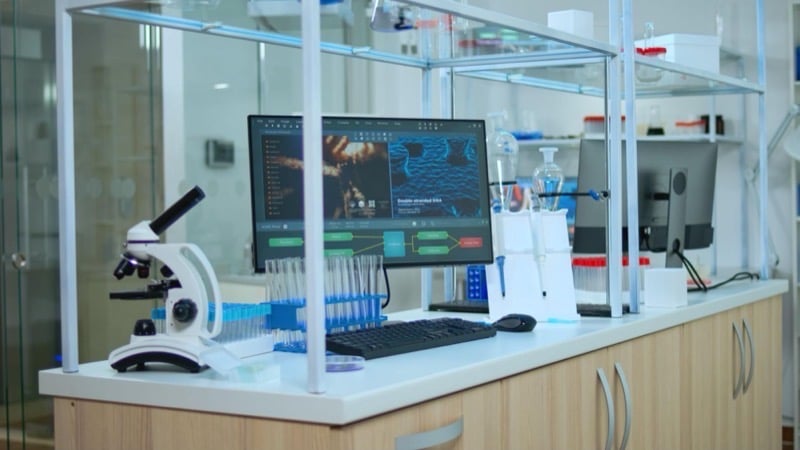
Automating repetitive, boring, or dangerous tasks can be useful in laboratory work. Image used courtesy of Adobe Stock
Other repetitive, error-prone life sciences research tasks include transferring samples between vessels, test tubes, and microwell plates; dilutions; aspirating and washing small sample holders; and more. Transferring and adding dilutions across microwell plates is particularly cumbersome. Some plates have up to 384 wells, and getting the volume right and tracking which plates have been treated is a challenge in itself.
CECC-AX Controller Features
The CECC-AX can be configured using traditional PLC programming or with Python. This flexibility extends capability and allows biologists and medical researchers to use Python, which they are more likely to have used than PLC programming. This can speed installation, as many biologists have already used Python in some capacity.
Each controller can also be interfaced in a variety of ways. Ethernet, EtherCAT, serial interfaces, digital and analog I/O ports, and other fieldbus options make it easy to connect the controller to many devices. This is especially important because some laboratory equipment is not built with automation in mind, and automation equipment is not built with biology labs in mind.
The CECC-AX is also designed to meet the European Union’s Cyber Resilience Act (EUCRA). The EUCRA is a set of standards that aims to protect devices from cyberattacks. With drug development as a multi-billion-dollar research industry, a single cyberattack could cost a fortune and delay life-saving treatment development.
The controller itself has a compact physical footprint and can be mounted virtually anywhere. Designed for benchtop machinery, its small size and flexibility simplify crowded laboratory benches.
A Solution in the Life Sciences
The CECC-AX controllers are designed for liquid-media handling and pressure-controlled dispensing in life sciences laboratory and production applications. Automation significantly benefits sample preparation, pre-analytical processes, dispensing controlled volumes of liquid, and other related tasks.
Related Content