Facebook
 Google
 GitHub
 Linkedin
Festo Enhances Pneumatics With Digital Closed-Loop Control System
Festo has developed Control Pneumatics technology to improve precision and efficiency in compressed air and gas applications via digital closed-loop control.
Compressed air is often the most expensive form of energy consumed in industrial settings. This means that reducing compressed air consumption can have lasting benefits for manufacturing and automation industries. Festo has taken this into account and created a new digital closed-loop control system for pneumatic systems. The result is a control strategy designed to deliver precise movement, dynamic response, and increased energy efficiency.

Overshoot and undershoot can cause a significant waste of compressed air or gas: Festo has designed its Controlled Pneumatics technology to reduce this waste. Image used courtesy of Festo
Controlled Pneumatics
Festo’s new Controlled Pneumatics technology intends to be an ideal solution for applications that use compressed air and gas, including surface processing, web tensioning, vacuum gripping, and gas shielding. According to Festo, this technology can reduce compressed air usage by up to 50%. This translates to substantial energy savings and a reduction in greenhouse gases created by the energy production process. In addition to reducing compressed air usage, the system can be used to reduce the usage of other common gases used in industry, such as nitrogen, hydrogen, carbon dioxide, helium, and argon.
Digital Closed-Loop Control
Traditionally, pneumatic systems use on/off solenoid valves, which operate in a binary fashion, either fully opened or fully closed. Controlled Pneumatics replaces these with proportional pressure regulators, which allow fine adjustments to air and gas flow. The ability to fine-tune the amount of gas flowing helps to increase the efficiency of the system. In addition, the regulators use piezoelectric valves, which are highly precise, consume 95% less energy than solenoid valves, and do not generate heat.
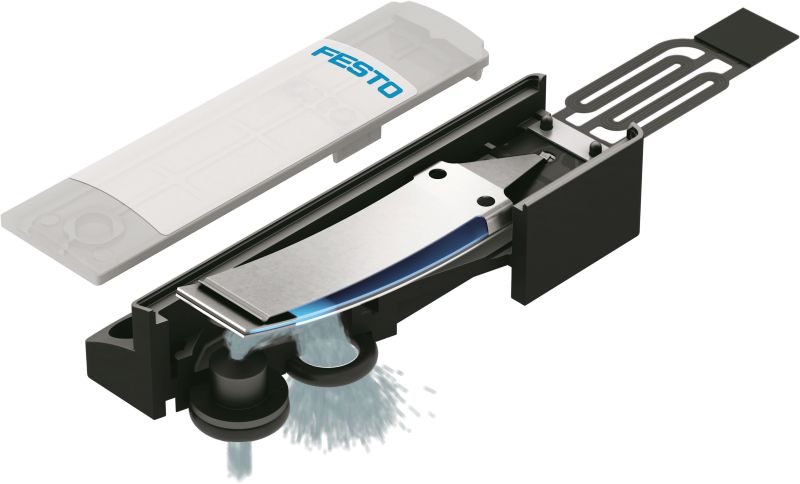
Controlled Pneumatics uses piezoelectric valves in its proportional pressure regulators for compact efficiency. Image used courtesy of Festo
The use of a control system, in tandem with a more efficient valve, is what gives Controlled Pneumatics its advantage. The system constantly monitors pressure and flow using built-in sensors. Data from these sensors is sent to a controller, which adjusts the valve openings in real time to maintain optimal pressure. This prevents overshooting and undershooting, reducing wasted air and gas. The system also integrates high-speed digital communication, ensuring rapid response times to reduce gas waste further.
Advanced control algorithms are used to monitor the status of the valves constantly. This gives them the ability to maintain stable and linear pressure and flow and adjust pressure based on demand rather than running at a constant high pressure. Controlled Pneumatics can even detect leaks and alert staff for an immediate response. Leak detection allows plants a better method for learning about, finding, and troubleshooting leaks.
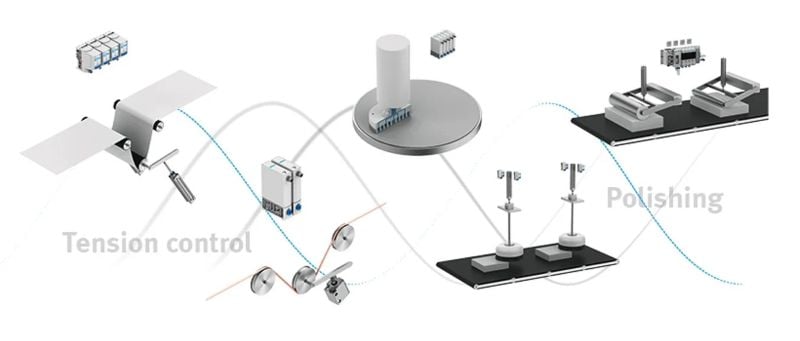
Controlled Pneumatics can be used in many different pneumatic applications to help reduce the costs of air and gas usage. Image used courtesy of Festo
Efficient Pneumatic Control
Festo has designed its new Controlled Pneumatics technology for manufacturers looking to enhance their air and gas systems and increase plant efficiency. A factory using Controlled Pneumatics for nitrogen purging in silicon wafer manufacturing reduced gas consumption by 75%, saving $163,000 per 1,000 systems and cutting CO₂ emissions by 1,045 metric tons.