Facebook
 Google
 GitHub
 Linkedin
Festo Releases VEFC Mass Flow Controller for Inert Gases
The new VEFC mass flow controller from Festo comes in a slim package and features millisecond response times, making inerting convenient and fast.
Festo’s new VEFC mass flow controller offers fast response times in a compact package. The new controller line is designed to accurately measure and control mass flow rates of inert gas for welding shields and other inerting tasks. Festo expects battery cell production, food and beverage manufacturing, and specialty markets to be the primary applications of this device.

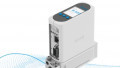
Festo’s VEFC mass flow controller has a compact width of 24 mm. Image used courtesy of Festo
Differential Pressure Measurement and Flow Rate
Differential pressure measurement is a common way to measure mass flow rate indirectly. When compared to turbine flow meters, differential pressure measurements have few moving parts, require little maintenance, and are simple to use once calibrated.
As a fluid flows through the gauge, it is restricted through an orifice of known size. The pressure is measured as a difference between the upstream and downstream sides of the orifice. The higher the pressure drop from the inlet to the outlet side, the higher the flow rate. From Bernoulli’s equations, the mass flow rate (ṁ) can be calculated from the generic equation:

where ΔP is the differential pressure, ρ is the density, and K is a constant that depends on the geometry (area of the critical orifice) and fluid properties. The mass flow rate increases as a square root of the differential pressure. K can be calculated as well, but more often than not, the entire system is calibrated based on actual measurements instead.
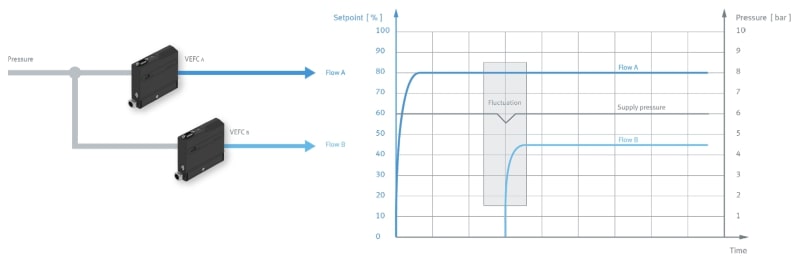
The VEFC mass flow controller uses the differential pressure measurement method to measure flow rate. Image used courtesy of Festo
VEFC Mass Flow Controller
Festo’s new VEFC mass flow controller is capable of handling inert gases at volumetric flow rates of up to 200 l/min and is built in a slim package that is only 24 mm wide. It is rated to IP20, making it suitable for continuous use in indoor manufacturing facilities. Each controller has a DB-9 port for communication and is powered with 24 V DC.
Designed to be used in closed-loop control, the VEFC can take a differential pressure measurement using its piezoelectric sensor, calculate the flow rate, and then make adjustments to the flow in a matter of milliseconds. The controller can make these quick adjustments while minimizing ringing, making small, repeated inerting operations possible.

The VEFC mass flow controller can be used in the food and beverage industry to help package items like bags of chips. Image used courtesy of Adobe Stock
Flow Control Applications
For gases, it is useful to use a mass flow rate over a volumetric flow rate. Volumetric flow rates are dependent upon temperature and can vary in an industrial environment with fluctuating temperatures.
A compact mass flow controller can be used for numerous industrial purposes. The VEFC is built for inert gases, so it can be used to supply shielding gas on portable welding rigs that will experience a range of temperature conditions during service. It can also be used to ensure consistent flow in inerting blankets over flammable vapors and other such safety-critical operations.
Another common application is in the food and beverage industry. Many items are packaged with inert gas to prevent spoilage that would be present if air was allowed to enter. Bags of chips and other snacks can be filled with nitrogen (almost inert) to extend the shelf-life of the product. Accurate flow rates ensure that bags have the proper fill without bursting during transit.
Ultimately, the VEFC’s quick response times, high degree of accuracy in all conditions, and small form factor make it a useful tool in most inert gas metering operations.