Facebook
 Google
 GitHub
 Linkedin
Festo’s VEMD Expands Gas Control with Software Configuration
The latest VEMD Mass Flow Controller enables software-based gas selection, reducing hardware needs and enhancing flexibility for industrial gas flow management.
Festo’s latest iteration of the VEMD Mass Flow Controller has expanded its software capabilities. Instead of requiring a separate mass flow controller for each type of common gas in an industrial process, the same controller can be configured programmatically for multiple gas chemistries. This makes supply issues and other gas delivery problems much easier to work around. It can also speed up prototyping and conversion of process lines without the need to purchase new hardware.
Common Gas Control
The most common industrial gases, nitrogen, oxygen, argon, carbon dioxide, and others, have wildly different physical properties and thus often require different hardware for industrial use. For example, nitrogen is nearly inert and can be used to provide a blanket over flammable vapors to limit their chances of igniting. On the other hand, once a fire is started in an oxygen-rich environment, it is difficult to extinguish. Because of these different properties, it is not uncommon for industrial sites to have to buy individual mass flow controllers for each gas.
The newest version of the VEMD controller allows for software-configurable gas control. Instead of having to buy a controller for each type of gas, this controller can be programmed for many of the common industrial gases. This in itself is a major advantage; there is no need to buy additional hardware if there is an issue in the nitrogen supply chain, and argon needs to be used for inerting instead.
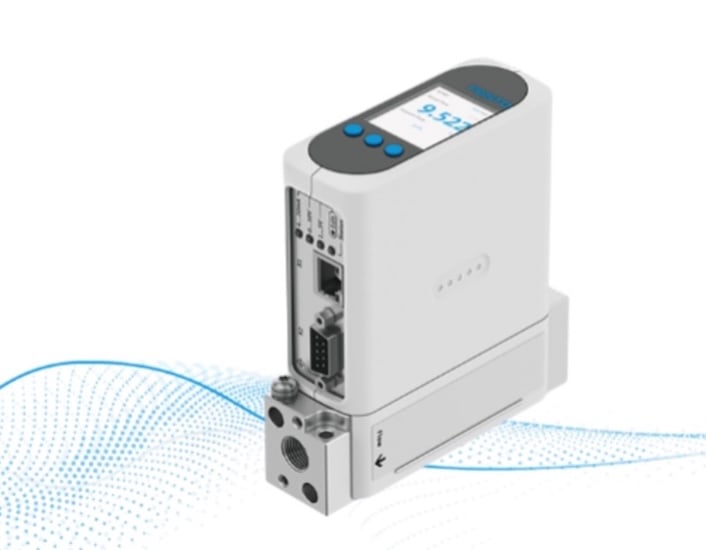
The Enhanced VEMD Mass Flow Controller. Image used courtesy of Festo
Festo did not stop with configuration options. The latest version also has more streamlined interfacing, with improved digital connections over Modbus TCP/IP, Modbus RTU RS-232, and RS-485. It can also communicate over common analog standards, such as 0-10 VDC, 1-5 VDC, and 4-20 mA, making it easy to integrate with other equipment.
The mass flow controller can handle different flow rates, depending on the model. Units that have a maximum controlled volumetric flow rate of 20 L/min to 200 L/min are available. Furthermore, each included an embedded thermal sensor for improving accuracy and reducing hysteresis across valve opening and closing cycles.
Potential Applications
Festo's tight control loops on the VEMD allow it to precisely meter the flow of common gases, making it suitable for numerous applications. In particular, Festo envisions this controller serving biomedical, chemical, pharmaceutical, and food and beverage industries.
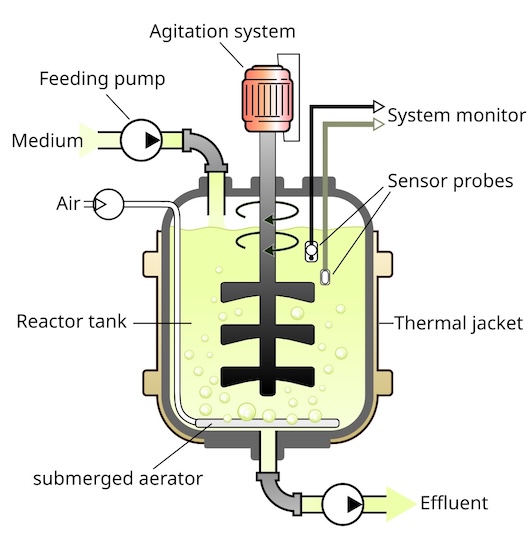
This bioreactor has an air feed, but others may require air or oxygen, followed by an argon purge during cleaning. Image used courtesy of Wikipedia Commons
In terms of actual unit operations equipment, these controllers would be useful for managing the gas flow to bioreactors and fermenters. During operation, these require a specific mix of gases to grow and control the population of cell cultures and yeast. However, during the cleaning stages, the vessel may need to be purged with inert gas, such as argon, to kill these populations and remove the residue to prevent cross-contamination.
Overall, the ability to switch between gases programmatically is an advantage that many industries will use.
Related Content