Facebook
 Google
 GitHub
 Linkedin
High Frame Rate Cameras Reveal Hidden Machine Vibrations
A camera-based vibration monitoring method could reduce reliance on accelerometers in noisy industrial environments.
Researchers at Hiroshima University are exploring a new way to capture and analyze machine vibrations using high-frame-rate cameras rather than traditional accelerometers or acoustic sensors. By combining 1,000-frame-per-second imaging with digital image correlation, the team can visualize vibration signatures across different robot postures and frequencies. The approach could support predictive maintenance in noisy industrial environments, although further work is needed to adapt the technique from controlled laboratory conditions to real-world factory settings.
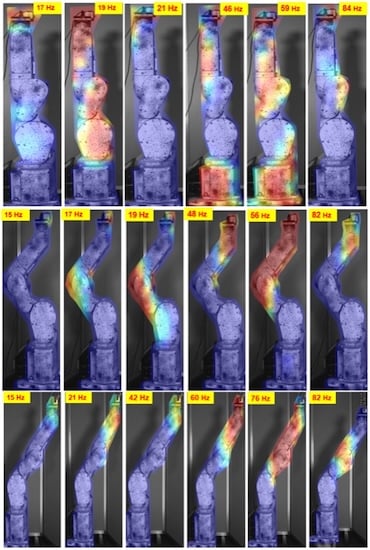
Visualization of vibration for three different postures. Image used courtesy of Applied Sciences
Importance of Vibration Monitoring
Vibration is a part of all machining, manufacturing, and assembly processes. However, hidden in the vibrations are signals that can indicate when components are wearing, need lubrication, or replacement. For example, consider a motor with worn bearings. The motor’s vibration signal will change as the bearings erode, long before they fail catastrophically. By monitoring vibrations, engineers can replace bearings during planned maintenance rather than during unplanned downtime. This process can also be used to detect cavitation in fluid lines, where collapsing bubbles produce a distinct vibration pattern from healthy fluid flow.
Visual Vibration Monitoring
At Hiroshima University, researchers developed preliminary testing and visualization methods for monitoring vibrations with an HFR camera. At 1000 frames per second at 1920x1080 pixel resolution, the camera captures subtle motions of their test robot. From there, a DIC routine aligns the images in time and space to develop a model of the robot's vibration during operation. Then, these vibrations are characterized by frequency and can be cataloged or visualized at different frequencies.
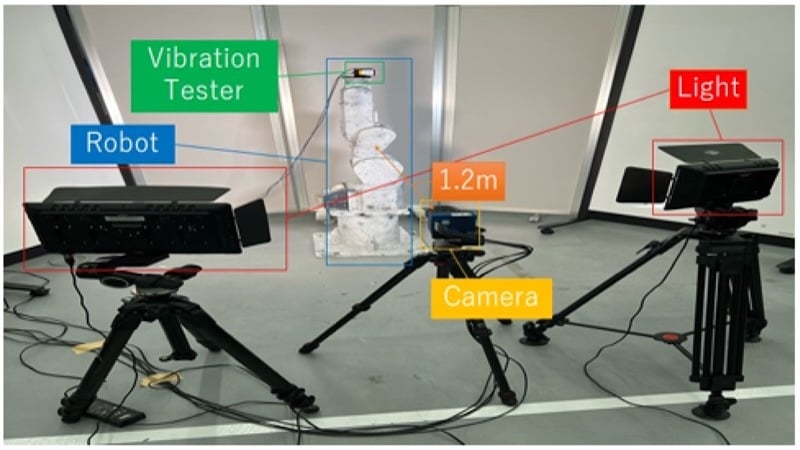
Hiroshima University’s experimental setup, with controlled lighting, temperature, and background noise. Image used courtesy of Applied Sciences
Potential Applications
One of the key advantages of camera-based vibration monitoring is the ability to remove background noise, enabling it to function in acoustically noisy environments. In many manufacturing facilities, multiple machine cells may perform the same task, contributing to the background noise floor. This background noise can fool acoustic sensors and accelerometers, making it difficult to pinpoint the problem equipment.
Future Work
The ability to visualize vibrations can improve predictive maintenance schedules without the need for sensors directly on the machine, while limiting background noise. However, this research is preliminary. Researchers conducted their tests under controlled lighting and temperature conditions in a laboratory with minimal background noise. Future work will focus on bringing the system from the laboratory into the real-world environment.
Another caveat is that 1000 frames per second sounds fast. In reality, this can capture vibration signatures up to 500 Hz, per the Nyquist theorem. The research focused on signals of up to 200 Hz, which is adequate for large motions, pumps, and most motors. High-speed motors, such as those found on drills, turbo pumps, and other such equipment, would not be captured by this system. As camera systems improve, higher frame rates and better resolution will help alleviate these limitations.