Facebook
 Google
 GitHub
 Linkedin
How Dexterity’s Mech is Changing Industrial Work Dynamics
Dexterity’s Mech robot is designed for warehouses to support labor-heavy tasks, sparking discussion about how automation fits into the modern workforce.
Factories and distribution centers are feeling the strain. As e-commerce continues to surge and consumer expectations grow, warehouse floors are being pushed to their limits. Workers are tasked with heavy lifting, repetitive sorting, and time-sensitive loading, often in environments that challenge both safety and endurance. Employers are under pressure from staffing shortages and struggle to find ways to boost efficiency without compromising worker well-being.
Dexterity believes they have a solution with Mech, their latest release. Unlike traditional machines that are fixed in place or follow rigid programming, Mech is mobile, autonomous, and built with two arms that mimic the reach and dexterity of human limbs. Its primary role is to support physical tasks like lifting, stacking, and sorting boxes, functions that typically wear down human workers over time. Though still in early deployment, the Mech robot signals a shift in automated expectations and processes.
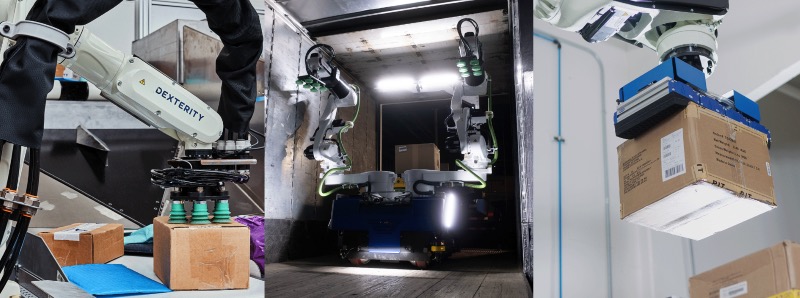
Introducing Dexterity’s Mech Robotic System. Image used courtesy of Dexterity
Collaboration and Adaptability
One of the most immediate implications of Mech’s arrival is how it could reshape roles inside industrial workplaces. Rather than replacing workers outright, the robot is designed to operate alongside them. With one person capable of overseeing up to 10 Mech units at once, human labor shifts from performing strenuous work to managing and coordinating it. That redistribution of labor may help reduce the risk of strain injuries, a common issue in logistics jobs.
Mech’s design prioritizes adaptability within existing facilities. It doesn’t require warehouses to be rebuilt around it. Instead, it’s made to operate in “brownfield” environments, older facilities already equipped with legacy systems. Thanks to its four steerable wheels, Mech can navigate crowded or cluttered spaces independently. Once at a workstation, it’s capable of lifting to 130 pounds and stacking items as high as eight feet, a level of strength well beyond what most autonomous machines currently offer. These features allow it to function in spaces that aren’t highly controlled, making it more usable for companies hesitant to overhaul their infrastructure.
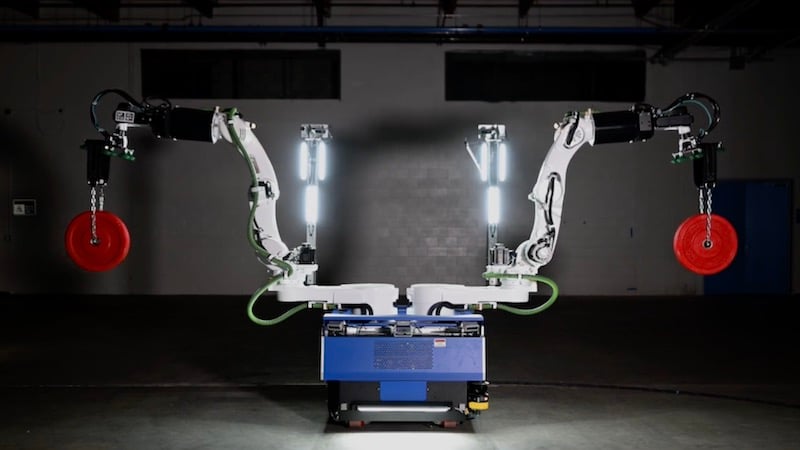
The Mech robot has a higher payload capacity than many autonomous robots. Image used courtesy of Dexterity
Did You Say AI?
At the core of Mech’s operation is its AI system. Rather than following a single script, it runs hundreds of models simultaneously to determine how to handle each task. That might mean recognizing how to arrange a random set of boxes or deciding how much pressure to apply to a crushable item. Sixteen embedded cameras help it identify its surroundings, scan for objects, and strategize its next move, all while functioning in environments with temperatures ranging from 32 to 122°F. These capabilities introduce a different kind of reliability and the potential to handle various new tasks.
Continuous Evolution Through Software Updates
The robot also evolves. Much like updating an app on a smartphone, Mech can be given new skills via software. Its current launch function is truck loading, but additional task-specific applications are expected to roll out throughout the year. For businesses, this could mean fewer purchases of specialized machines and more flexibility as operations grow or change. However, it also raises questions about how much adaptability hardware can support, and how many different roles one robot can reasonably fill.
A Balanced Approach to Automation
For Dexterity, Mech is a step toward what its leadership sees as a more balanced form of automation. Samir Menon, the company’s founder and CEO, has emphasized the goal of empowering human workers rather than sidelining them. Still, as automation becomes more capable, the line between assistance and replacement will likely remain a topic of debate, not just for Dexterity, but for the industry as a whole.
As logistics continues to grapple with the challenges of scaling safely and efficiently, robots like Mech could become a familiar presence on the warehouse floor. Rather than offering a complete solution, Mech represents a shift in how companies approach the balance between human labor and machine support, one that may reshape not just how work is done, but who does it.
Related Content