Facebook
 Google
 GitHub
 Linkedin
Intesis 700 Air Gateways Add Mitsubishi Controller Support
New compatibility lets Intesis 700 Series gateways expose Mitsubishi HVAC data to BMS platforms without middleware.
HMS has recently updated the Intesis 700 Series Air gateway to add direct compatibility with a broad range of Mitsubishi Electric centralized controllers. So those VRF and PAC systems can now be exposed natively to BACnet, Modbus, KNX, and common home‑automation platforms. The change lets a single 700 Series gateway map controller datapoints (setpoints, modes, alarms, sensor readings, runtime counters) into standardized Building Management System (BMS) objects without the need for custom protocol converters. That reduces commissioning time, standardizes datapoints for firmware updates and maintenance, and delivers cleaner centralized monitoring and energy‑management data while keeping existing Intesis configuration tools and workflows.
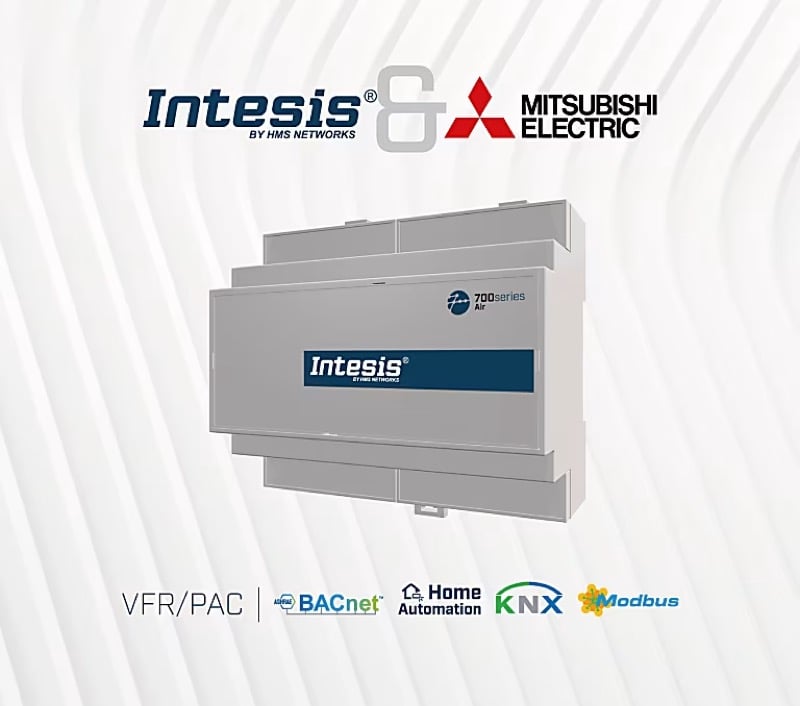
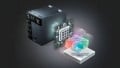
The Intesis 700 series air gateways are now compatible with Mitsubishi centralized controllers. Image used courtesy of HMS Networks
So, What’s New With the 700 Series?
The 700 Series Air gateways now list direct compatibility with these Mitsubishi Electric centralized controllers: AE‑C400, AE‑C400E, G‑50, G‑50A, GB‑50A, GB‑50ADA, AB‑150, AE‑200, AE‑50, AG‑150A, EW‑50, EW‑C50, and EB‑50GU. With the new compatibility with Mitsubishi controls, integrators can now map centralized controller datapoints, such as setpoints, modes, alarms, sensor readings, and runtime counters, into standardized BMS objects and registers.
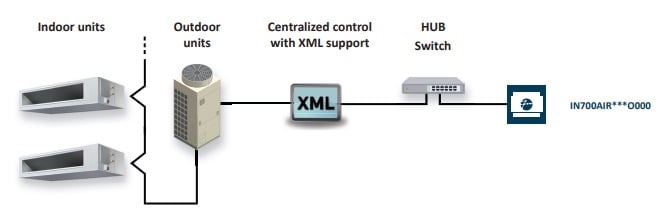
Image depicts a typical setup for a connectionto Mitsubishi Electric centralized controllers. Image used courtesy of HMS Networks
Technical impact
Intesis gateways act as protocol translators and data point normalizers. With the new controller support, a single 700 Series Air unit will be able to poll Mitsubishi centralized controllers, perform scaling and type conversion, and present values as native BACnet objects, Modbus registers, KNX group addresses, or endpoints for home automation systems, reducing the overall cost of systems by removing the need for middleware and reducing the overall number of devices on the network, simplifying topology and lowering points of failure.
Commissioning and lifecycle
The latest update introduces ready-made datapoint templates along with a streamlined set of configuration tools for the new controllers. This significantly reduces manual effort during commissioning, since fewer mappings need to be created from scratch. Using standardized data points makes future tasks simpler as well. For example, firmware updates and remote diagnostics for the Intensis 700 series are much easier to handle because the object IDs and mappings remain consistent across different sites, while making ongoing facility maintenance and lifecycle management more straightforward.
Operational benefits
Sharing centralized controller data at the Building Management System (BMS) level helps in several ways, including improving scheduling, detecting faults, and managing energy more effectively. Facility teams will also be able to collect and analyze runtime and alarm data, coordinate scheduling across multiple Variable Refrigerant Flow (VRF) zones, and implement targeted efficiency improvements, such as adjusting setpoints, without installing additional data-collection systems.
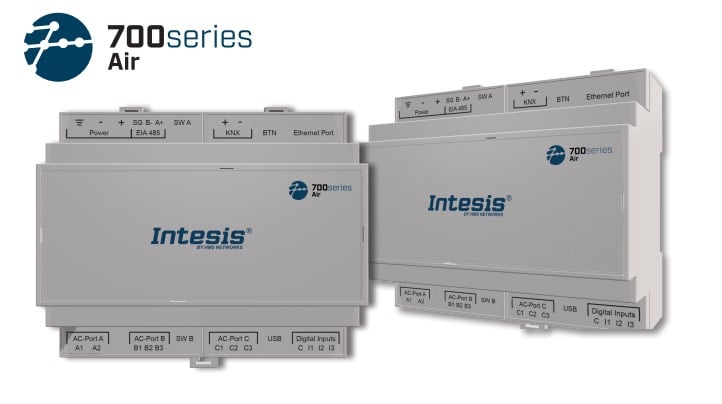
The Intesis 700 series air gateway. Image used courtesy of HMS Networks
In today's buildings, whether they’re brand new or a century old, it’s common to see different vendors collaborating. Intesis simplifies this collaboration by improving communication between Mitsubishi Electric centralized controllers and other systems. The improved communication reduces engineering time for projects involving multiple vendors, enables quicker setups, and provides better access to operational data, which, in turn, helps optimize energy use. Whether for retrofitting older buildings or for new construction, this update simplifies integration and makes HVAC data more accessible to building automation systems.
Related Content