Facebook
 Google
 GitHub
 Linkedin
Kollmorgen Releases Next-Generation Programmable Motion Controller
Motion controllers are becoming more popular in automation due to their fast communication, quick computing, and integrated programming abilities. Check out Kollmorgen's latest motion controller, the PCMM2G.
When using a servo motor in an application, you need a drive system or motion controller to manipulate the electrical power and receive feedback signals from the motor. The automation control system then communicates to the motion controller with position and control signals such as start or stop. The motion controller's job is to move the motor to the commanded position at the commanded velocity, acceleration, and deceleration.
Recently, Kollmorgen released the PCMM2G programmable controller, the successor of the company’s earlier PDMM and PCMM controllers, to handle small and large-scale motion control needs.
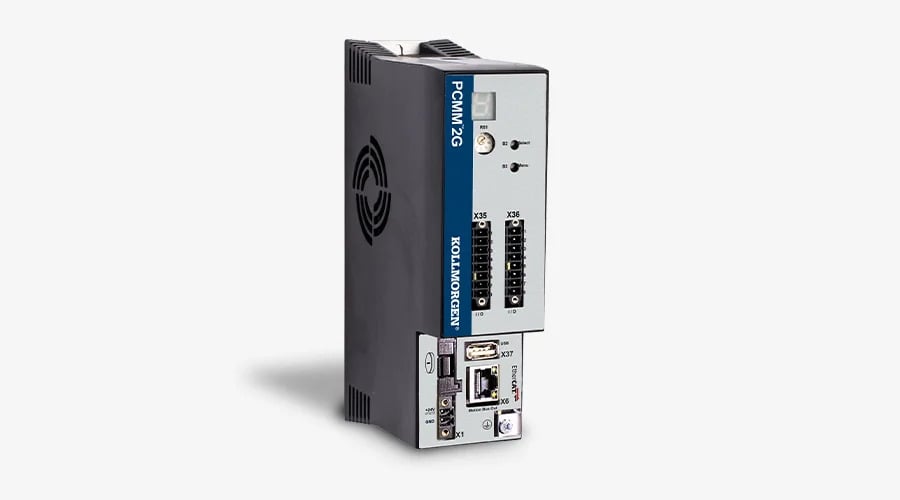
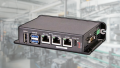
The new, next-generation PCMM2G motion controller from Kollmorgen. Image used courtesy of Kollmorgen
PCMM2G Programmable Motion Controller
Built on a platform similar to the PDMM or the PCMM motion controller, the PCMM2G programmable motion controller offers a more flexible platform with its ability to interface with most third-party automation systems. It has a 1.5 to 3.5 times faster fieldbus cycle rate than the previous generation of controllers. To make this quick cycle rate possible, the PCMM2G uses a 1.5 GHz quad-core processor. The faster processor also allows the PCMM2G to synchronize up to 64 axes, making the PCMM2G an excellent choice for small to complex motion systems.
The PCMM2G also features flexible communication, as it supports topologies such as UDP, HTTP, Modbus, Ethernet/IP, or ProfiNet. Along with multiple industrial protocol support, the PCMM2G can also support an external time-keeping server through a network time protocol (NTP). NTP is used in many servo synchronization applications to ensure all the axes and communication are received promptly. If it is not, then the system shuts down. The PCMM2G has 16 GB of internal flash memory for storing automation tasks and configurations, six digital inputs, two digital outputs, and internal safety modules.
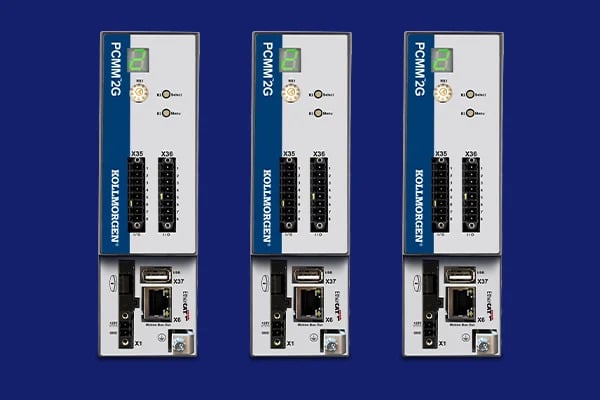
Integrating the PCMM2G with the Kollmorgen Automation Suite provides users with simple setup and operation. Image used courtesy of Kollmorgen
Kollmorgen Automation Suite
The PCMM2G can be configured through the Kollmorgen Automation Suite (KAS), an interactive software tool for configuration, integration, and tuning. KAS communicates with the drives over Ethernet infrastructure while a USB port is provided for backing up or restoring configuration files.
Programming motion within KAS can be done in two ways, either with PLCopen for motion standardized function blocks and a library of reusable and scalable code components or through Kollmorgen's Pipe Network which uses a graphical framework of pre-programmed and tested control blocks that are dragged into position. KAS also provides an interface for PLC programming of Kollmorgen automation controllers, supporting all the IEC 61131-3 programming languages, HMI development, and network setup tools.
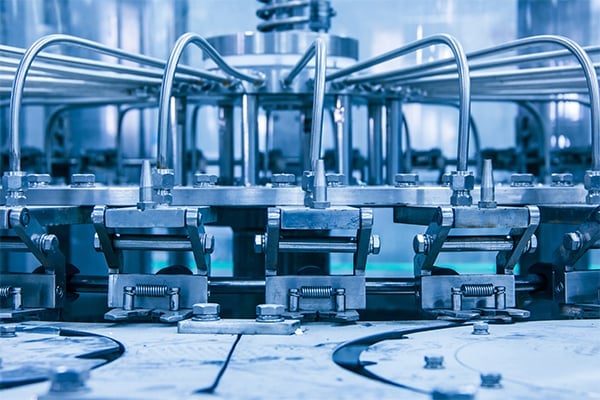
The PCMM2G is suitable for both small and large-scale applications. Image used courtesy of Kollmorgen
Servo Motor Control
A servo drive system is often quite simple; a PLC or controller will send the drive a position value with speed, acceleration, and deceleration values. When done, the drive will move the servo motor with these commanded values and report them back to the control system. Today, we are seeing more motion controllers than servo drives. A motion controller is capable of much more. Typically, the manufacturer will provide software where users can program in motion paths, or develop special synchronization programs. A motion controller can handle very complex motion applications, whereas a typical servo drive might not be able to handle them.