Facebook
 Google
 GitHub
 Linkedin
Lanner Electronics Releases Industrial PC Designed for Edge AI Applications
The EAI-I351 embedded AI platform is powered by NVIDIA Jetson Thor, offering real-time processing and control for industrial robots, AMRs, and smart factories.
Autonomous mobile robots (AMRs) are transport robots that move parts and raw materials around a factory without the need for barcode tape or predefined paths. The robots use sensors and vision systems to navigate around the factory floor, avoiding obstacles.
Recently, AI has been employed with AMRs to optimize routes between stops. These AI models, however, require some high-power computers. Lanner Electronics, a global supplier of industrial AI hardware, has designed an IPC specifically for AMRs that accommodates complex AI algorithms.
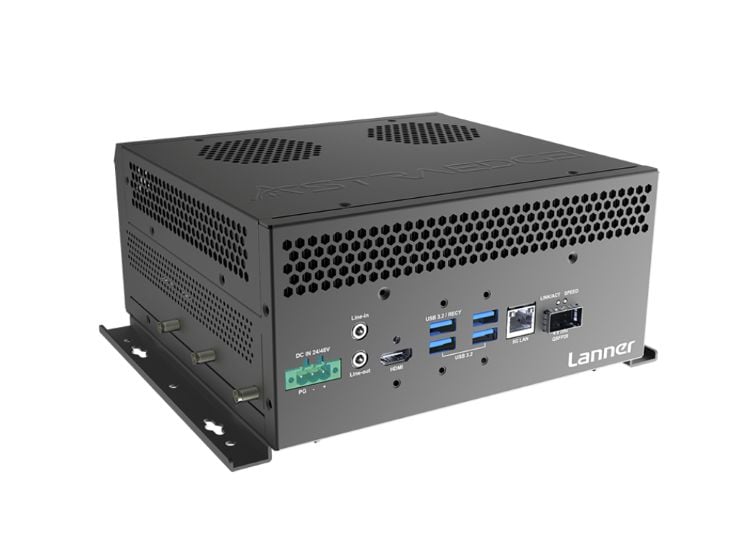
Lanner’s EAI-I351, built on the NVIDIA Jetson Thor system-on-module. Image used courtesy of Lanner Electronics
The EAI-I351 Industrial PC (IPC)
Powered by the latest NVIDIA Blackwell architecture, the EAI-I351 is a 14 or 12-core ARM Neoverse 64-bit IPC designed for use in industrial environments. Equipped with an NVIDIA Jetson T5000 or T4000, depending on the model, the EAI-I351 comes standard with memory sizes up to 128 GB, serial connections, four USB 3.2 ports, four digital I/O ports, eight GMSL2 deserializer ports (video in), and Wi-Fi.
These connections enable typical sensors and vision systems commonly found on an AMR, but the EAI-I351 doesn’t have to be used only on AMRs. With its powerful GPU, the EAI-I351 can be used for a wide variety of industrial AI applications.
The IPC is powered via 24 VDC or 48 VDC and has overall dimensions of 201 mm x 180 mm x 95 mm. Wall mounting of the EAI-I351 is the only option due to its size, and the internal fan needs to be considered when determining a mounting location.
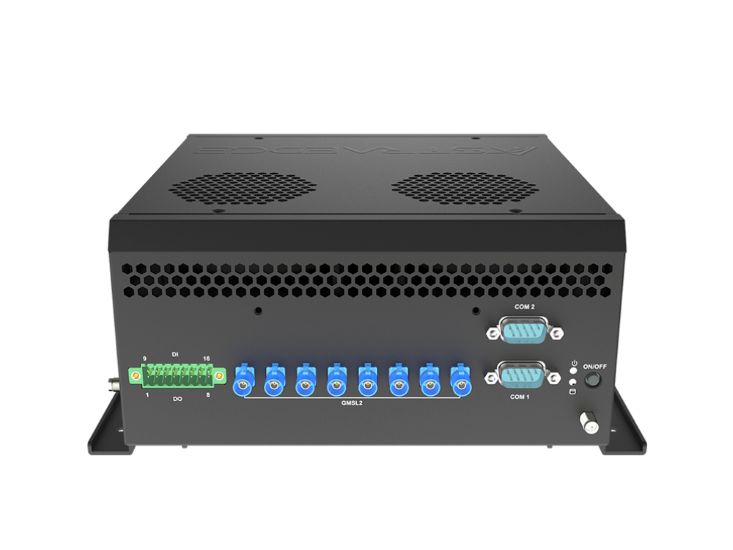
Back side of the EAI-I351 showing multiple vision and serial ports. Image used courtesy of Lanner Electronics
AI Route Optimization
Typically, robots follow predefined paths that are taught by users, but when a mobile robot needs to navigate its own environment and create its own path in real time, AI comes in handy. AI algorithms are used to help the robot make path and obstacle-avoiding decisions on the fly. The EAI-I351 uses NVIDIA’s AI software stack, including NVIDIA Isaac for robotics, to optimize robot paths and learn about the environment.
Vision Optimization
In order to avoid obstacles, AMRs rely heavily on vision systems. These systems require high-bandwidth and low-latency communications paths. To meet this need, the EAI-I351 has eight GMSL2 deserializers that are used for automotive cameras. These connections, coupled with NVIDIA Metropolis, an AI-powered vision processing application, give the AMR the capability to detect objects around its environment and make decisions before a collection happens.
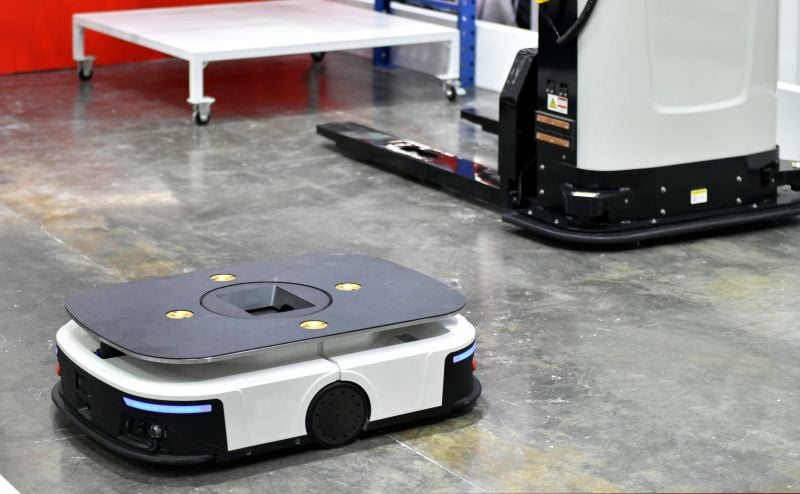
The EAI-I351 is well-suited for AMR applications in logistics. Image used courtesy of Adobe Stock
Advancing Mobile Robotics
AMRs are great tools to move products and raw materials around a factory or warehouse, but they do come with limitations: they require constant high-speed Wi-Fi to communicate back to the fleet management software, they often struggle with unstructured environments, and they frequently require significant operator training.
By incorporating an AI controller such as the EAI-I351 with an AMR, however, decisions can be made without constant communication, unstructured environments can be navigated with extensive AI vision systems, and less training would be required as the AI model would do most of the decision-making.
Related Content