Facebook
 Google
 GitHub
 Linkedin
MiR’s VDA 5050 Adaptor Enhances Robot Interoperability
MiR’s VDA 5050 software adaptor enables seamless communication between robots from different manufacturers, reducing data silos and optimizing automation.
Mobile Industrial Robots (MiR) has developed a software adaptor that enhances interoperability between robots from different manufacturers. The VDA 5050 allows users to more easily interconnect robots across platforms by using MQTT protocols to enable data to flow between robots. The MQTT protocol integrates with MiR’s RESTFUL robot interface using a newly-defined VDA messaging system.
Kevin Dumas, Vice President of Product at MiR, further explains the VDA 5050: “Our new VDA adaptor provides multi-vendor integration to offer smooth deployment and configuration, compliance with industry standards, and ongoing alignment with advancements and customer needs.”
Interoperability
There are plenty of stand-out names in the robotics industry. However, each one has their own methods of collecting and storing data, leading to data silos that are not accessible by other platforms. A human operator must often make sense of the data collected by each robot, sometimes in their own software program, making this a tedious process.
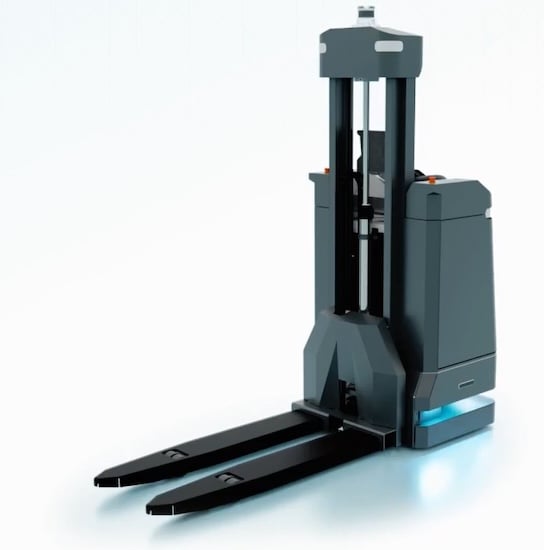
Ensuring this MiR1200 Pallet Jack does not collide or develop conflicting paths with a third-party robot is exactly why the VDA 5050 Adaptor was designed. Image used courtesy of MiR
Interoperability between systems would mean that messages could be sent between autonomous robots without the need for human intervention and interpretation of data. This could clear up the complexity and confusion around route mapping and optimization of materials handling in the automated manufacturing environment.
Development of the VDA 5050 Standard
The German Automotive Industry Association (VDA) and the VDMA Materials Handling and Intralogistics Association saw the challenge of interoperability between robotic systems. They teamed up to develop the VDA 5050 standard, which allows common communication between different systems. Now, autonomous mobile robots (AMRs) and other commonly used transport robots are marked as VDA 5050 compliant, meaning they use these standard communication protocols.
The VDA 5050 Adapator
The adaptor acts like an interpreter. It receives communications from the various systems and interprets them into the VDA 5050 standard. This allows for a seamless user experience and integrates all of the robots, regardless of manufacturer.
As a software adaptor, it can be updated and patched as the VDA 5050 standard evolves. This provides some future-proofing; the standard may change, but this will not make the robots or the adaptor obsolete.
One key advantage of using the VDA 5050 adaptor is that the proper robot can be chosen for the task. Without interoperability, a robot may be a good choice for a specific task, but communication issues may limit the choices.
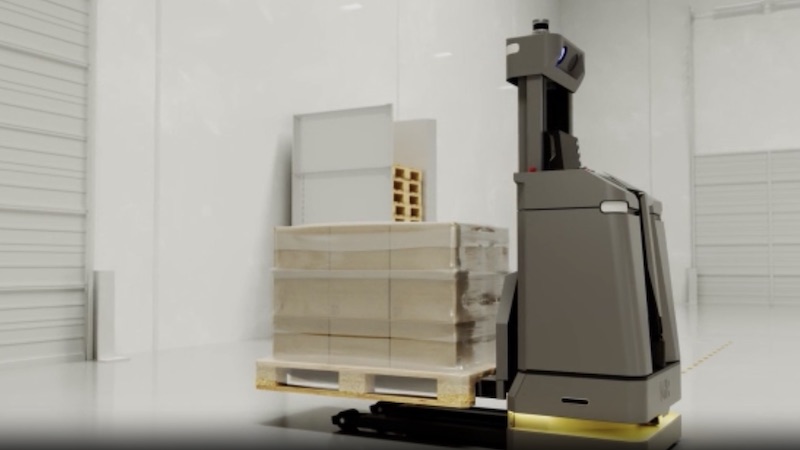
The VDA5050 adaptor enables communication between AMRs from different manufacturers. Image used courtesy of MiR
Applications
MiR expects the biggest application case for the VDA 5050 is in facilities that use multiple autonomous mobile robots (AMRs) from different manufacturers. This is a common occurrence; flat, small package-carrying AMRs may come from one manufacturer, while fork and lift trucks come from another. If these AMRs all share the same floor space but have different communication protocols, collisions, full stops, and other such issues are more likely to occur. By deploying the VDA 5050 software adaptor, all of these robots can communicate together, all viewable from the RESTFUL interface.