Facebook
 Google
 GitHub
 Linkedin
Neugart Broadens Drive Portfolio With Software and Motion Systems
New software, pro-series precision gearboxes, and integrated linear motion solutions highlight Neugart’s push toward more dynamic, efficient drive systems.
Neugart is expanding its drive technology portfolio with a coordinated mix of new software, precision gearboxes, cost-focused robotics gear solutions, and integrated rack-and-pinion systems. The latest releases reflect a broader shift in automation toward application-specific performance, higher dynamics, and improved efficiency without increasing system cost. Together, the updates aim to help machine builders size drives more accurately, boost motion performance, and simplify integration across a wide range of industrial applications.
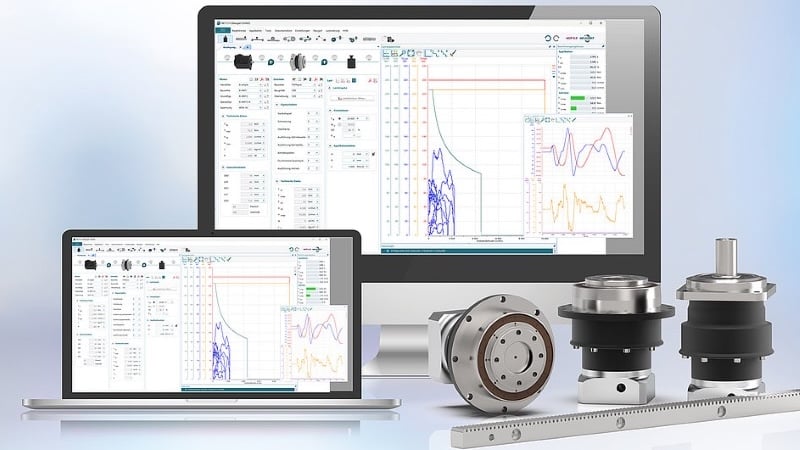
Neugart’s NCP 5.0 sizing software works with precision gearboxes and rack-and-pinion components used for system-level drive design. Image used courtesy of Neugart
NCP 5.0: Sizing Software Closer to Real-World Operation
At the software level, Neugart has introduced version 5.0 of its Neugart Calculation Program (NCP), a free sizing tool designed to simplify gearbox and motor selection. The latest version focuses more on real-world operating conditions, enabling more precise gearbox dimensioning and improved utilization of the upper performance limits. It allows designers to select smaller gearbox sizes while maintaining performance. This feature may lead to potential cost and space savings. NCP 5.0 also introduces characteristic maps that visualize gearbox utilization, giving users clear insight into how closely a selected solution matches the application profile.
Usability has been further refined with new tools for determining positioning accuracy and lead or pitch, as well as an optimized gearbox filter. With these additions, NCP continues to serve as a foundation for complete drive train design, allowing users to configure gearbox-motor combinations in minutes based on application data.
Pro Series Precision Gearboxes for Highly Dynamic Applications
On the hardware side, Neugart is expanding its precision gearbox lineup with a new performance class above its existing offerings. The newly introduced PSNpro, PSFNpro, and PSBNpro series feature new gear technologies and materials. These design changes intend to improve load distribution and dynamic capability. Optimized tooth flank quality also reduces point load peaks. One of the most significant gains comes in cycle torque, which has increased substantially compared to previous precision gearbox generations. This increase in cycle torque allows the pro series to rival—and in some cases exceed—the performance of spur gearboxes in applications with frequent load and direction changes.
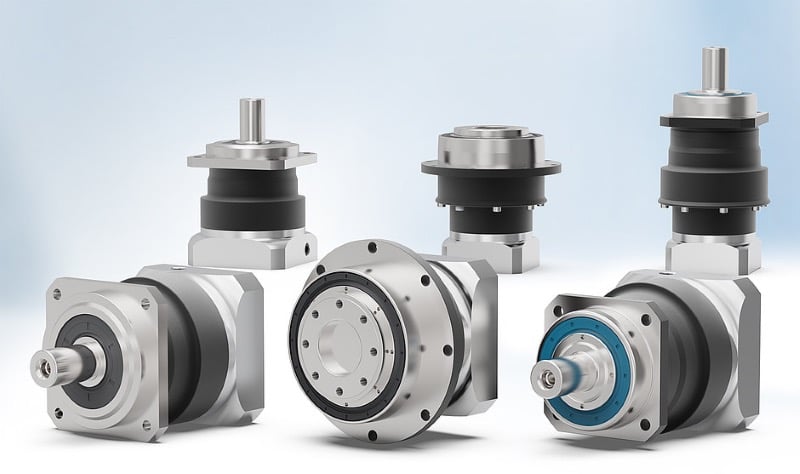
Precision gearboxes from Neugart’s portfolio, including high-performance and application-specific models for dynamic automation tasks. Image used courtesy of Neugart
The pro gearboxes use helical gearing to achieve low transmission fluctuation between input and output, resulting in smooth motion and high synchronization accuracy throughout rotation. The smoother motion can visibly improve process quality in applications such as woodworking machines, where chatter marks are a concern, while also reducing operating noise under high loads.
Another development focus was reducing mass inertia, particularly in smaller frame sizes. By consistently applying the modular principle, the input stage has been made smaller than the output stage, reducing the rotating mass. The result is faster acceleration and braking, along with improved control quality for highly dynamic axes.
NDFC Series: Cost-Effective Gearboxes for Delta Robots
Complementing the high-performance pro series, Neugart is also expanding its delta robot portfolio with the NDFC gearbox series. Positioned below the NDF series, the NDFC focuses on overall cost-effectiveness while retaining features critical to reliable, high-speed pick-and-place operation.
The series is available in three frame sizes, with multiple ratios and selectable torsional backlash ranging from 1 to 5 arcminutes. This new series features include helical gearing, preloaded angular contact roller bearings, a coaxial layout, and a dynamic drive system. A cage-designed planet carrier and optimized radial shaft sealing contribute to durability and positioning accuracy. Options include food-grade lubrication compliant with NSF H1 and ISO 21469 standards for environments with higher hygiene or corrosion-resistance requirements. In addition, there are nickel-plated output flanges and stainless steel output shaft options.
Integrated Rack-and-Pinion Solutions for Linear Motion
Rounding out the portfolio expansion, Neugart has introduced a new integrated gearbox pinion rack solution to simplify rack-and-pinion drive design while maximizing precision and efficiency.
The system combines matched gearboxes, preassembled pinions, and hardened steel racks into a coordinated solution from a single source. The induction-hardened and tempered racks are available with straight or helical gearing, covering module sizes from 1.5 to 5 mm and meeting quality level 6 requirements. Heat treatment and grinding deliver high surface quality for durability and process reliability, with standard rack lengths of 1000 mm and 2000 mm, as well as customer-specific designs.
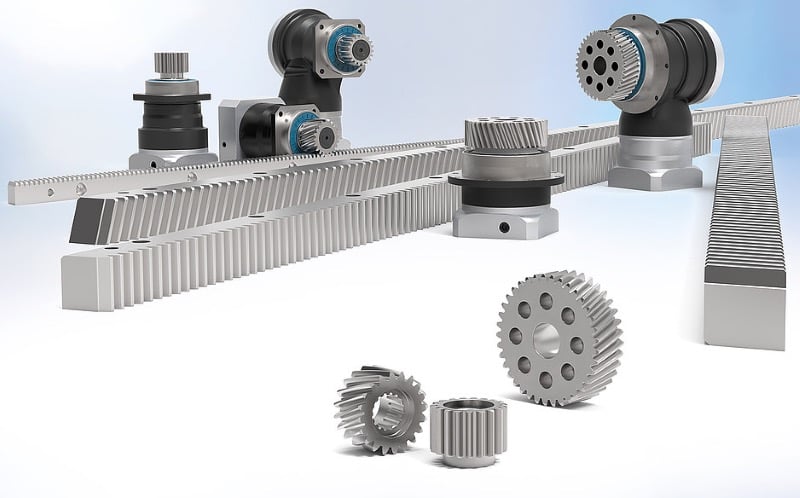
Integrated gearbox–pinion–rack components designed for high feed force, precise positioning, and flexible linear motion systems. Image used courtesy of Neugart
The system can be configured with coaxial or right-angle gearboxes from Neugart’s Precision or Economy Line, depending on application requirements. Robust output shaft bearings withstand high radial and axial loads during dynamic operation, ensuring smooth motion, high feed force, and long service life. Typical applications include portal milling machines, robot linear axes, and flatbed laser systems, where precise positioning and high-speed motion are required over extended travel lengths.
A Broader View of the Portfolio
Neugart’s latest developments address multiple layers of modern drive system design. Rather than focusing on individual components in isolation, the portfolio emphasizes coordination. For machine builders and automation engineers, that approach offers greater flexibility in matching drive solutions to real operating conditions, whether the priority is maximum dynamic performance, cost efficiency, or simplified system design.