Facebook
 Google
 GitHub
 Linkedin
Omron’s Edge Device Simplifies Data Collection, Connects Legacy Devices
Omron has built its DX100 Data Flow Edge device to bridge OT data collection and IT communications. The device connects to existing equipment and features a low-code environment for fast deployment.
In any factory, OT operations create products that are sold for a profit, while IT operations maintain the technology stack that keeps the company running. The two operations are getting closer as management wants process and machine data to be accessible. An edge device resides on the factory floor and provides a gateway between the I/O devices and the IT infrastructure.
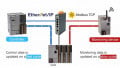
Recently, Omron Automation released the DX100, a data flow edge device that is capable of connecting directly to I/O devices and PLCs over industrial protocols like Ethernet/IP, and IT devices for the purpose of collecting, transferring, and displaying data.
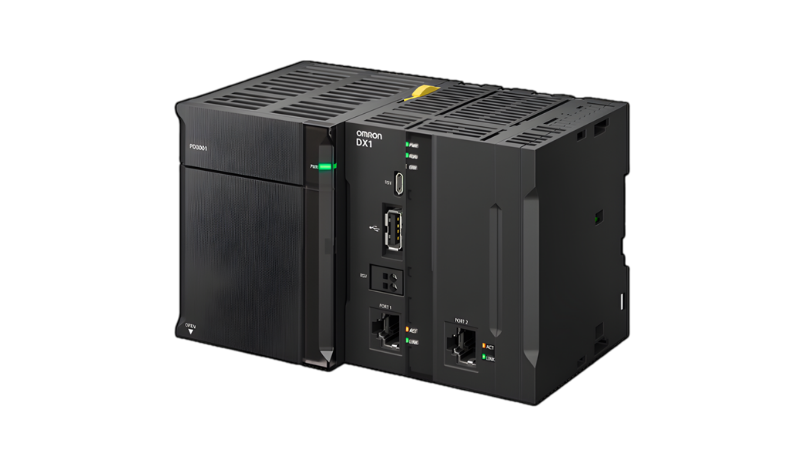
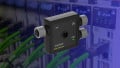
Omron’s DX100 Data Flow Edge device connects to PLCs, sensors, and other types of automation equipment. Image used courtesy of Omron Automation
DX100 Data Flow Edge Device
At first glance, the DX100 looks like another Omron PLC, but look closer, and you will find that the DX100 is a purpose-built device that can store, communicate, and display data from automation equipment from around the factory floor. The edge device has two isolated Ethernet ports, a USB port for flash memory storage, and 64 GB of onboard memory. The unit is mounted on a DIN rail and is powered by an NJ-PD3001-DC power supply.
The DX100 was designed to be installed in existing plants that do not have the capabilities of collecting process data on their equipment. The DX100 can connect to existing PLCs and extract process data without modifying existing machine code. Once the data is collected in the DX100, it can be viewed via the onboard web server or pushed to existing IT infrastructure or even cloud services.
The DX100’s flow editor features an intuitive drag-and-drop interface for low-code programming. Video used courtesy of Omron Automation
Low-Code Programming
The DX100 uses Omron Synapse with SpeedBee flowchart logic. This low-code programming interface uses drag-and-drop function blocks in a flow chart fashion, enabling designers and programmers to collect data from other PLCs or I/O devices on the network and make custom dashboards with it.
With the SpeedBee using a flow chart style of programming, the custom logic can quickly be created with less time debugging and learning frameworks and other programming languages.
Open Protocols and Cloud Services
When you want to push your data to larger storage systems, you can interface directly with SQL servers or use MQTT to publish data to a cloud repository. Being able to connect directly with these technologies saves money on IT servers and facilitates cloud-based data storage. The DX100 can also subscribe to MQTT servers to collect data from multiple systems around the factory.
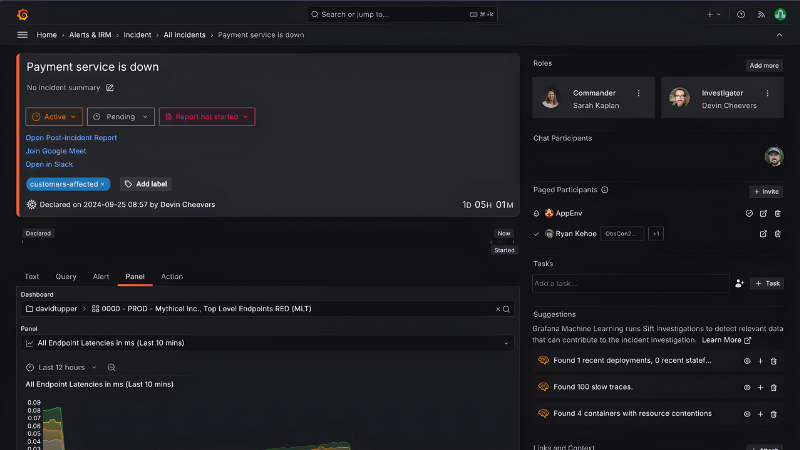
A snapshot of a sample dashboard from Grafana. Image used courtesy of Grafana
Visualizing the Data
Stored data can be hard to understand without visualizing it. The DX100 comes pre-built with Grafana, a tool for creating vibrant dashboards without requiring data to be stored in any particular way. Pre-built charts can be arranged in panels and connected to data sources. Once you have the dashboard customized, it can be hosted on the DX100 and accessed via the unit's IP address in a standard web browser.
Collecting Data on Brown Field Equipment
Any manufacturing equipment generates data that tells the manufacturing engineer how the machine performed on any given day. This data also shows the quality engineer how much scrap was made over a shift and whether the parts produced were near the end of a tolerance. If this data is not collected, it is lost forever. If it is collected, it can be searched and analysed for quality anomalies or predictive maintenance. The DX100 gives the power of data collection to all factories, big, small, and even old.