Facebook
 Google
 GitHub
 Linkedin
OnRobot’s VGP30 Vacuum Gripper, Designed for Heavy Payloads
OnRobot has designed its newest pneumatic vacuum gripper, the VGP30, to lift high payloads of up to 30 kg. The gripper can also handle porous surfaces, oddly-shaped objects, and thin cardboard.
OnRobot has launched the VGP30, a vacuum gripper capable of lifting high payloads up to 30 kg. It has been designed to grip not only heavy payloads but also irregular surfaces, porous materials, and other challenging items. With advanced controls for energy savings and less than a day of deployment time, OnRobot has designed the VGP30 to make material handling operations simpler and more efficient.
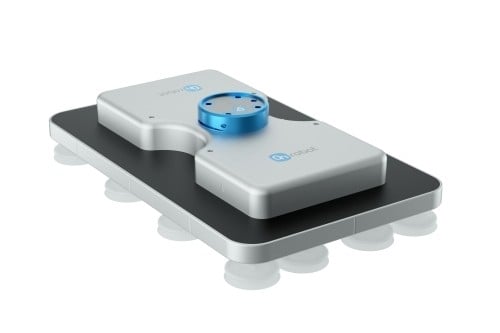
The OnRobot VGP30 can lift payloads up to 30 kg. Image used courtesy of OnRobot
Pneumatic Vacuum Grippers
Vacuum grippers are commonly used in the picking, packing, and palletizing/depalletizing stages of manufacturing processes. Instead of gripping hands or fingers, soft suction cups are used to move items that are fragile or soft. A good vacuum gripper can conform to the item's surface, maintain a strong vacuum (and thus provide plenty of grip), and be reusable many times over.
For the most part, manipulation robots that can use gripper hands can also be fitted for vacuum grippers. The trick is to ensure that there will be places to run and protect the vacuum lines from pinching and cutting. Once the robot has been fitted with the vacuum lines and gripper, the vacuum is applied to the suction cup, flattening it slightly and gripping the object. The vacuum is then removed to release the object.
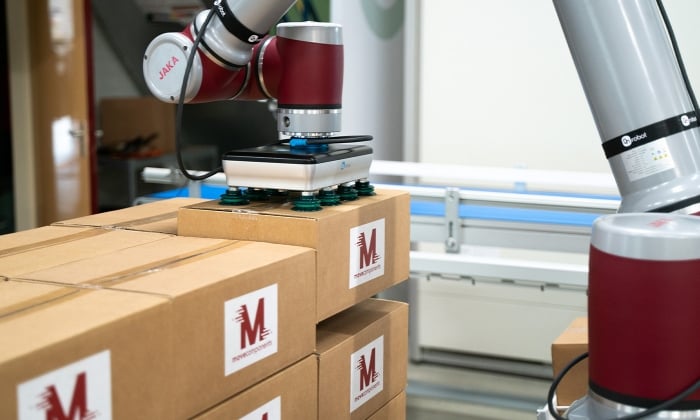
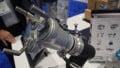
Pneumatic vacuum grippers utilize suction cups and vacuum power to lift objects. Image used courtesy of OnRobot
Vacuum Gripper Challenges
Vacuum grippers are limited in their lifting capacity. The lifting capacity depends on the strength of the vacuum, the quality of the seal the suction cup forms with the surface of the item, and the durability of the suction cup itself.
Not all materials are suitable for vacuum gripping. Porous surfaces are difficult to pick up, as it is hard to draw a vacuum on them. The same is true for irregular surfaces—surfaces that are not perfectly flat will lose vacuum as air seeps in through the poor sealing between the gripper and surface.
As a suction cup wears, it may require more energy to pull a vacuum. Without proper monitoring, a failing vacuum gripper can quickly become an energy hog. Furthermore, it can lead to more dropped items, causing damage and increasing the potential for injury.
The VGP30 Vacuum Gripper
The VGP30 pneumatic vacuum gripper addresses some of these issues. First, its ability to lift such a heavy payload is an unusual feature for vacuum grippers. In order to safely and securely grip items that are heavy, the grip is integrated into a complex control system that manages energy usage. This system applies only the correct amount of vacuum for the item and alerts the operator if there is a problem pulling a vacuum on a particular item. This high-level control allows the gripper to handle difficult items, such as porous surfaces or "minimal material" cardboard, that are not very stiff and can sag if moved with weaker vacuum grippers.
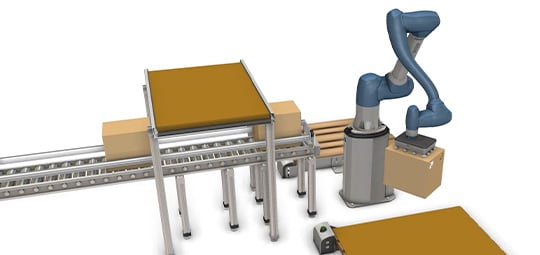
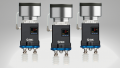
The VGP30 gripper can be used with OnRobot’s D:Ploy for reduced deployment time. Image used courtesy of OnRobot
In general, vacuum systems are labor-intensive to install. Another set of key features of the OnRobot VGP30 is the quick deployment time and ease of integration with existing hardware. The VGP30 is ready to deploy from the box and integrates with many popular robot manipulator models. The gripper is designed to be used in conjunction with OnRobot's D:Ploy platform.
Palletizing and Material Handling
Ultimately, the OnRobot VGP30 will see use in handling cardboard boxes during palletization and depalletization operations. As companies try to reduce the amount of packaging during shipping, thinner cardboard has become more common, and thin materials are hard to move with a traditional vacuum gripper. Furthermore, with an aging workforce, the ability to move goods with a robotic vacuum gripper saves workers from ergonomics and repetitive motion injuries that stem from moving boxes.
Related Content