Facebook
 Google
 GitHub
 Linkedin
Parker Gen IV DFplus Hydraulic Valves Use New Chipset for Data Processing
Generation IV voice coil drives with proportional control, improved data handling, and LED status indicator are now available from Parker.
Parker has released the newest upgrade to their DFplus valve series. The Generation IV valves are a significant upgrade over the previous generation of valves, with the addition of a new chipset that can provide relevant process data, even when the valve is not fully powered. The latest models also have a multi-colored status LED visible from all directions to aid troubleshooting.
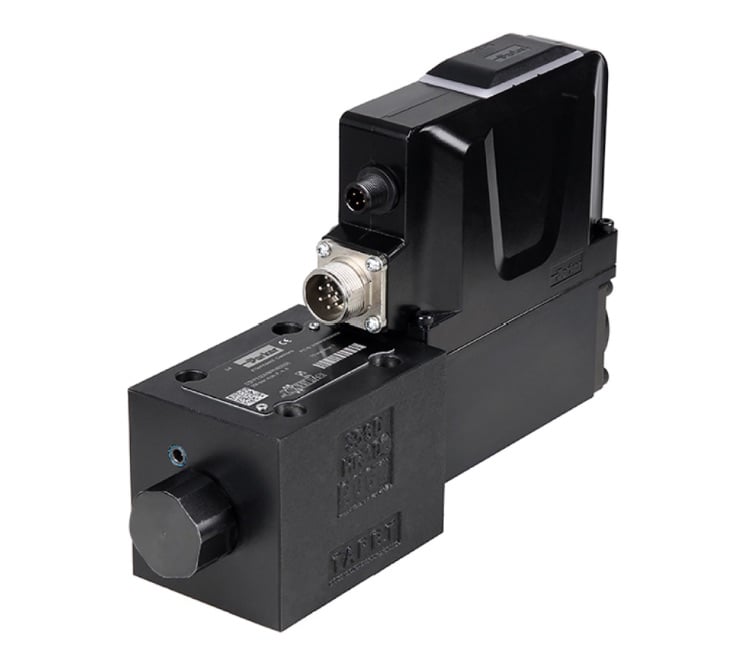
Parker’s new DFplus Gen IV proportional valve. Image used courtesy of Parker
New Features
The newest chipset features an integrated near-field communication (NFC) chip. The NFC chip is designed to transmit data to nearby technicians and engineers, even if there is a problem supplying power to the valve. Many similar valves will lose data if unpowered and cannot transmit it without power, giving the Gen IV version an advantage over previous generations of valves.
Furthermore, the addition of a multicolor status LED saves time troubleshooting as well. The LED pulses' color and frequency can tell maintenance technicians where to start their problem-solving efforts. Visible from 360 degrees, the LED acts as a beacon for quick evaluation of operation at a glance.
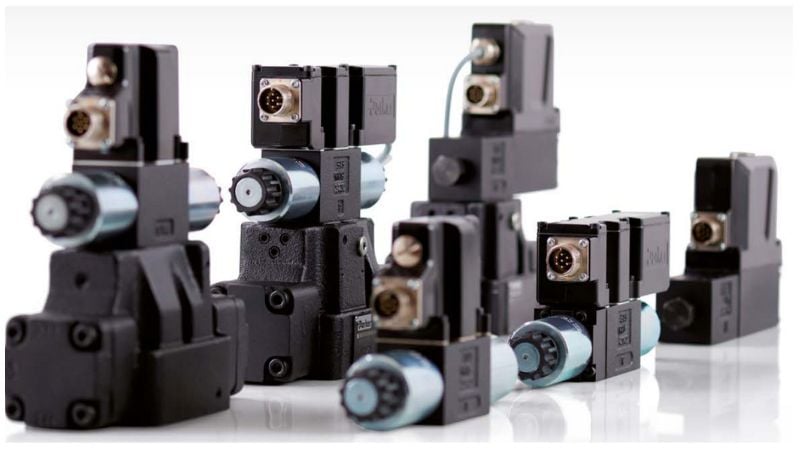
The new fourth-generation valves offer superior performance and reliability and come in a variety of configurations. Image used courtesy of Parker
Interfacing is performed over Parker’s ProPxD software, which has also been upgraded for better oscilloscope function. This helps engineers change parameters more quickly and predictably than previous versions.
The fourth-generation valve did not lose any features from previous generations, either. It can still communicate over EtherCAT to PLCs and other devices. It is still as rugged as ever before, with up to 10 billion cycles without failure and withstanding up to 60 g in mechanical shock.
Voice Coil Drive
At first glance, a “voice coil drive” sounds like something from science fiction, where an operator talks to a valve, and it opens or closes on voice command. While such technology does exist, it has limited practicality. Instead, “voice coil drives” get their name from speakers.
The cone of a speaker is driven in a linear direction based on the frequency of the signal that is applied to its coil. As the coil energies, it creates a magnetic field and pushes the magnet at the speaker's base to move in response to the frequency. A voice coil drive works similarly; a signal is applied to a coil, which drives a linear actuator, such as a valve stem, in response to the signal's frequency.
Voice coil drives do not require strong return springs. Return springs can resonate at certain frequencies and often fail due to fatigue under repeated loadings. Without these, the voice coil drives are good for 10 billion cycles.
Advantages of Proportional Control
Proportional (P) control has some primary advantages over Proportional Integral (PI) or Proportional, Integral, and Derivative (PID) control. P control is simpler and has fewer variables to tune. This is a key feature in some systems, as too many “knobs” to turn means it is extremely difficult to get the desired results, especially for technicians who are inexperienced or do not have the background for such adjustments. Furthermore, the P control can respond much more quickly to system changes.
Applications
These fourth-generation valves can act as a 1:1 replacement for the older generation III valves. Valves are quickly installed and integrated with existing control hardware and software systems, though with enhanced capabilities over the generation III valves.