Facebook
 Google
 GitHub
 Linkedin
Pilz Releases IO-Link Safety Master for Modular and Decentralized Automation
The IO-Link safety master PDP67 is part of Pilz’s larger IO-Link safety system. The master functions as a decentralized interface to the safety control system, enabling simple and scalable automation.
Pilz has expanded its IO-Link safety system with a new safety master designed to be scalable and reduce wiring and troubleshooting time. The new IO-Link safety master PDP67 functions as a decentralized interface to a higher-level controller. It is capable of bidirectional communication and is built to withstand harsh conditions in manufacturing and industrial facilities. Each PDP67 is certified up to Safety Level PLe/SIL 3.
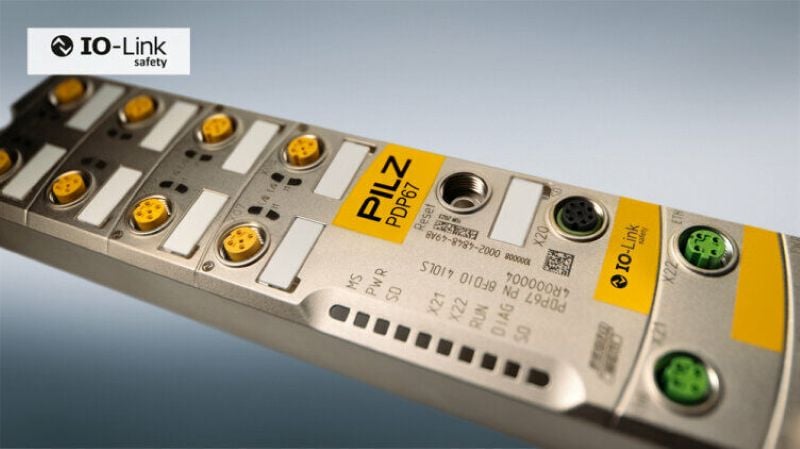
Pilz’s new IO-Link safety master PDP67 includes four IO-Link safety ports and four configurable safe digital input or output ports. Image used courtesy of Pilz
Why Use a Decentralized Safety Architecture?
Decentralization allows for much easier scale-up and modularization of hardware and systems. Instead of sending every signal back to a central control room or server, local or machine-level issues are addressed at the machine. This means significantly fewer wires running through the plant, and the ability to add, subtract, or reconfigure existing hardware with a much quicker commissioning time.
By separating safety hardware into its own system, safety signals, such as those from emergency stop buttons, interlocks, light curtains, and others, are not mixed in with regular data acquisition and control. The safety hardware can stop machinery and send status messages, but it is not contributing to the rat's nest of wiring. This makes it easy to separate out safety problems from other process excursions.
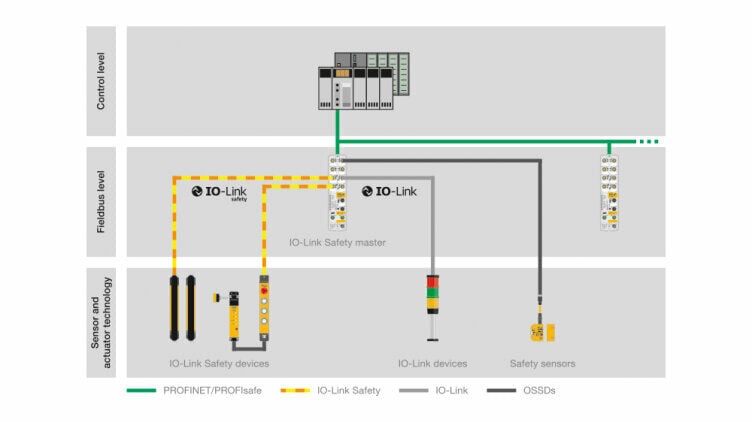
The new IO-Link safety master PDP67 is part of Pilz’s larger IO-Link safety system, connecting sensors, actuators, and other field devices. Image used courtesy of Pilz
IO-Link Safety Master PDP67
The IO-Link safety master PDP67 was designed with heavy industry in mind. It features a ruggedized package, capable of either IP67 or IP69 protection, meaning it can be used in dusty, dirty, and humid environments. Pilz also points out that the system is capable of being used up to 5,000 m above sea level and can withstand temperature extremes of -30 ℃ to 70 ℃, making it versatile enough for refineries, food and beverage processing industries, and other such challenging environments. These can be used outdoors, which is often where safety incidents occur, and where other such systems fail.
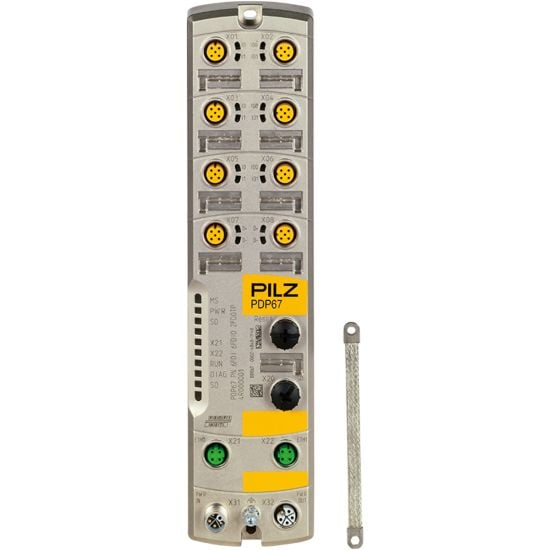
Pilz’s IO-Link safety master PDP67 can be programmed and configured with a built-in web-based server. Image used courtesy of Pilz
The system uses M12 connectors, making it easy to integrate with existing control hardware. These standard connectors make it possible to "plug and play" with many third-party sensors and actuators. The bidirectional communication capability allows sensors and actuators to be connected through the same ports, simplifying wiring and troubleshooting headaches. Failsafe signals, standard safety signals, even legacy or classic safety sensors with OSSD outputs can be routed through this system. In total, there are four Class A safety ports and four additional ports, each with two safe, digital inputs and outputs.
Access to the IO-Link safety master PDP67 is granted through a web server. The web server is used for programming, configuring, and commissioning the entire safety system. Ultimately, downtime and commissioning time are reduced thanks to this decentralized safety system.
Modular and Decentralized Safety
Any machine builder or automation engineer should consider whether a decentralized safety architecture will benefit their system. In many cases, it will simplify wiring and provide a way to make systems more modular, meaning scale-up is much quicker. Virtually any industry will benefit from enhanced safety and scalability.