Facebook
 Google
 GitHub
 Linkedin
SICK Launches SIG300 IO-Link Master With Logic Tools
Sensing leader SICK releases the SIG300 IO-Link master with eight ports, EtherCAT support, local logic processing, and high-output power for flexible, decentralized automation.
Collecting data and driving actuators is the lowest level of control on the plant floor, but nevertheless, there is no way that industry can thrive without such effective I/O control. Sensor industry giant SICK has introduced the latest device intended to bring more capability to IO-Link control: the SIG300.
This sensor integration gateway (SIG) device is an 8-port IO-Link master that expands the feature set from previous generations. The SIG300 boasts three different fieldbus protocol versions for easier system integration, the ports are designed to allow higher power output for larger devices, and a newly redesigned web server interface provides a seamless user experience for initial configuration.
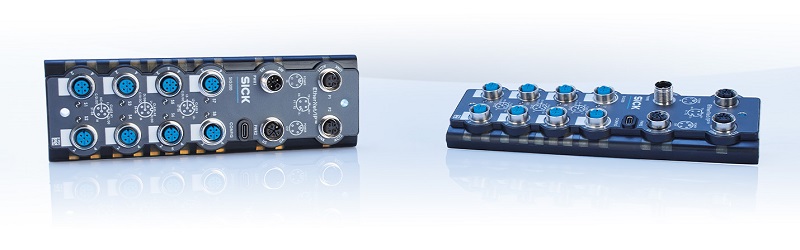
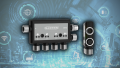
The new SICK SIG300 IO-Link master.
EtherCAT Fieldbus Variant
The new SIG300 portfolio is built on the success of the SIG200, but with a number of notable enhancements. The ability to link to increasingly popular EtherCAT networks was a top design priority, giving the new device a firm foothold in all popular network configurations.
The SIG300 family is also available for Ethernet/IP and PROFINET networks. In addition to the fieldbus (PLC network) support, several common IIoT protocols also provide immediate, secure data links to edge and cloud networks for longer-term data storage and analytics. RESTful API, MQTT, and (coming soon) OPC UA are factored into every product variant in the family, regardless of fieldbus selection.
More Ports with More Power
The SIG300 contains eight multi-purpose ports. By default, they are all enabled for IO-Link data handling, but they can be individually configured for DI or DO. Like many IO-Link masters, pins 2 and 4 are designated for separate signals, which can be individually configured within each single port. This effectively raises the capability to sixteen digital signals, although splitter cables would be necessary in such cases.
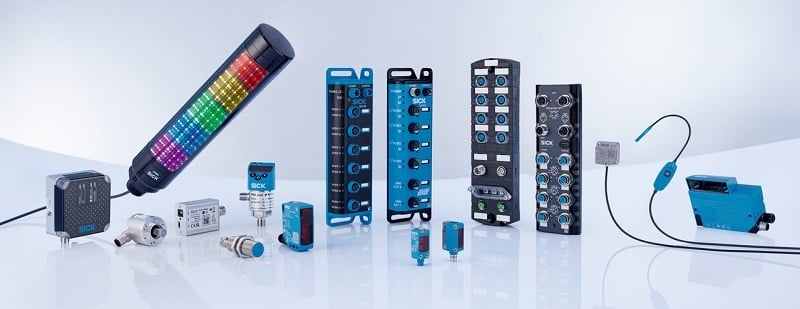
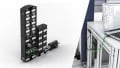
SICK’s IO-Link device portfolio creates an entire field-level network.
To further set this device apart from predecessors, two of the ports are available with IO-Link Class B outputs, providing a total of up to 4 amps of device supply current through two galvanically isolated power supply pins. The remaining Class A ports can support up to 2 A. When configured as discrete digital outputs, each signal pin can supply 200 mA directly to load devices.
SOPASair: The Power of Decentralization
Device configuration is accomplished over a web server with a dedicated USB-C connection, removing the need for PLC connection or extra installed PC software for startup. Not only can the ports and connection addresses be assigned, but IODD (IO-Link device description) files can be loaded to the SIG300 for simple device replacement.
A separate tab in the SPOASair web server software allows logic to be calculated and performed right on the device, saving processing time and extra programming on the part of the PLC.
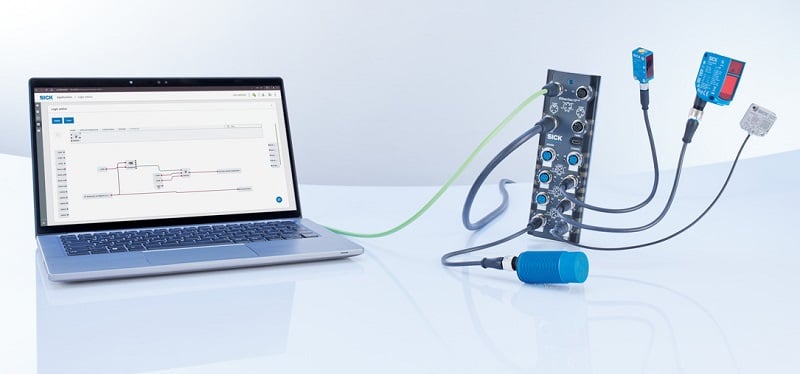
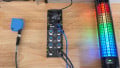
Simple I/O logic can be performed right on the device.
Control.com’s engineering team was fortunate enough to have a sneak preview of the SIG300 and found that simple tasks, like monitoring level height with a sensor and stack light, can be applied and implemented in mere minutes with no involvement of the PLC system.
IO-Link for Modular Machine Automation
As we have seen for years, modularity is a key to making machines operate into the future amid an unpredictable landscape. Changing functions, adding workcells, and upgrading individual elements are an inherent part of manufacturing, and devices like SICK’s new SIG300 IO-Link master play a pivotal role in decentralizing some of the control, while still providing the capabilities that we expect from brand-new, cutting-edge automation.
All images used courtesy of SICK