Facebook
 Google
 GitHub
 Linkedin
Wenglor Expands IO-Link System Solutions With Latest Devices
Wenglor has added IO-Link masters, IO-Link hubs, and IO-Link converters to its portfolio of IO-Link solutions, enabling fast, bidirectional communication between control systems and devices.
Many companies are seeing the advantages of using the popular IO-Link protocol for their field I/O components. The protocol allows for diagnostics and the connections of multiple devices on one network node. Recently, Wenglor Sensoric Group announced the expansion of its product portfolio to include new IO-Link masters, hubs, and converters.
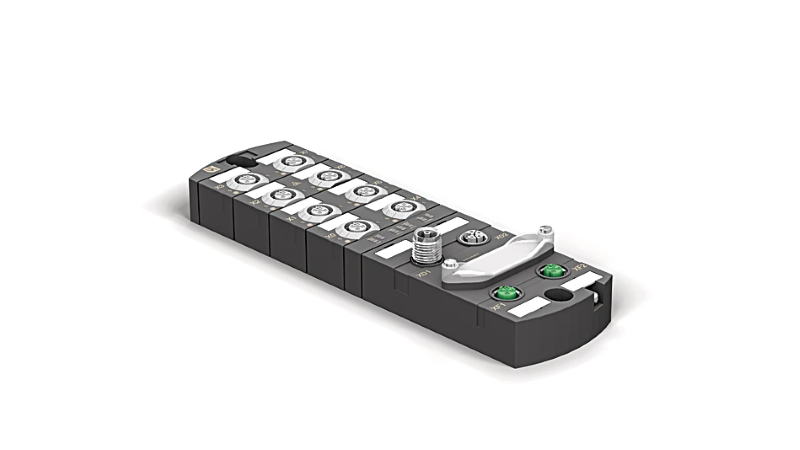
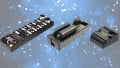
Wenglor’s new IO-Link masters are available to connect I/O Link devices with EtherNet/IP, PROFINET, or EtherCAT. Image used courtesy of Wenglor
IO-Link Masters
The new IO-Link masters from Wenglor support three popular industrial protocols, including Ethernet/IP, PROFINET, and EtherCAT. Each master includes eight ports, which can be configured as digital I/O ports or IO-Link ports. The outputs have a max switching current of 2 A, and the unit operates on 18-30 V DC. All the connections use industry-standard M12 5-pin connections. An integrated web server facilitates configuration as well as status updates from the device. Each master can also communicate over MQTT, OPC UA, or REST API.
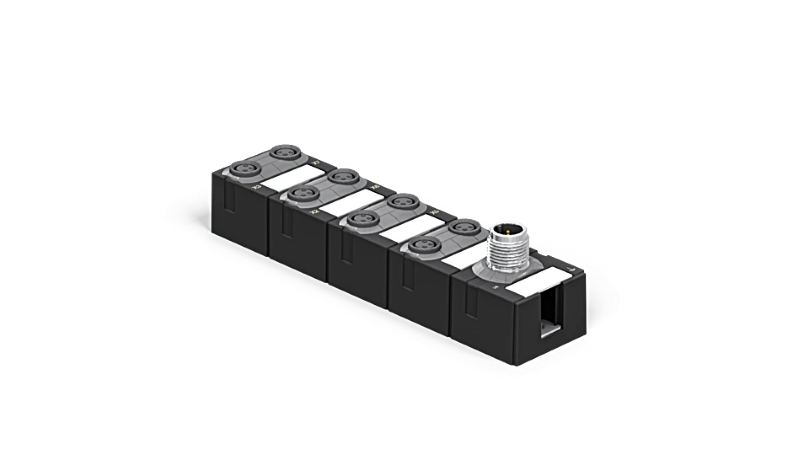
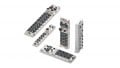
Wenglor’s new IO-Link hubs are available in a compact version for tight-fitting applications. Image used courtesy of Wenglor
IO-Link Hubs
With IO-Link, each port can be used for a variety of functions, but sometimes, all you need is more digital inputs and outputs. The new IO-Link hubs from Wenglor do just that by providing up to 16 digital inputs or outputs on a single IO-Link port. The new hubs come in two models. Both have eight ports that can be configured as inputs or outputs, the difference being the size of the ports. The EP8H001 uses M12 ports, while the EP8H002 uses M8 ports. The smaller ports offer a compact overall size for tight-fitting locations. Each port of either model has a maximum current rating of 4 A and an operating voltage of 18-30 V DC. Sensors can receive supply voltage through each port with a max rating of 2 A. One communication port is used to connect the hub to an IO-Link master.
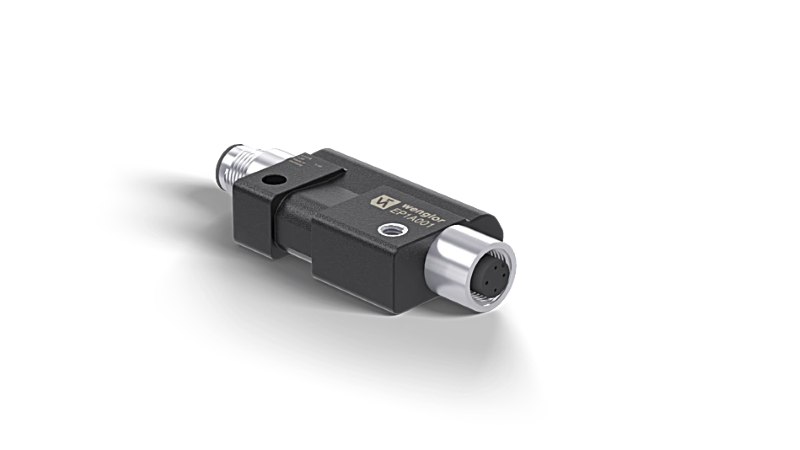
Wenglor’s new IO-Link converters convert analog signals into digital IO-Link signals. Image used courtesy of Wenglor
IO-Link Converters
Not all devices, such as analog devices, can be connected to an IO-Link master. These sensors will typically output a voltage or current signal that would need to be converted to a digital signal before being connected to the IO-Link master. The new IO-Link converters from Wenglor do just that. The converters take analog signals, either current or voltage, and transform the signal into a digital signal for the IO-Link master. This little device allows designers to use existing fieldbus connection technology for analog devices, which would otherwise require analog input panel I/O devices installed in the field. One end of the converter plugs directly into an empty IO-Link port, while the other end accepts an M12 connector that can be wired to your analog device.
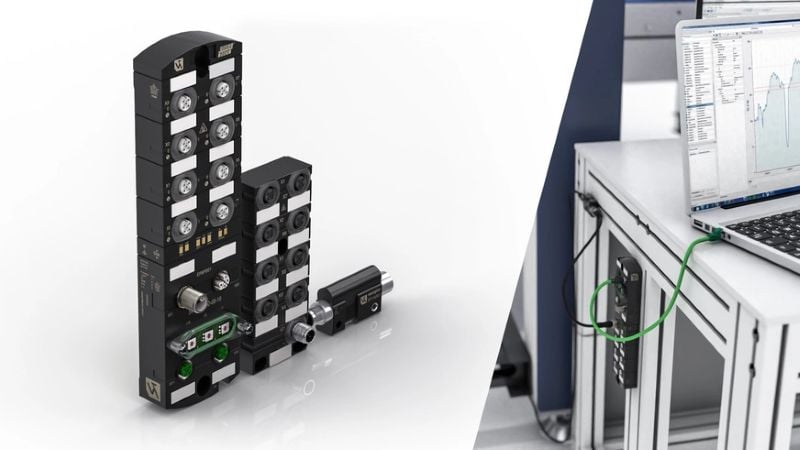
Wenglor’s newest IO-Link solutions enable bidirectional communication between control systems and field devices. Image used courtesy of Wenglor
IO-Link Topology
Staying competitive in an ever-changing industry is difficult, but Wenglor is making the right decision with the release of IO-Link devices. IO-Link devices allow electrical designers to combine multiple field devices onto one node and enable controls designers to manipulate, diagnose, and view the status of the devices over an Ethernet network.
For an IO-Link device to communicate on the industrial network, there needs to be an IO-Link master. All of the devices connect to the master, and the master converts the IO-Link digital signals to industrial protocols such as EtherNet/IP, PROFINET, or EtherCAT. These protocols are commonly used by PLCs or other control systems. This topology creates a powerful network of devices with the power of diagnostic data and parameterization at the control system.
Related Content