 Facebook
 Google
 GitHub
 Linkedin
Robotiq Debuts AI-Driven Robot Gripper With Tactile Sensing
The 2FC physical AI gripper combines tactile sensors with embedded AI to detect slip, estimate pose, and handle various parts in machine tending, pick and place, and assembly.
Robots that collaborate alongside human workers are frequently used in dynamic environments. Because they are regularly deployed and redeployed to different tasks, having a gripper that can adapt to various objects without a tooling changeover is key.
Robotiq specializes in dynamic grippers capable of parallel and encompassing gripping. Recently, the company added AI functionality and tactile sensors to its popular 2F gripper. With these upgrades, the gripper can now detect presence, orientation, and force, as well as report on object type, slip detection, and pose estimation.
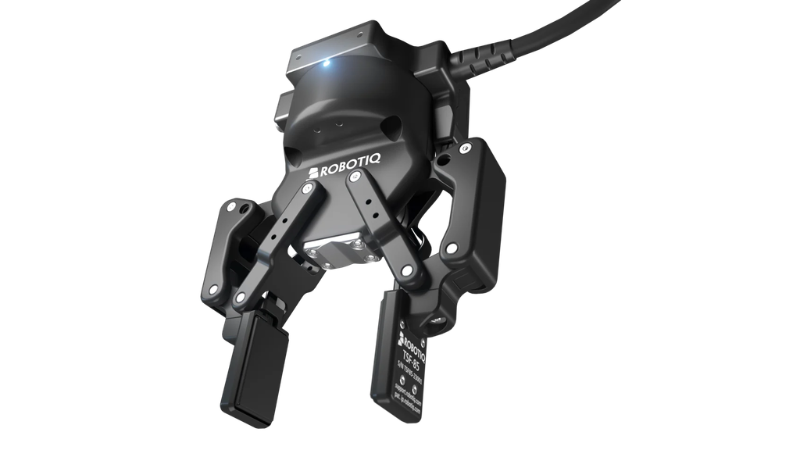
The 2FC AI-enabled robot gripper, equipped with millisecond-level tactile sensing on each finger. Image courtesy of Robotiq
The 2FC AI Robot Gripper
Robotiq’s 2FC physical AI gripper is an electrically controlled gripper with integrated tactile sensors on each finger. Data from the sensors is fed directly into Robotiq’s AI hub, where the software reports gripping results back to the control system, communicating grasp quality, slip detection, and pose estimation. The software also supports the gripping process by repositioning the robot when an object is off-center within the gripper’s travel and verifying that the correct part was grasped.
The algorithm performs these functions thanks to sensors on each finger that measure pressure, vibration, force, speed, and position. Data from each sensor is recorded at millisecond intervals, analyzed by the AI algorithms, and made accessible through a single unified framework via an API.
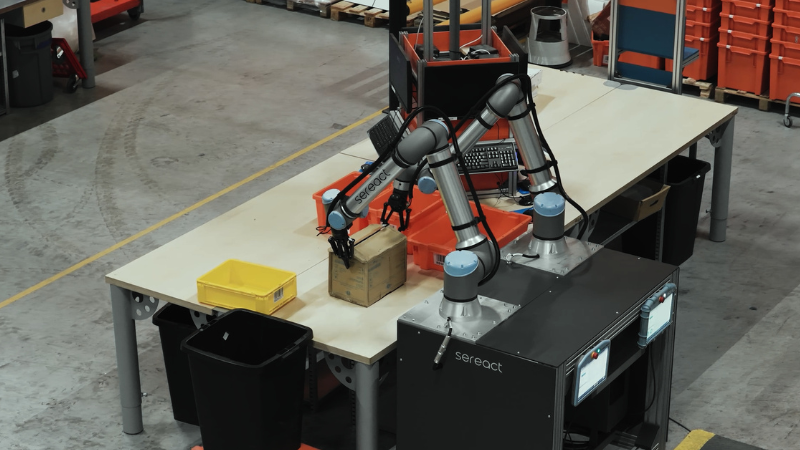
Robotiq’s 2FC is ideal for applications with variously shaped objects. Image courtesy of Robotiq
Gripper Options and Brownfield Additions
The 2FC is offered in two versions: the 2FC-85 and 2FC-140. These versions share similar specifications with other 2F grippers. Grip force ranges from 0 N to 235 N, and payload capacity reaches 5 kg for the 2FC-85 or 2.5 kg for the 2FC-140. The closing speed ranges from 20 mm/sec to 150 mm/sec, and a single Ethernet cable supports both power and communications.
If your system already uses a Robotiq 2F gripper, the tactile sensors and AI hub can be retrofitted in the field. The upgrade works on either a 2F-85 or 2F-140 without changing Tool Center Points (TCPs), leaving existing programs unaffected.
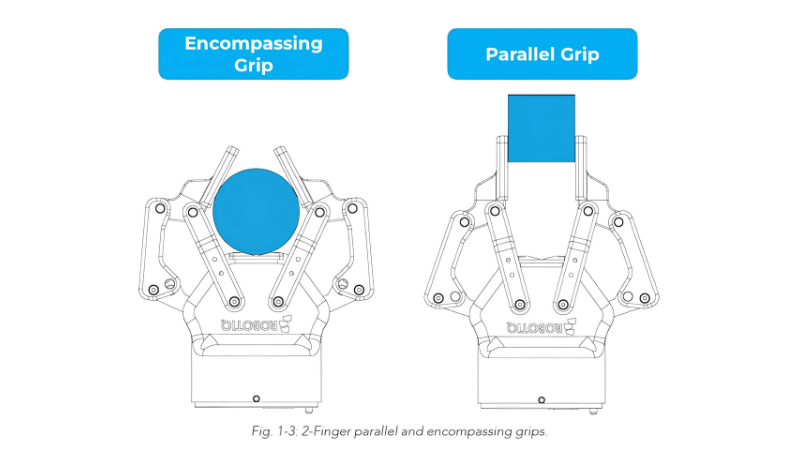
The difference between encompassing and parallel gripping actions. Image courtesy of Robotiq
Dynamic Gripping Applications
Robots that collaborate alongside humans are frequently installed on worktables where part locations are imprecise, meaning conventional grippers can move or knock over a part being picked. A common solution is to add custom fixturing or a vision system.
Robotiq has designed its 2FC gripper to avoid knocking the part over: when only one finger sensor detects contact, the system guides the robot to adjust its path while closing until the opposing sensor makes contact. The 2FC then reports orientation, force, and whether the part matches the expected shape, making it suitable for high-mix applications.
While AI has been used heavily in machine vision applications for many years now and tactile gripper sensors are not a new invention, the 2FC’s integration of millisecond-level sensing and onboard intelligence aims to advance adaptive robotic gripping.