Facebook
 Google
 GitHub
 Linkedin
SMC Expands Guided Cylinder and Clamp-On Flow Sensor Series
SMC has added new bore sizes and features to its MGPK series compact guided cylinders and updated its PFUW series clamp‑on flow sensors with non‑intrusive flow sensing from 0 to 200 L/min.
SMC has updated two product lines aimed at common factory automation challenges, particularly around space constraints and installation effort.
The MGPK series compact guide cylinders now include smaller bore sizes, which can also be used as mechanical stoppers. Overall, the redesign cuts volume by up to 28 percent and reduces weight by up to 41 percent, making the cylinders easier to integrate into compact machine layouts. For larger bore sizes, the company has added an optional air-cushion feature.
SMC’s PFUW series clamp-on flow sensors now support a measurement range from 0 L/min to 200 L/min. Because the sensor mounts externally on the pipe, it can be installed without cutting into the line or contacting the fluid, simplifying maintenance retrofits and reducing contamination concerns. This is particularly useful in fluid systems where cleanliness or material compatibility is critical.
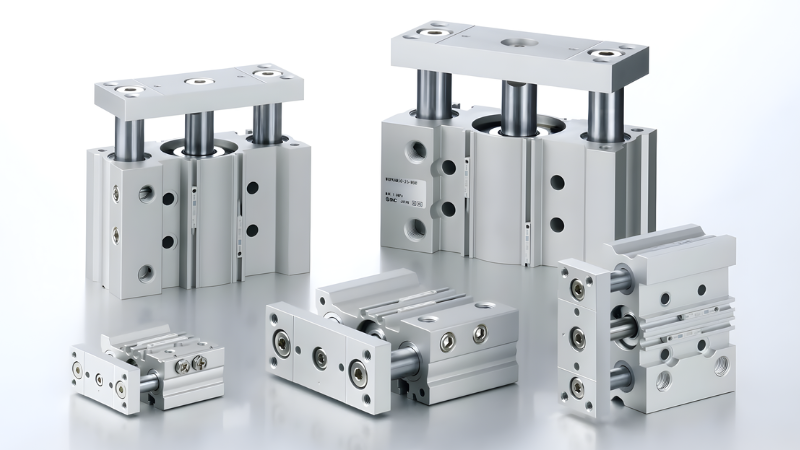
SMC adds new bore sizes and features to its MGPK series compact guide cylinders. Image used courtesy of SMC
MGPK Series Compact Guide Cylinders
SMC has reduced the size of the MGPK series but managed to keep the rigidity that is necessary for guided motion. The cylinder’s internal volume has been cut from 538 cm³ to 390 cm³, and its weight has dropped from 0.32 kg to 0.19 kg.
The series’ new small bore sizes, ø6, ø8, and ø10, extend its use in tighter spaces and enable the cylinders to be used as mechanical stoppers, removing the need for separate stop components in some designs. For larger sizes, SMC has added an air cushion that helps soften the end of stroke impacts to reduce overall shock loads and limit wear during operation.
The MGPK guide cylinder series features 33% thicker plates for increased strength, improving critical areas. Its optimized internal layout maintains rigidity while being more compact. A lube retainer has been added to the guide rod to keep grease in place and to extend maintenance intervals in systems that cycle more often than others. Additionally, the added symmetrical port positioning aims to simplify piping, minimize installation errors, and accelerate commissioning on the shop floor.
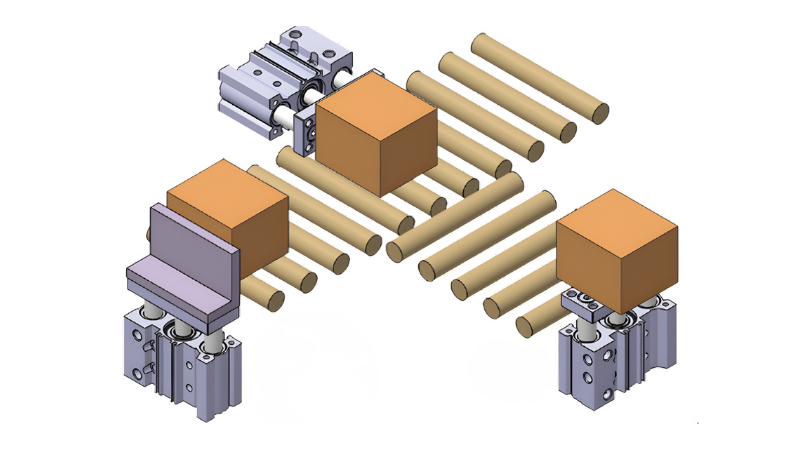
SMC’s MGPK compact guided cylinder is ideal for lifting, stopping, or pushing applications. Image used courtesy of SMC
PFUW Series Clamp-On Flow Sensors
SMC’s PFUW series clamp-on sensor covers a rated flow range of 0 L/min to 200 L/min and mounts directly to the outside of the pipe. Because it installs externally, flow can be measured without cutting into the line or breaking the process. The sensor never comes into contact with the fluid, which avoids several common issues, including piping work, increased pressure drop, and new leak points. SMC groups these advantages into eight “zeros,” addressing concerns such as clogging, leakage, pipework, pressure loss, L/min detection, contamination, wetted-material compatibility, and foreign matter entering the piping. Measurement down to zero flow also supports startup and low-flow conditions.
The PFUW sensor is compatible with both metal and hard resin piping and supports a range of common industrial fluids, including water, oils, antifreeze, chemicals, beverages, and other high-pressure fluids. It is IO-Link compatible for straightforward integration into control systems and is available for nominal equivalent port sizes of 1/2 inch, 3/4 inch, and 1 inch, with selectable flow ranges of 60 L/min, 100 L/min, and 200 L/min.
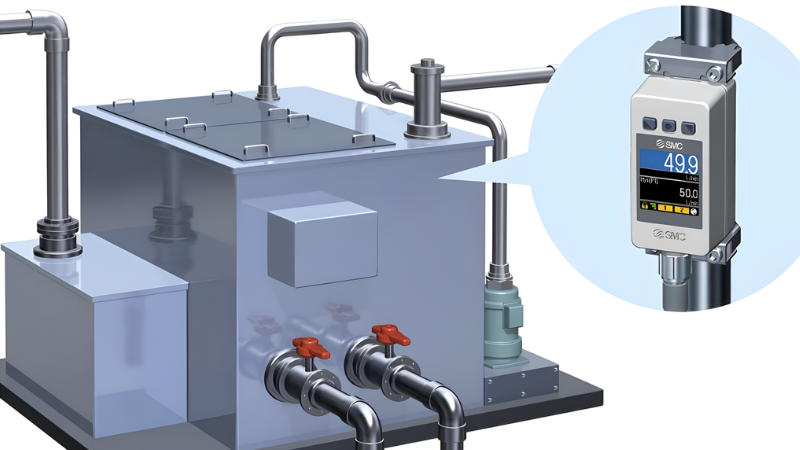
The PFUW clamp-on sensor can be used in applications ranging from drainage management to bottle filling and coolant monitoring. Image used courtesy of SMC
Enhancing Industrial Automation
The latest updates to SMC’s MGPK and PFUW series expand the configuration options available to machine builders and system designers. Changes to the MGPK compact guide cylinder add new sizes while maintaining rigidity and simplifying installation. At the same time, the clamp-on flow sensor update broadens flow measurement capability without requiring changes to existing piping. Together, the updates provide additional design flexibility for both new equipment and retrofit applications.