Facebook
 Google
 GitHub
 Linkedin
TI Unwraps Industry’s First Functionally Isolated Modulators for Robots
The new modulators bring high-resolution and galvanic isolation into a compact package.
Texas Instruments has launched a new family of functionally isolated modulators designed to improve current and voltage sensing precision in sub-60V robotic systems. As robotics picks up steam in the marketplace, many believe that legacy sensor solutions force engineers to choose between resolution, noise immunity, and system footprint.
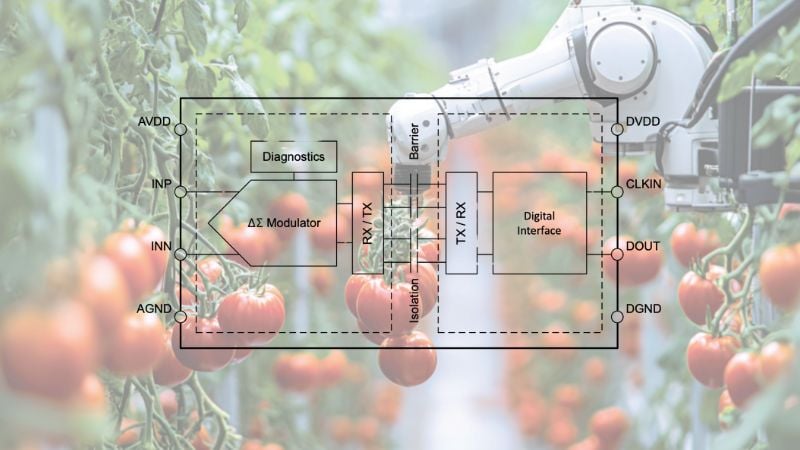
Block diagram of the modulator overlaying an application in which current- and voltage-sensing accuracy helps robots to be more precise.
TI designed its new modulators to eliminate this trade-off by offering precise measurements, robust isolation, and small form factors in a unified solution.
3 New Functionally Isolated Modulators
Texas Instruments claims its new line of functionally isolated modulators significantly improves current and voltage sensing precision in compact robotic systems. Aimed at low-voltage robotics systems below 60 V, the three new products include the AMC0106M05, AMC0106M25, and AMC0136 modulators (datasheets linked).
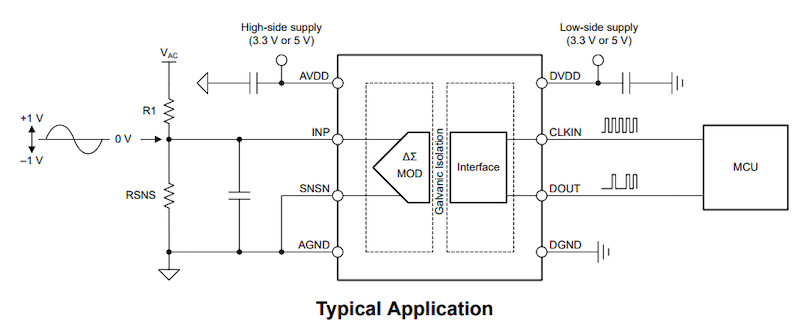
Typical application of the AMC0136.
The family supports 12 to 14 effective number of bits (ENOB)—notably larger than traditional 8- to 11-bit analog sensing solutions. According to TI, this higher resolution means more accurate detection of low current and voltage signals. By incorporating galvanic isolation, these modulators achieve a common-mode transient immunity (CMTI) of 150 V/ns for high-speed switching in gallium nitride (GaN) motor drives and mitigate microcontroller data corruption from ground noise.
To reduce the footprint in space-constrained robotic systems, the devices ship in a compact 3.5 mm x 2.7 mm VSON package to save sensing circuit size by over 50% compared to reinforced isolation counterparts. Within the family, the AMC0106M05 supports ±50-mV input, while the AMC0106M25 and AMC0136 extend input ranges to ±250 mV and ±1 V. All devices share a digital interface that supports oversampling ratios to enhance signal-to-noise performance without sacrificing system bandwidth.
Precision in Low-Voltage Robotics
Precision control in low-voltage robotics is a fundamental bottleneck with roots in the limitations of traditional current and voltage sensing architectures.
For context, most compact robotic platforms operate at sub-60-V bus voltages. Within this voltage class, engineers must extract precise current and voltage information to control torque and maintain dynamic stability during fast or delicate operations. However, legacy analog front-end architectures are limited in ENOB, meaning quantization noise constrains the resolution of feedback signals. This restriction ultimately reduces the fidelity of current loop regulation, degrades torque linearity, and can impair the robot’s ability to execute rapid or fine-grained adjustments.
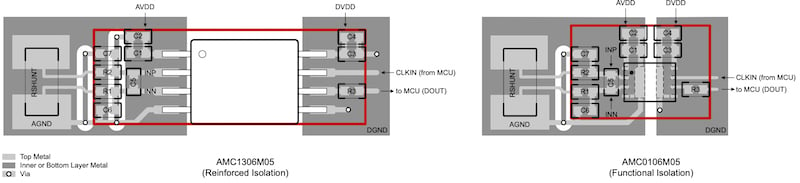
The AMC0106M05 is said to halve PCB size requirements.
These issues are further compounded by the inherent electrical noise produced by high-frequency switching in three-phase inverters. When motor drives operate with switching edges exceeding 50 V/ns, non-isolated sensors become susceptible to common-mode noise, leading to offset drift and measurement corruption. These distortions propagate through the control loop and reduce system responsiveness. Reinforced isolation techniques, while effective in preserving signal integrity, impose size and cost penalties that are unacceptable in compact robotic form factors.
To resolve this precision bottleneck, TI believes that sensor architectures must integrate high-resolution analog-to-digital conversion, galvanic isolation with high common-mode transient immunity, and compact physical design. Only by addressing all three constraints can next-generation robotics achieve human-like dexterity and efficient power management.
Closing the Loop
Robotic systems are evolving to meet stricter performance thresholds in constrained power and space envelopes, and that means sensing architectures must deliver more than marginal gains in resolution or isolation. Texas Instruments hopes its new modulators can solve these challenges by offering designers a new solution that combines high resolution and transient noise immunity in a small package.
The AMC0106M05, AMC0106M25, and AMC0136 are now available through TI, along with supporting evaluation modules and design collateral for immediate deployment in low-voltage robotic applications.
All images used courtesy of Texas Instruments.