
 Facebook
 Google
 GitHub
 Linkedin
7 Things You Need to Know About Measuring Voltage
Voltage is a simple topic at the surface, yet also extremely complex, with thousands of scenarios involving the unseen forces of electron flow all around us. These 7 facts might surprise you!
Here are seven facts you should know about voltage:
1. Voltage is not a single quantity, but a difference between two distinct values
It’s easy enough to ask, “what is the voltage at this point in the circuit?” And indeed, if someone poses such a question, you could assume that they mean with respect to the main neutral or to the negative side of the battery or power supply. But the concept itself is very important: we cannot simply have a voltage at some point in a circuit.
Failures always come from the wrong amount of current at a place in a circuit. Perhaps a broken wire means zero current. Or an overheating issue causes too much current. If we wish to locate the problem, we must be able to distinguish between the terms “voltage at a point in a circuit” (again, with the assumed ground/neutral reference) and the term “voltage across a device in the circuit.”
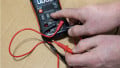
The main point: you need to be sure about where the multimeter’s black COM lead should be placed.
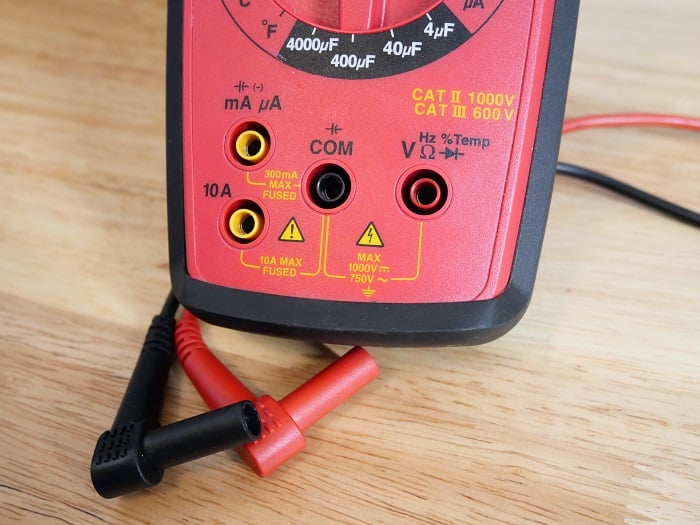
Figure 1. Two test leads are critical to measuring voltage, unlike pressure measurements, to which voltage is often equated.
2. Voltage is present at all times in all places
As you walk through your house, you don’t often think about voltage being present in and around every object, but it’s true. There are entire industries devoted to solving the problem of static electricity, which can place large voltages on random objects, just waiting for a touch to generate a quick spark and discharge.
This is often harmless, but here are three places where it’s a problem: a kid going down a plastic slide, a gas pump with flammable vapors surrounding you, and a sensitive unprotected computer circuit. The slide is the most commonly felt, but the gas pump and the circuit can be far more dangerous and costly. Just remember, you always have voltage. The air has voltage, and every object has voltage. When necessary, understand how to properly touch an object that will return you to the same voltage as the surroundings (or ground yourself) before accidentally creating a spark in the wrong place.
3. Voltage is related to current, but it doesn’t depend on current
Ohm’s Law relates voltage, current, and resistance in a linear relationship. With the resistance of a load held steady, then voltage and current are directly related; double the voltage, and you’ll double the current. However, you can have voltage without having any current in the circuit, and Ohm’s Law seems to break down. This fact is most obvious in open circuits, where the nearly infinite resistance is multiplied by the zero current, and the voltage should also be zero. Yet, we measure the voltage across the open circuit, and we will see a finite value.
In the presence of an open circuit, we are instead measuring the “potential” voltage, not the voltage dropped by the power being dissipated in a load.
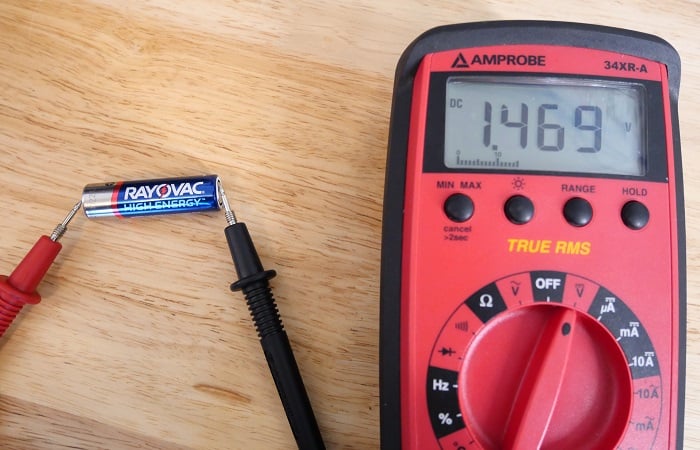
Figure 2. This battery, which represents a simple ”open” circuit, certainly still has voltage, but no current.
4. Voltmeters cannot display the exact voltage at every moment
Digital voltmeters are limited by a refresh rate, so every small spike or drop in voltage will be neither measured nor displayed. Analog meters, though they do not have a refresh rate, take time to respond to changes, so they will be unable to show rapid changes in voltage. Think of them instead as showing you the “average” voltage over the last second or so.
Most of the time, this rolling average is just fine. But if you truly need to measure high-speed signals, the instrument of choice would be an oscilloscope, displaying waveform profiles with time precision down to billions of samples every second!
5. You cannot measure the actual voltage dropped across a component
When you measure voltage, a tiny amount of current travels through the voltmeter from +V to COM. When you try to measure the voltage of a terminal or a load, there is a little bit of extra electricity going through the meter, and as far as the circuit is concerned, this means that the load resistance just dropped a tiny bit. It’s not much, but it's enough to change the circuit.
Most of the time, this small change is completely a non-issue for an electrician, and it’s not even worthy of discussion. But are there circuits in which this could be significant? Yes. In high-resistance circuits, like semiconductors, the resistance of the devices may be somewhat close to that of the voltmeter (perhaps the off-state resistance of a MOSFET). If the equal resistance of that meter is suddenly introduced, the resistance of the load drops to one-half, and the current through the circuit doubles! When we’re talking about millions of ohms of resistance, it’s still not much current, but the results on the meter display would certainly not paint the correct picture!
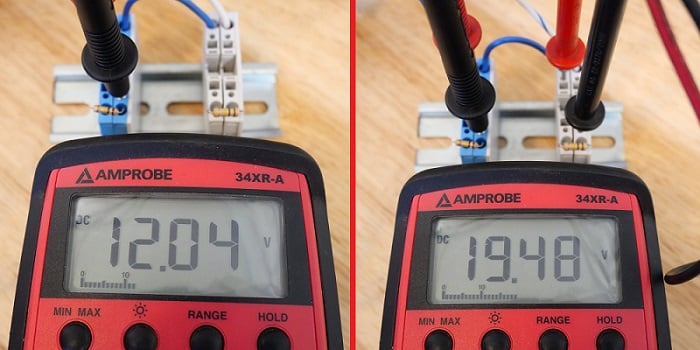
Figure 3. On the left, we see a simple voltage measurement of a series resistor. But on the right, the only change is that another voltmeter has been placed across the other resistor. That voltmeter makes a huge difference!
6. You can produce arcs even from low-voltage batteries
I’ve very rarely been given a shock by a measurement tool. But the first time it happened was (not coincidentally) only a few minutes before I truly understood how an insulation multimeter (mega ohmmeter) really worked!
When a battery-produced DC voltage is converted to AC through an inverter, it can be sent to a transformer like any other AC signal. That might very well be a step-up transformer, converting the meager 6-9 volts of the AA batteries into upwards of 500 or even 1000 volts. And that is certainly enough to produce a visible arcing voltage and enough to wake up a curious young engineer.
Fortunately, the total power of a spark coming from a few AA batteries is very small, so it is unlikely to be dangerous, but it teaches you to respect the laws of electricity and be very cautious about how you use your hands to hold the meter leads onto the device.
7. Voltage can stick around for years
You know this one; you’ve bought batteries from the store that have an expiration date of years in the future, maybe even a decade. But some devices can store a massive amount of power, and if they are a high-quality design, it may take several decades for that voltage to finally dissipate through the resistance of the circuit, the air, or the materials in the devices.
One notorious culprit is capacitors. If the large capacitors used in devices like motor drives and old cathode-ray TVs are stored in a dry, moderate environment, and if they do not contain some sort of slow dissipation resistor, they can hold energy for a very long time.
If you come across a large capacitor, it only takes a quick moment to measure the voltage across the leads. If it holds a charge, you can connect a high-value resistor (like 100k to 1M) across the leads and watch it slowly drain until the voltage is gone.
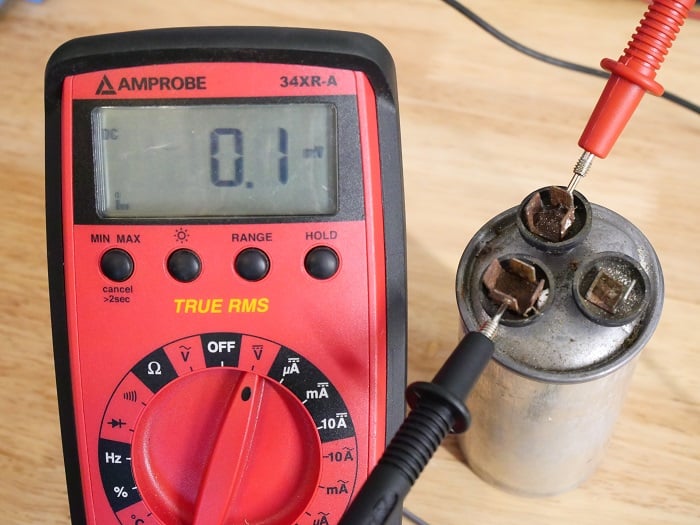
Figure 4. To make sure an old capacitor is safe, be sure to measure the voltage. If any is present, leave the voltmeter attached, or install a resistor until the voltage drops to zero.
To succeed in electronics, you don’t need to know everything about electricity, you just need to be smart enough to keep learning from your mistakes!
If you want to know more about meter measurements, be sure to check out our Control.com ebook.









Very interesting. I was asked (at a job interview) “What is the voltage across an open switch?” My answer was that it was impossible to answer that question. Seeing the puzzled look of the interview panel (or wanting to disqualify me immediately) I explained without knowing the voltage “source” one cannot indicate the voltage across an open switch. If the circuit was North American domestic light it would be approximately 110V. And that I can easily answer the question of what is the voltage across a closed switch ...nearly zero volts. Another time, I disqualified myself from a research proposal when the author indicated the voltage at a certain point (e.g. A) , omitting a reference. As this article emphasizes, voltage is always across two points.