Facebook
 Google
 GitHub
 Linkedin
How to Choose the Right Industrial Power Supply for Your Cabinet
A clear overview of industrial power supply types, specs, and design factors for building dependable control cabinet systems.
Nearly every control cabinet needs a DC power supply. Some cabinets consume only AC power for motor controls, but aside from these exceptions, cabinets require DC power for PLCs, HMIs, digital and analog I/O devices, relays, and contactor coils. Providing this DC power is the job of the industrial power supply. In this article, we’ll take a close look at a Recom RACPRO series supply, illustrating many critical features for designers and users.

Figure 1. Having a reliable power supply is critical for machine design.
What’s So Special About an Industrial Power Supply?
The term power supply is not unique to the industrial control cabinet. The phrase also applies to computer power supply units (PSUs) and sometimes to power adapters (cords) that are used to charge laptops and other electronics.
Computer PSUs are not appropriate for industrial applications for two main reasons. First, they do not supply the necessary 24 volts for industrial I/O. Second, they cannot easily be mounted into a control cabinet without significant modification. The same limitations apply to power adapters with special USB or laptop cable connectors.
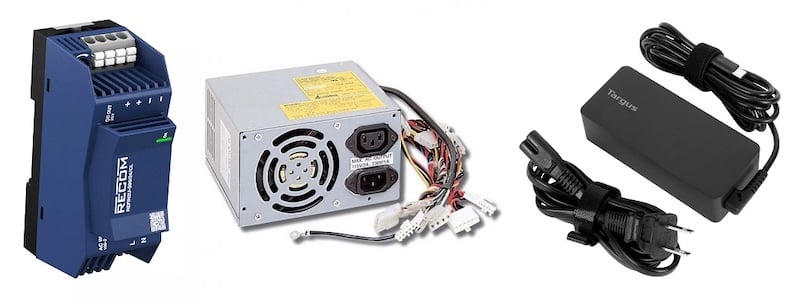
Figure 2. Industrial power supply (left) compared to a computer PSU and a laptop power supply (center and right). All are high quality, but built for different purposes.
To be useful in a control cabinet, the following traits apply:
- The unit provides DC power at 24 volts.
- The entire unit can be easily mounted inside a cabinet. Mainly, this consists of a DIN rail attachment on the rear or screw holes in an open-chassis design. Power supplies are usually tall and slim so that they save space inside the cabinet.
- Screw or clamp terminals allow the panel designer to route the power properly to terminal blocks. It’s rare to use standard Molex, JST, or NEMA line cord ends within the cabinet.
Power Supply Features
There are other features that are often included on industrial power supplies, but aren’t strictly necessary. When choosing the right supply, consider the future of the design; will any of these features be useful for troubleshooting or system expansion?
Redundant Output Terminals
Output terminals are usually marked with (+) and (-) to indicate polarity. Some supplies have one of each. These can connect to terminal blocks with jumpers to further distribute the power.
Some supplies have only a second (-) terminal, which can link to a nearby power supply to form a common ground, necessary for communication.
Having a second (+) and (-) can place multiple supplies in parallel to provide more power or redundancy in case of a failure of one of the supplies.
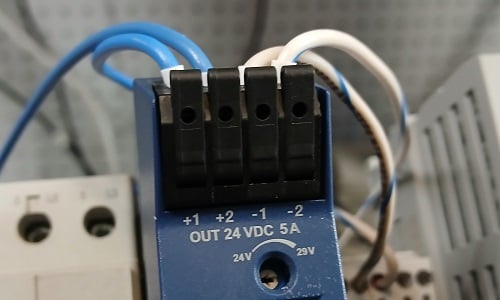
Figure 3. Two sets of output terminals allow the supply to be placed in a parallel configuration.
Operating Status Contacts
A set of contacts closes while the supply is active. If the input fails or the output draws too much power (a possible short-circuit or overload), the contact will open, and that signal can be sent to a control system.
Voltage Adjustment
A small screw terminal allows the user to adjust the output voltage. A few cautions:
First, only adjust this while measuring the voltage when fully loaded (all relevant output devices energized). If it is adjusted when unloaded, it will drop as more devices turn on.
Second, the adjustment does not compensate for a failing supply. If the voltage is dropping over time, examine for wiring problems or consider replacing the power supply; do not simply adjust the output over and over.
Indicator LEDs
Most supplies have only a single LED that indicates proper working status. However, some supplies use a series of LEDs like a bar graph to indicate the power consumption at a quick glance, saving time for the technician who no longer needs to measure the current to see a rough snapshot of the I/O.
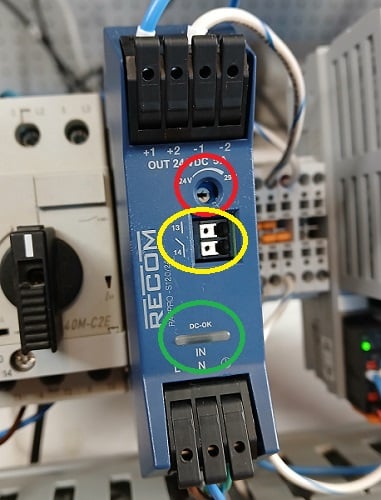
Figure 4. This power supply has an output status contact (yellow), status LED (green), and voltage adjustment (red).
Important Operating Specs
Most industrial supplies provide 24 volts, but it’s important to know if you have other cabinet devices (like motor drives) that require 5, 12, or even 48 volts. Most manufacturers offer product lines with these output voltages as well. If the devices require several different voltages, you must install a separate power supply for each voltage. If you provide more voltage than the rating states, you can cause irreparable damage.
After voltage, the next most important spec is the maximum output power or current. Some power supplies list the power rating in watts. Others list the current in amps. Both ratings are equally useful, since power is simply the multiplication of voltage and current. Adding up the total power consumed by all the devices will provide the same insight as adding up the current consumed by all the devices.
Unlike voltage, the current/power provided by the supply must meet or exceed the sum of the devices in the system.
Fluid Flow Analogy
To explain the voltage/current question further, imagine voltage like pressure, while current is like the amount of flow that is available. If we exceed a system’s pressure, it can burst the pipes. However, if we need sufficient flow, we must have a reservoir that is capable of providing at least that amount of flow, and hopefully more. A well pump can provide 60 psi with enough flow to fill a small pressure tank for a single house, a few dozen gallons at a time.
A city reservoir also provides the same 60 psi of pressure, but with thousands or millions of gallons available, so that it can supply water to many houses and businesses.
The power supply always provides a fixed voltage, and it should not be exceeded. If many devices (houses) are in the system, the unit must supply a lot of current. A small power output will suffice only in the case of a small benchtop system.
Operating Conditions
A few more subtle and often-overlooked specs can make or break a supply. Operating temperature can be a factor, since climates vary widely between cold winters and blistering heat inside a cabinet in the middle of summer.
Various ingress protection (IP) ratings dictate the number and size of openings in the case, preventing certain levels of dust, dirt, and moisture.
Explosion-proof is another optional rating that provides sealing of the case, but it’s no longer for protecting the power supply–it’s protecting the environment from sparks of live electronics inside the supply.
Choosing the Best Supply
A good practice for system design is to first account for all devices, understanding exactly what the demands and operating conditions will be for each unique system. Once those values are known, add a factor of safety before choosing the power supply. Many design firms use established practices, but for in-house designs, be sure you know exactly what you need before installing. A failed power supply is an instant kill for the entire system, when it could have been prevented by simply purchasing a better supply in the first place.
All images used courtesy of the author
Related Content