Facebook
 Google
 GitHub
 Linkedin
Lock Out/Tag Out: The Law, The Purpose, and The Details
The purpose of LOTO is to create a method of reducing the chance that a worker will be exposed to hazardous energy. It’s important for companies to establish an SOP for standardized LOTO practice.
Lock-Out/Tag-Out, or “LOTO” procedures, are used to control hazardous energies during maintenance or repair procedures. In LOTO, plugs, valve handles, and other energy control devices are completely covered and fitted with a lock to prevent unauthorized access. A tag is also included with the lock that says who locked down the equipment, their contact information, and when it was locked.
Hazardous energies, as defined by OSHA, are any process medium that can cause injury, damage, or death. This can be electrical energy or process fluids, such as steam, hydraulic fluid, compressed air, or hazardous products like flammable liquids. It can also include thermal energy, lasers, chemical energy, kinetic energy, potential energy, or numerous other energy sources.
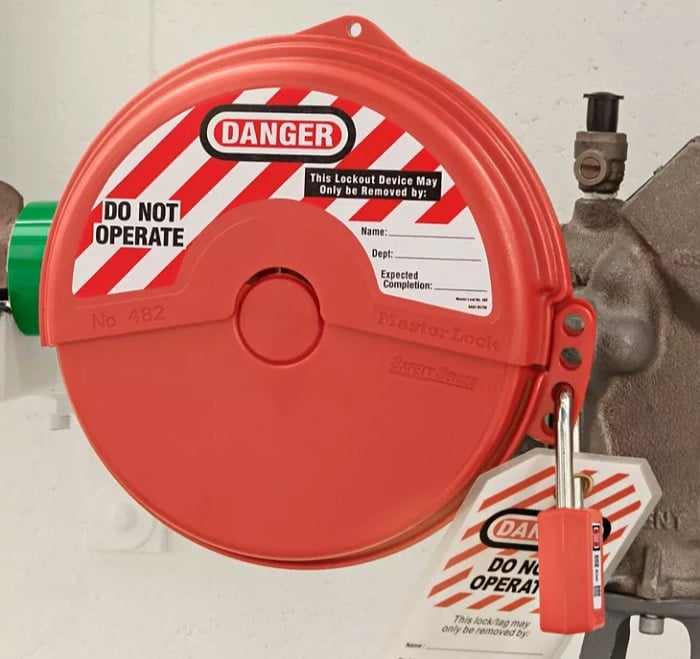
Figure 1. This valve handle cover is locked out and tagged out (LOTO) to prevent it from being opened during maintenance. Image used courtesy of Uline
Purpose of LOTO
The general idea behind LOTO is creating an organized, traceable method of eliminating the possibility that a worker will be exposed to hazardous energy sources. For example, consider the maintenance technician who decides to work on a large hydraulic press. He needs to crawl through the press to perform the repair. If he simply unplugs the press and begins his work, some other technician may walk in, see the press unplugged, and plug it in. The press begins working again, likely injuring or killing the technician.
With the preferred LOTO procedure, the technician unplugs the press. They place the plug in an enclosure and then lock it with their unique lock. This way, if someone walks through and sees the unplugged press, they physically cannot plug it in. The technician also fills out a tag with their name, contact information, and date, and likely also sends out an email or text, communicating that the press is out of service. A similar procedure is likely repeated on the hydraulic supply to release built-up system pressure.
When the work is finished, the repair technician uses his unique key to open the lock and bring the press back into service.
OSHA estimates that through proper LOTO procedures, nearly 120 fatalities and 50,000 injuries are prevented per year.
OSHA and LOTO
Title 29 Code of Federal Regulations Part 1910.147 is the section that governs LOTO procedures. As with many codes, the code itself does not tell exactly how LOTO must be implemented. It states that hazardous energies must be controlled at all times, and that some mechanism of LOTO must be implemented if any part of a worker’s body enters the space where hazardous energies are present.
In the hydraulic press example, what if the worker didn’t need to crawl through the press to perform the repair, but could instead make a repair external to the press? They may not have to perform LOTO for the hydraulic system. They may still need one for another hazardous energy, such as electrical energy, depending on the nature of the repair.
There are certain procedures where shutdown is impractical, or where the continuity of service is essential, where LOTO is not required. However, the code does not highlight explicit examples. In these cases, the burden of proof for an “essential service” or “impractical to shutdown” falls squarely on the company. In terms of design, these operations that cannot be LOTO should be limited.
Older equipment may not have a mechanism for LOTO. As of January 1990, any new or retrofitted equipment must be fitted with LOTO capabilities. Some equipment can be temporarily grandfathered in, but as soon as a major renovation or upgrade has been performed, it must have the LOTO capability. While OSHA provides no definition of “major upgrade,” the burden of proof, once again, would fall on the company as to why a piece of equipment did not have LOTO capability if there was a safety excursion.
Specific Procedures
In principle, LOTO sounds simple. One can imagine locking up the plug to a piece of equipment and repairing it. However, there are some complications. Suppose a piece of equipment must be repaired over multiple shifts. How are LOTO procedures altered to ensure that the hazardous energy is controlled throughout shift changes? What about situations where multiple employees are working on the device?
OSHA does not specify every detail about how LOTO should be implemented in a facility. They state that the hazardous energies must be controlled and that these hazards should be communicated to all personnel. However, the regulations do not specify how they are to be controlled. Therefore, it is important to establish a set of standard operating procedures (SOP) for LOTO that can be implemented repeatedly across the facility.
In the case listed above, one possible scenario is to use multi-lock hasps. Each employee has their own lock that they can lock the hasp closed. In order for this equipment to be started again, every single employee working on the device has to remove their own lock. If one lock is left in place, the hasp cannot be opened, and the equipment cannot be energized again.

Figure 2. Up to six people can work on a machine with this hasp in place. Each one would put their lock through one of the holes in the red part of this hasp. Image used courtesy of Uline
Shift passdown procedures and leave time should be discussed in the LOTO SOP. For example, if a technician is about to take a two-week vacation, they should NOT give their key to someone else; they should meet with the technician who will fill their role. They will discuss the situation, and then the substitute technician will place their lock through the hasp. Then, the technician who is about to go on vacation will remove theirs. In essence, they are transferring control of the hazardous energy from one technician to the other.
It may seem like overkill in some situations, but it is important to maintain these procedures. If a technician does not transfer the hazardous energy control to someone else, the temptation is to cut off the lock once the machine is repaired. That can lead to a dangerous situation and could be an OSHA violation.
Also, transferring a key for a lock is never a safe alternative. Each technician should have individual locks and keys that are unique. Nobody should be able to open another technician’s lock. It is tempting to buy cheap LOTO kits with a bunch of identical locks; this totally defeats the purpose of LOTO.
LOTO in the Workplace
Companies should constantly update LOTO procedures as new situations arise. While the OSHA code states a few bits about what is expected, each manufacturing facility will have its own challenges to address. As near-misses and new problems become known, the SOP should be updated and communicated to all workers.
Featured image used courtesy of Adobe Stock