Facebook
 Google
 GitHub
 Linkedin
MIKROE Accelerates PLC I/O Testing with Photorelays from Toshiba
MIKROE’s Opto 8 Click helps PLC designers compare Toshiba photorelays, so they can build prototypes and pick components more quickly and easily.
Engineers tasked with designing new PLCs and controllers are faced with challenging component selections, such as choosing just the right isolation devices for PLC I/O modules. To aid in this challenge, Toshiba Electronics has installed its TLP3640A and TLP3122A photorelays on the new MIKROE Opto 8 Click development board. Having both of the Toshiba photorelays on one board lets developers compare their performance before making final design choices.
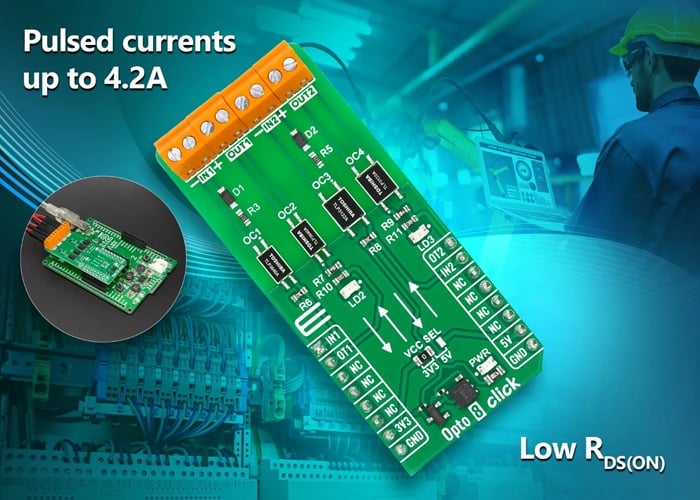
The new Opto 8 Click development board features two different photorelays from Toshiba. Image used courtesy of Toshiba
Simplifying Component Evaluation
The new Opto 8 Click board saves both time and money by eliminating the need to build two separate prototype circuits. It includes 2x Toshiba TLP3640A and 2x TLP3122A photorelays on a single board, one of each for input and output function texting. Both photorelays provide at least 3750 Vrms isolation and meet cUL, UL 577, and VDE safety standards. This makes them well-suited for safety-critical industrial applications. Engineers can test each device against the other under the same conditions or use all four together to drive bigger loads like DC motors, without extra prototype hardware. Since it’s part of MIKROE’s Click board system, developers can add it to their setup quickly and start testing right away.
The device is rated for up to 60 V in its off state and can function within a temperature range of -40°C to 110°C. This wide range gives engineers more flexibility for thermal design in factory automation equipment, measuring tools, and other electronics used in harsh environments. Both photorelays have low leakage current when off and low resistance when on, reducing power loss and keeping switching efficient.
Comparing Two Photorelays for Different Design Priorities
The TLP3640A comes in a small 4-pin SO4 package, so it works well for high-density PLC I/O modules with limited PCB space. It can continuously carry 1 A and withstand pulse currents up to 3 A, with an average on-state resistance of 0.14 Ω. Its main benefit is fast switching, with turn-on and turn-off times of 0.5 ms and 0.2 ms, respectively. This makes it a good choice for analog interfaces, measurement tools, and compact control systems.
The TLP3122A, the second installed relay, is offered in a 4-pin SO6 package. This is slightly larger, but it’s designed for applications that need higher output current, handling up to 1.4 A continuously and 4.2 A in pulses, with a typical on-state resistance of 0.13 Ω. Its switching speed is slower, with turn-on and turn-off times of 3 ms and 1 ms, respectively, but its higher current capacity makes it suitable for heavier industrial loads and for replacing mechanical relays in some cases.
With both devices on the same evaluation board, engineers can directly compare the trade-offs. This helps them decide whether faster switching or higher current capacity is better for their needs.
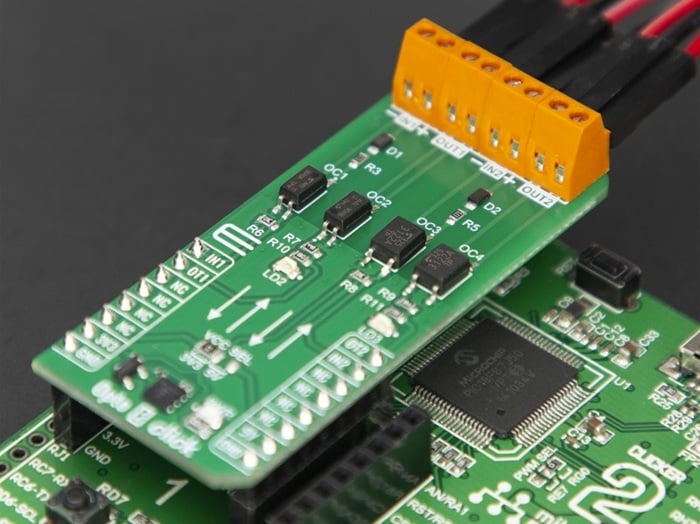
The Click board ecosystem from MIKROE is designed for wide support across many electrical applications. Image used courtesy of MIKROE
Software Support Accelerates Development
MIKROE’s software ecosystem supports the hardware with example code, software libraries, and the open-source mikroSDK development framework. The unified API makes it easier to integrate across supported platforms, so engineers can start evaluating the hardware with minimal setup.
Instead of launching a new photorelay, Toshiba’s latest announcement focuses on making the component evaluation process easier for industrial hardware designers. Integrating the TLP3640A and TLP3122A photorelays with MIKROE’s widely used Click board platform allows engineers developing PLC I/O modules to evaluate performance, confirm designs, and select the most suitable component prior to finalizing production hardware.