Change in armature current by changing torque only affect active power while armature current is affecting factor in both active and reactive power eq

It's under stood that active power equals square root 3times armature current times terminal voltage times power factor, it's also understood that to change active power you must change power flow of engine to change torque translated in Aternator to armature amperes.
My question is that why by changing in power flow which lead to change in torque translated to armature amps to change active power, why not also reactive power since it's equation is:
Sq root times armature current times sin pf angle, since I changed armature current by changing power flow and torque, knowing that changes in volt and pf angle are not that so much to make big change?
 
Changing mechanical power affects active power (PPP) because it changes the torque, which directly impacts armature current carrying active power.Reactive power (QQQ) is less affected because it depends more on the generator's excitation (field current) and less on the mechanical power.
 
Yes I already know this, but what I mean in my question is that in both equations of active and reactive power we find armature current so:
What is the relation between armature current and reactive power?
 
@Wilimohi,

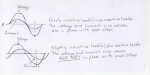
The EFFECT of reactive current is to change the angle between generator terminal voltage and generator stator amperes. Reactive loads do this to the electric transmission and distribution grid--it causes the two sine waves (system voltage and system current) to shift a part from a "natural" in-phase conditions (fully resistive loads). Electric power (watts, kW, MW) is the product of current time voltage (times the square root of 3, times the power factor) at an instant in time.

Scan_20241201.png

The two sketches attempt to show what happens for purely resistive loads (pf=0; VArs=0) and somewhat inductive loads--the inductive loads cause the current and voltage sine waves to shift out of phase with each other. (The voltage sine wave crosses the zero axis before the current sine wave--or the current "lags" the voltage.) The two sine waves are both at 50 Hz (or 60 Hz), but when there is some reactive load (any combination of inductive or capacitive loads) the effect is to shift the voltage and current sine waves out of phase with each other.

Again, has been written before: The power factor is a measure of the efficiency of the amount of real work (horsepower) with respect to the total amount of energy being produce/consumed. The power factor is 1.0 (unity power factor) when there is no reactive load (or when the generator terminal voltage is exactly equal to the grid/system voltage the generator is synchronized to). And, the power factor is less than 1.0 when there are reactive loads (lagging direction when the load is more inductive; leading direction when the load is more capacitive).

And, an old adage commonly used in electric power generation is, "Lagging VArs feed a lagging load."

Since the measurement of electric power (the vertical dashed lines) at an instant in time for both the current and sine waves even when the current and voltage values are exactly the same (as was the intent of the drawings) the measurement of the two sine waves occurs in an out-of-phase condition, meaning the total real power (watts; kW, MW) is less that what it would be if the two sine waves were in phase with each other.

That's what happens with the loads (induction motors, particularly) on an electric power transmission and distribution system--the reactive loads shift the current and voltage sine waves out of phase with each other--meaning the system is less efficient at delivering REAL power (watts/kW/MW)--because some of the total power (VA; kVA; MVA) is being "consumed" as reactive current (VArs/kVArs/MVArs), the effect of which is to shift the current and sine waves out of phase with each other. The Reactive Capability Curve shows what the power factor is (again--the measure of efficiency!) for a given VA/kVA/MVA (the hypotenuse of the 'power triangle' formed when the generator is producing both watts/kW/MW AND VArs/kVArs/MVArs). The 'power triangle' is formed by the real power (watts/kW/MW) which is the horizontal value on the Reactive Capability Curve, and the reactive "power" (VArs/kVArs/MVArs) which is the vertical value on the Reactive Capability Curve, and the hypotenuse is the apparent power--the algebraic sum of real power plus reactive "power" (VA/kVA/MVA). The apparent power (VA/kVA/MVA) is the TOTAL amount of power being produced by a generator; when the generator is producing some reactive current (VArs/kVArs/MVArs) AND some real power (watts/kW/MW) the VA/kVA/MVA of the generator is the algebraic sum of the real and reactive power (again, technically it's not correct to call reactive current reactive "power"--but it is commonly referred to as reactive power).

If left "unattended" the grid/system will eventually start to experience brown-outs (the intensity of incandescent lamps starts to dim, sometimes considerably). And, if left unattended further, the electric power transmission and distribution system will simply "collapse" and end in a black-out (no electric power). And, it's usually the grid/system voltage that suffers when the two current- and voltage sine waves of the grid/system are out of phase with each other. The generators are doing their best to provide the real current required by the loads on the system, but the voltage suffers more than the current on the grid/system.

Now, I can hear your mind grinding away as it says, "But he is talking about the electric power transmission and distribution grid/system, and I want to know what happens when my generators are producing reactive power!" Well, one way the voltage and current sine waves can be brought closer back to being in phase with each other--improving the efficiency of the electric power transmission and distribution grid/system--can "produce" reactive current (reactive "power") to "share" in providing reactive current needed by the various reactive loads on the grid/system. So, just as with "real" load sharing, generator can also share in the reactive load sharing. And the way that happens is by varying the excitation to increase or decrease the generator terminal voltage with respect to the grid/system voltage. (There are other ways, but none are as variable (adjustable) as changing excitation.)

But here's the problem: Most power plants do not get paid for the reactive current they produce (or consume); they only get paid for the watts/kW/MW they produce. And when a generator is producing reactive current and real current the machine's ability to produce real current for the same input power to the generator is reduced--meaning the revenue coming to the power station isn't as high as it could be if the power station was only producing watts/kW/MW and not producing any reactive current (VArs/kVArs/MVArs). But sometimes it's just as important to produce reactive current as it is to produce real power.

There are grids/systems which can experience large swings in grid system voltage because of things like the distances between other power plants and large loads, residential and/or industrial, (sounds like where the power plant you find yourself at now). And often some power plants are called upon to "support" grid voltage and they do that, primarily, by varying their excitation which varies the generator terminal voltage. Some grids will see immediate and noticeable/significant changes in grid system voltage when the excitation of generator(s) is varied (changed), and others will not see so much of a noticeable change; it depends on many factors, including physical distance, transformer impedances, nearby loads, etc.

What it sounds like to me is that your power plant is being used (or is being attempted to be used) as voltage support for the grid/system. This may or may not be possible given the requirements of the support AND the capability of the equipment.

My head is spinning trying to understand what you are saying and what you are asking--and I know some of that is because English is most likely NOT your native language. I've overcome that before--hundreds of times. But, when one has been doing this as long as I have (decades) the chances of not being able to "get over the hump" ("make the understanding light" go on for someone) keeps increasing--and I guess I've finally found the one on this topic. I predicted this in one of my very first responses to your first thread, and we've arrived there it seems. There are all kinds of mathematics which can be used to describe or predict what happens in electric power generation and transmission and distribution, but I'm a simple person and I like to keep it simple--because, generally, I don't know what people's education, background or experience is and if I start bombarding them with formulae and vectors their eyes just gloss over and they stop listening. (I generally am very verbose anyway, so adding lots of maths doesn't help when I'm trying to explain something.)

We (well, not me) are going to keep dancing around your questions because you will not provide any actionable data. You ONLY provide some whisps of information about the plan (known as anecdotal data what it is supposed to be doing and how it's supposed to be operated, and whether or not it's actually doing what it is/was intended to do. Without REAL (actionable) data--values of MW and MVAr for ALL three machines when synchronized to the grid, a SLD (Single-Line Diagram)--a simple drawing of how the machines are connected to each other and to the grid, and some basic idea if the frequency of the grid the machines are synchronized to is stable or drifting or hunting uncontrollably. We need to know what the grid voltage is doing when the generator terminal voltages are being changed, what the three machine's pf and MVAr values doing as the other machine's change theirs.

We don't know if the machines at your site are identical, made by the same manufacturer, or if they were installed and commissioned at different times and made by different manufacturers and have different generators (rating) and exciters (manufacturers, type of exciter (static; brushless; PMG; etc.).

We don’t know if the excitation system configuration settings and tuning parameters are the same or different for each generator.

it seems there might be some kind of PMS (Power Management System) that sends commands to the diesel-generators to control power (real power) and VAr or power factor.

We don't know if your plant has transformer tap-changers (another way of adjusting reactive current flows).

You wrote in one thread that one machine (we don't know if it is always the same machine or if it occasionally happens to all three machines) always goes to a low power factor (high MVAr value) in the leading direction and for some reason you don't seem to be able to change that machines excitation to restore proper operation. In this thread you seem to be saying (struggling to say) that the pf/MVAr value doesn't change when the machine load (real power) is being changed. I sorry; I can't keep up.

If the three generators at your site are connected directly to the same bus without any step-up transformers between the generator breaker and the bus they connect to at the plant then it's very likely that the reactive load is not being shared equally/properly between the three machines. It would seem that one machine (always the same machine, or different machines) is overwhelmed by the other two machines which are producing a LOT of reactive current and someone is trying to use one machine to "compensate" for the other two machines. (Again--this is purely conjecture on my part--there is no proper explanation of the configuration of the plant, and if a SLD were supplied no explanation would be necessary as it can be visually seen on the diagram.)

@Wilimohi, that's all I got for you and this line of questioning. Hopefully I haven't driven you to the point of confusion but these are NOT easy topics to describe in a few paragraphs and without more graphics than I can produce. You may have witnessed some things which you are attributing to one cause/result which aren't really related. Or someone may be doing that (incorrectly attributing what was observed to the wrong cause/effect/result). But, while I applaud you for asking these difficult questions I just don't seem to be providing the information you need. That's all I can do--is provide general information--at this point. Because I don't really understand the plant, the situation(s), the configuration and how it's all being operated or was designed to operate, so I can't offer anything more concrete than this attempt at explaining basic fundamentals in a few paragraphs. I wish you luck on your journey of discovery. It's taken me decades to get to this point--understanding many of the things I studied in university, but which weren't clear then and, honestly, wouldn't have made my job as a commissioning engineer any easier. I believe you won't get to a similar point in less than a few years, and that point is understanding the concepts enough to even attempt to be able to explain them to someone else so they can understand it. Which is much longer than this thread. I have had the opportunity to learn from and befriend some extremely intelligent people in my life (in power generation) and while most of them were more than capable at their job many of them just didn't have any idea how to explain watts versus VArs, or Droop Speed Control, so that I or others could understand them. And that includes university professors and textbook/reference book authors. But, I know when I'm beaten--and this is it. Best of luck--your journey has just begun.

I sincerely hope others reading your threads can help--but based on the number of responses to your threads I'd say that's not going to happen. And we all need to remember--this is a forum about controls, not AC (Alternating Current) power generation fundamentals (and that includes me from now on). There's LOTS of YouTube videos about these topics; maybe you'll get lucky and find the one that makes that light of understanding go on brightly for you. And, again, this being a controls forum you might find better luck in other forums.

Tchau!
 
WTF So it's the reactive load which splits armature current into two compenents, Icos pf angle, which affects real power that can be varied and controlled by variations of fuel flow using the governor, and Isinpf angle which affects the reactive power and can be changed and controlled by varying field current.
Concerning your questions about the sight of diesel power plants the informations you requested I can't give you now because I am not there now.
I asked my question in the section of the forum concerning power generation, if I asked it in sections concerning control then I must be blamed, also my question is some how related to control as the device concerning to control the terminal voltage and reactive power (AVR) is control device containing components directly related to control like (Pid) or (Partial derivative integral controllers), the same can be considered for devices controlling speed and frequency.
But although my question concerning armature current is simple but one way to refresh informations and may it's the best way is to get answers directly from expert ones like you..
Any how apologies for any confusion
 
@Wilimohi,

So, just as with "real" load sharing, generator can also share in the reactive load sharing. And the way that happens is by varying the excitation to increase or decrease the generator terminal voltage with respect to the grid/system voltage. (There are other ways, but none are as variable (adjustable) as changing excitation.)
@WTF, I have been asking people at my work and people online for information to my following question, and have yet to receive a satisfactory reply. I thoroughly enjoyed reading your post, seen quoted, and am hoping maybe you can elucidate me on this: how does varying the exciter voltage change the power factor of the generator? I understand that changing the system load to be more inductive or capacitive would, by nature, shift the power factor of the power being pulled to the load from the generator. I understand that we use VAr output from generation for voltage support, and that we contol this by adjusting the exciter field. In my mind, however, raising the voltage on the exciter should not shift the current waveform phase?

As an example of my thinking, let's assume unity power factor, and the current and voltage waveforms are completely in phase. Since V=IR, I can see how raising the amplitude of the voltage waveform would necessarily raise the amplitude of the current waveform, but I cannot in any way see how it would shift the waveform phase. Electrically, mechanically, and/or physically, what is happening here? I have come across synchronous machine V-curves, but I do not understand why this phase shift happens.

Thank you very much and I look forward to your reply. Feel free to be as verbose and diagram/math heavy as you like, I will do my best to follow.
Nate
 
@Natnater,

As I've written above, I seemingly have hit the wall on this thread and this topic. I generally attempt to describe things based on my experience, and THEN start using maths and vectors and such, because when I first began working in the power generation business I started with the maths and vectors and such and just saw people's eyes rolling back in their heads whilst they were thinking, "Another egghead school-boy using fancy words and terms when he obviously doesn't know what he's talking about...!" So, I quickly stopped doing that and started just showing them what would happen when adjustments were made during machine operation. And, that's all they really ever wanted to know--if I do this, that will happen; or what do I do if this happens? All the maths and vectors and such are really just ways of predicting what's going to happen and/or by how much something will change if this (or that) changes. If the operations supervisors says to an operator, decrease the power factor to 0.9 lagging (from 0.97 lagging) the operator needs to know that he or she has to change (increase) the excitation (which is really trying to increase (or "boost") the voltage of the grid/system the machine is synchronized to. Maths and vectors alone aren't going to l'arn the operator how to do it. He (or she) has to have experienced what happens when adjusting the excitation of the machine while the real power (watts/kW/MW) stay relatively constant.

I would love to be able to tell you precisely which formula and its description will exactly answer your question--but that will require me to go and find my textbooks from university (with my notes in the margins), but they are five thousand miles away now and I'm perfectly happy where I am.

There is a little mnemonic term that is commonly used in the power generation (and electrical) industry: ELI the ICE man. The 'L' in ELI refers to an inductive load, and when the load is inductive (or "made" to be inductive) the voltage sine wave --the 'E' term in ELI--leads the current sine wave, the 'I' term in ELI. This means that the voltage waveform will cross the zero axis (increasing or decreasing) BEFORE the current waveform. This is the EFFECT of VArs on the system--to shift the voltage, or current, sine waves out of phase with each other.

The 'C' in ICE refers to a capacitive load, and when the load is inductive (or "made" to be inductive) the current sine wave--the 'I' term in ICE--leads the voltage sine wave, the 'E' term in ICE. This means that the current waveform will cross the zero axis (increasing or decreasing) BEFORE the voltage waveform. Again, this is the EFFECT of lagging VArs on the system--to shift the voltage, or current, sine waves out of phase with each other.

This little mnemonic works really well with the descriptions used for VArs and power factor: lagging and leading. When the load is inductive the current ('I') lags the voltage crossing the zero axis. When the load is capacitive the current leads the voltage crossing the zero axis.

I know there are some maths/formulae that can be used to prove what was just written (presuming I didn't make and typographical errors, which I'm prone to make at times!). But, again--they are just proofs or predictors for what actually happens.

Lest there be any further confusion, we are talking about the VArs or power factor at the synchronous generator terminals. And the VArs coming from (lagging VArs) or going into (leading VArs) the generator stator can be used to offset what's really happening on the grid/system the machine is synchronized to.

When a synchronous generator (and its prime mover), synchronized to a grid/system with many other synchronous generators (and their prime movers), is being operated with its generator terminal voltage equal to the voltage of the system grid it is synchronized AT THE LOCATION where is it connected to the grid/system then no (zero) VArs will be flowing into or out of the synchronous generator. The power factor at the generator terminals will be 1.0--unity during this time. If--while holding the generator real power output (watts/kW/MW) steady--the excitation of the synchronous generator is increased then lagging VArs will begin flowing out of the generator stator, which will begin to shift the voltage and current sinewaves out of phase with each other. If nothing else is done to keep the real power output of the generator from changing AND the excitation continues to be increased then the actual real power (watts/kW/MW) of the generator will begin to decrease (per the generator's reactive capability curve). (This is the part @Wilimohi has heartburn over that I can't help him with.) When the generator's excitation is increased above what is required to make the generator terminal voltage equal to the system/grid voltage at the location where the generator is connected to the grid system the net effect will be to try to increase the grid/system voltage AND the generator current and voltage sinewaves will shift out of phase with each other (the current sinewave will lag the voltage sinewave crossing the zero axis).

This is how AC (Alternating Current) power generator, transmission and distribution systems operate. The nature of the loads being powered by the grid/system will also have an effect on the relationships between the grid/system voltage and current sinewaves. Using generator excitation is one way the grid/system voltage and current sinewaves can be kept from drifting too far out of phase--which is when bad things can start to happen (brownouts; blackouts; etc.). There are other methods (tap changers on transformers; power factor correction capacitors; etc.)--but using synchronous generator excitation is kind of the first and simplest method--and also can be easily adjusted.

I don't think I've properly addressed all of your concerns/questions, but I think of this aspect of AC power generation like this: When increasing or decreasing the generator excitation above or below that required to make the generator terminal voltage equal to the grid/system voltage of the grid/system the generator is synchronized to at the point where the generator is connected to the grid is going to cause "something" to happen because increasing the excitation is going to try to increase the grid/system voltage and decreasing the excitation is going to try to decrease the system voltage and that "something" is the shifting of the phasing of the waveforms. And electrical power measurement occurs at an instant in time--the RMS values of the voltage and current sinewaves are multiplied times each other from that instant in time, and when the voltage and current sinewaves are NOT in phase with each other, well, the efficiency of power generation is decreased (by the power factor value). You can still be applying the same torque to the synchronous generator rotor but the amount of real power being produced will change as the excitation is varied. (Again, this can all be seen on the generator reactive capability curve.)

I'm certain you can find all manner of descriptions and videos and such on the World Wide Web for all the maths and formulae you could ever want. Me? I care about what happens when the "knobs" of the generator (and its prime mover) are adjusted, and how to adjust the knobs to achieve the desired goal/operating parameters. Sure, it would be easier if we could have graphs of the voltage and current sinewaves of the generator output (just like it would be nice to have a torque meter to see what the effect of changing the torque input to the generator from the prime mover does)--but in reality all anyone REALLY cares about is the watthour meter and how fast it turns.
 
@WTF? ,

Thanks for the explanation. I'm definitely still in the maths and vectors stage as a new engineer, though only for my own edification. My wife's eyes glaze over enough for all of the industry when I talk so I've learned my lesson there ;). I'm definitely still a bit confused as to what is actually happening though -- I understand synchronizing to the grid requires the same voltage, and I understand raising or lowering the voltage in comparison to the load/grid, but I still can't see how raising your voltage would cause your current waveform to shift.


To my understanding, the main component that changes the inductance or capacitance of a reactive impedance is not voltage, but frequency, right? Like, an inductor will have a different inductance at 60Hz vs, say, 400kHz. A voltage change at a constant frequency, however, shouldn't change the inductance, but just the voltage drop, I'd think? In my mind this would definitely cause the current waveform amplitude to change, but not the phase. I definitely feel like the answer is right in front of me, but I'm just missing something fundamental (my electromechanics class was a bit, eh, subpar).

Let me go on a limb here, and please correct me if this is insane: obviously a generator will have some natural impedance, right? There is likely some (large) capacitance between the stator and the rotor, and inductance in the windings. When the generator is being run at unity power factor, are the voltage and current waveforms actually in phase with each other, or are they out of phase, but such that the generator impedance at the terminal is opposite and equal to the load impedance? If it's the latter case, would raising the voltage of the exciter make the generator more capacitive, thus shifting its impedance compared to the load, thus causing impedance mismatch, forcing reactive power to exist? Though I don't think that's quite right, because I can't see how raising the voltage on a capacitor would make it more capacitive, it would just make the voltage higher (until you pop the capacitor, anyway).

It's this part here that I'm really confused about:

When the generator's excitation is increased above what is required to make the generator terminal voltage equal to the system/grid voltage at the location where the generator is connected to the grid system the net effect will be to try to increase the grid/system voltage AND the generator current and voltage sinewaves will shift out of phase with each other (the current sinewave will lag the voltage sinewave crossing the zero axis).
I'm beginning to appreciate that this might be a deceptively difficult question to be asking (and possibly this thread is not the right place, I don't want to muck up these forums). I greatly appreciate your response. I'm so fascinated by how these things work, and this question has become one of my White Whales, so to speak.
 
@Natnater,

Frequency has NOTHING to do with VARs or power factor. Inductors and capacitors are the explanation you need to get your head around.
It IS a deceptively difficult question, but like Droop Speed Control it is a deceptively simple concept—once you can let go of preconceptions and doubts.

I sincerely wish I had the key to help you (and others) grasp the concept. But, alas, I haven’t found it yet. One of the things I like most about teaching is that it forces me to learn new things and approaches and descriptions all the time. I will noodle this and see if I can find something that helps with accepting this concept. Because—yes, the sinewaves do shift as excitation is varied (I have viewed it on an oscilloscope with my own eyes). Yes, a generator does have internal impedance, but to my knowledge it’s relatively innocuous and doesn’t factor into the “equation.”

My wife says engineers can’t talk without a pencil and paper. ;-)

Sorry I haven’t been able to help with your understanding. A favorite author of mine wrote, “Learning is finding out what you already knew.” Think about that—when you finally grasp a concept don’t you feel like, “Yeah—I knew THAT!!!”

It will (eventually) happen! And when it finally does, it’s so satisfying!

Don’t give up.
 
@WTF?

Thank you for your help! I at least feel better knowing I'm not alone with this question, lol. It is officially my "white whale" and I look forward to hopefully finding an answer to it before I retire in 35 or so years :)
 
@Natnater,

No; you're not alone.

You might want to do some research on how power-factor correction capacitors work as they are used sometimes to correct for high inductive loads on power systems. Power-factor correction capacitors can't be easily varied--they are "switched in" and "switched out" and at some installations when they are being switched the earth around the substation where the banks are located actually moves (as in you can feel it in your feet) as well as hear it as a low, loud "crack". But you may learn how power-factor correction capacitors do their function in moving the voltage and current sinewaves back into phase with each other--and that may help you gain a better feel/understanding for what the physics are (though I'm going to bet there will be a lot of maths and vectors and other stuff which really doesn't explain what happens or why but is useful for predicting what will happen and that the impact of a certain size of power-factor correction capacitor bank will have on a system. (Me--I just want to see graphs of the voltage and current sinewaves before and after power-factor correction capacitors are switched in or -out. That would be enough for me! I don't need all the maths and vectors--I need to know the effects of switching them in or out.)

Anyway, let us know if you find anything useful. The new year is going to be taking me in a different direction (directions, to be exact) and while I will be checking into Control.com from time to time I'm not going to be responding as much as before (unless times allows, from time to time).

Best of luck--please, let us be the beneficiary of your research and learning. That's the best thing about World Wide Web forums--getting to know what happens and why it happens and how it happens, and Control.com is one of the best forums for getting feedback from people who get help (or nor) for their questions/problems. A former contributor used to say, "Feedback is the most important contribution here at control.com!" And it's as true today as it was a couple of decades ago. If you get help directly (off-line) from someone, very few people--if any--benefit from that learning experience. But, if you share you experience and problem-solving and solutions on a forum like Control.com, a LOT of people can benefit--now and in the future when people search for solutions/answers.

Tchau!
 
@WTF?

Best of luck with your change in direction(s)! Unfortunately for me as an Electrical Engineer in the power industry, I'm a physicist at heart, so I don't think I'll ever be ok with just seeing a graph of what's occurring and leaving it at that :).

Thank you for the help and the lead with capacitor banks, I'll look into those. I'll definitely post more questions that I have, though maybe I'd better remember my netiquette and post in a new thread!

Cheers
 
Top