Facebook
 Google
 GitHub
 Linkedin
Ask an Engineer: Universal Robots Shares Four Physical AI Predictions
Physical AI, where technology is applied to real-world devices like robots, is set to have a major impact over the next few years. UR Shares some predictions, along with some exclusive deeper insights.
The robotics industry is evolving faster than ever, and the signals of the future are already clearly visible. Anders Beck, Vice President for AI Robotics Products at Universal Robots, has shared four predictions about the most impactful physical AI developments for the years ahead.
Many engineers are curious about the role of AI in robotics, so our own Control.com engineering team posed a few follow-up questions to better understand the context of these predictions.
#1 Predictive Math: A Silent Revolution
The next big leap in robotics won’t come from hardware, it will come from math. Today, robots are reactive: they respond to inputs and adapt in real time. Tomorrow, they will anticipate.
Imagine robots that can forecast the impact of a path adjustment before executing it or simulate multiple “what-if” scenarios in milliseconds. This isn’t science fiction; it’s a natural evolution of how we compute derivatives and predict system behavior. While these methods are still largely in research, their potential to transform robotics is undeniable.
In my view, predictive intelligence will define the next generation of automation. The question isn’t whether this shift will happen; it’s how soon, and who will lead the way.
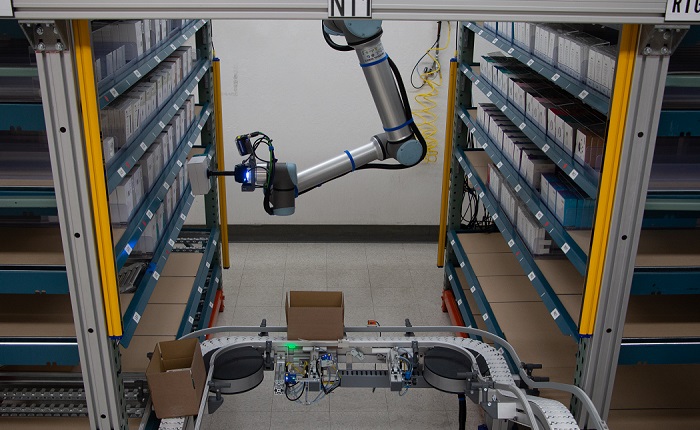
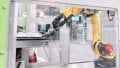
Figure 1. Anticipating paths in variable environments can be a major advantage for optimization. Image used courtesy of DCL Logistics
Control.com:
What role does AI play in mathematical calculations, since computers have already been computing complex math operations for half a century?
Anders:
I think what’s changing now is the ever-expanding quest for efficiency in AI models; that’s probably one of today’s main bottlenecks. That’s why we build so many data centers, in an attempt to scale that capacity.
One of the breakthroughs that’s happening, especially within the domain of robotics, is concepts like dual numbers and jets to represent various distributions in AI models, but what difference does that make? Primarily, mathematical models can begin to plan scenarios because you can represent many derivative states and orders of operation. As soon as you can get to that state where the controller has supplied many fallback strategies predicted in advance, the final operation becomes a lot more effective.
Control.com:
What are a few examples of robotic (physical AI) processes that will benefit from predictive math - the ‘impact of a path adjustment’? Most robot scenarios seem very focused on NOT deviating from a programmed path.
Anders:
Considering this from a robotics process, most existing robotics control policies react to input. But if you’re conducting a variable process, like surface finishing, you can predict what will happen as a scan is conducted across the whole surface. Or, consider an assembly process, which relies on plan A if everything is correct, but I could also predict 10,000 plan B’s that could be a fallback in case of unexpected errors. This computational ability provides a lot of efficiency compared to the relatively slow neural networks.
#2 From Solo to Synergy
Imitation learning will become a defining capability in the next wave of automation. Today, most robots operate as independent units, managed by centralized fleet systems or pre-programmed routines. Tomorrow, they will learn from each other and from humans - some guided, some autonomous - forming adaptive teams that share behaviors and strategies in real time.
This evolution builds on research where robots not only follow a leader’s trajectory but also observe, imitate, and refine actions collaboratively, enabling dynamic coordination without rigid scripts. Industrial robotics vendors have laid the groundwork with fleet management and synchronized motion for multi-arm systems, but true peer-to-peer learning and self-organization are still emerging. However, I am certain that in 2026, we will see real deployments leveraging imitation-learned physical AI models.
As safety standards, inter-robot communication, and orchestration tools mature, expect imitation-driven collaboration to move from niche pilots into widespread adoption across factories and warehouses - transforming robots from isolated units into cooperative, continuously learning teams.
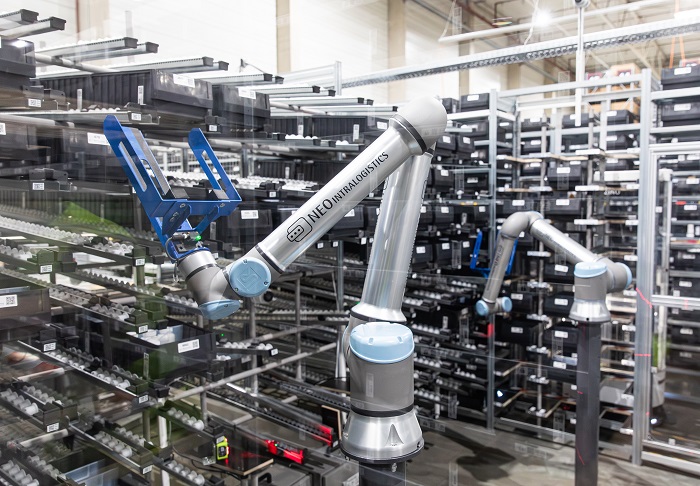
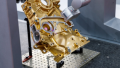
Figure 2. Inter-robot communication can further improve training. Image used courtesy of NEOintralogistics
Control.com:
What checks and balances must be used in AI learning? Could it fall victim to repeating unwanted behavior, like people learning bad practices by watching others?
Anders:
You need a solid, grounded methodology for measuring whether the current action was better than the last time. We've seen many inspection systems being trained by supervised learning; “I detected a new thing on a pick in this quality system - please tell me, is this good or bad?”
The process of the future is to train the model up front (pre-training), and then, as the system operates, new real-world pictures are fed back to further refine the model.
For some computer vision models, it can be difficult to provide sufficient upfront training to avoid it becoming a major setup exercise. The solution is a point that I’ll address again in my final prediction.
Control.com:
Reading between the lines, the difference between past and future: In the past, robots have been able to copy a human’s actions given the right sensor input. But in the near future, the goal is to follow human intent. What does that look like?
Anders:
In the market today, we see a lot of Silicon Valley model builders, feeding a massive amount of human training into robot models, to insert the human intuition element, “how would I even do this, how would I actually get a robot to assemble this part?”
Even more lately, individual manufacturers are starting to consider data collection on assembling their product, so they're also starting to generate data sets to train these AI models based on this data, leading to the idea of logical reasoning.
#3 Purpose-Built AI
Rather than generic AI platforms, manufacturers will increasingly adopt task-specific AI applications - solutions built for a single process like welding, sanding, inspection, or assembly. Expect AI welding, AI finishing, AI assembly, and AI inspection to become standard features in new robotic cells - bringing automation to processes once considered too variable or complex. These vertical applications will come out of the box pre-trained, pre-integrated, and ready to deliver measurable gains from day one.
Welding is a flagship example with AI-driven capabilities like vision-guided seam tracking and machine learning-assisted parameter optimization already transforming the trade of welding. Logistics is also an industry where we’ve seen great advancements, with AI-powered robotic systems now demonstrating the ability to perform complex pick, stow, and touch operations efficiently and at scale. In 2026, I anticipate we will also see investments spreading from logistics into retail.
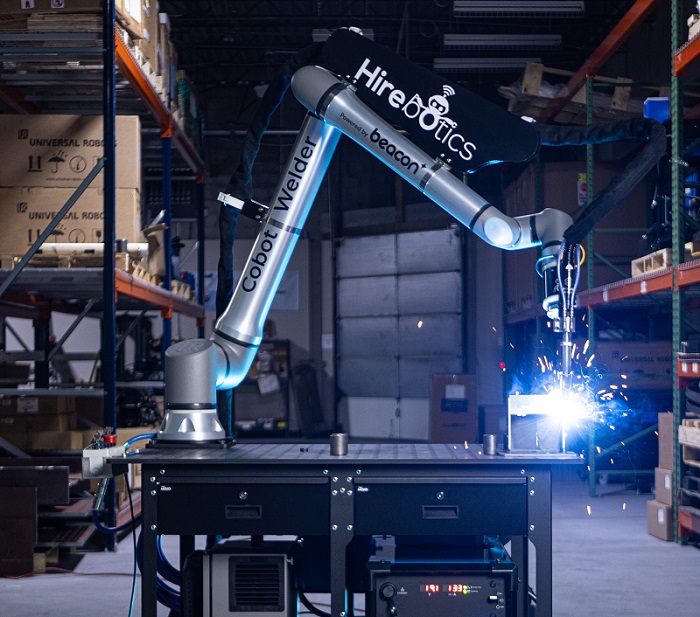
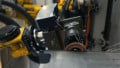
Figure 3. Welding is a prime candidate for dedicated AI training. Image used courtesy of Hirebotics
Control.com:
One of the benefits of traditional robots is that they are programmed much the same way across applications, so an engineer can understand the installation process in numerous applications: palletizing, welding, pick/place, whatever. Will companies now need to hire specific talent for designing/maintaining robotic systems for each kind of application, and will they need to be versed in AI?
Anders:
I think the future of talent will rely much more on user skills; for example, in a welding application, the need will be for those with welding talent. The new tools that they have will be much better, but they still need to prepare the metal. They still need to own the blueprints. They still need to assess the quality. But in the end, those fine motor skills it takes to make a perfect weld will no longer be a key requirement for a company. This is likely to be seen as a good thing, since it’s already becoming a rarer skill set to find.
We've already begun seeing this trend for several years, with more and more easy-to-use software packages for certain applications, reducing the demand for those robot programming experts.
Control.com:
How is this pre-trained strategy being embraced by engineers who tend to enjoy having more control over their devices and processes?
Anders:
I think that, for industrial-scale deployments, we are still in the early days of using fully autonomous robot programming. We have many partners who prefer small models, refining process parameters based on data. If it doesn't work after a couple of tries, then the manufacturer can simply decide to continue tweaking the parameters, but if that doesn’t work, it’s not a huge loss to simply abandon the trial.
I believe this is the year when we’ll see these move more into industrial deployment. My prediction is that we'll begin to see domain-specific applications first. Consider the computer vision area. AI has been the dominant technology for well over a decade, so nobody would ever think about implementing computer vision without using AI models nowadays. The trend of other applications will definitely follow this path.
#4 Date is the New Fuel
The next big shift won’t just be in how robots move or think, it will be in how their data creates value. Today, most of the rich information robots generate – sensor readings, vision frames, force profiles – stays inside the customer’s site. That’s great for privacy and speed, but it means AI developers often lack the real-world data they need to build smarter applications.
In the future, I see robot manufacturers creating secure, opt-in data exchanges. With customer consent and strong privacy safeguards, anonymized performance data could be aggregated and offered to AI developers as training sets or model services. Imagine welding robots sharing de-identified seam quality metrics, or sanding cobots contributing surface finish data, fueling smarter AI for defect detection, predictive maintenance, and adaptive control.
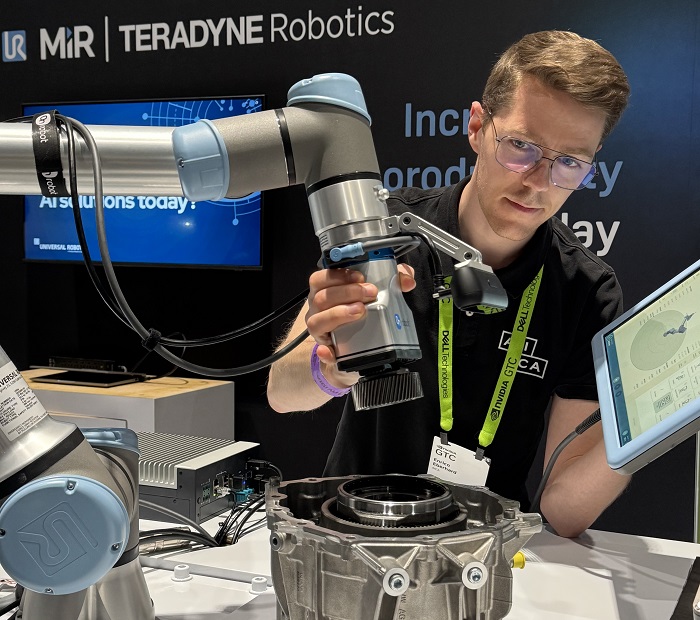
Figure 4. Simulated tasks can be used to farm massive amounts of model-training data. Image used courtesy of Universal Robots
Control.com:
Are there any examples of this kind of data already being collected and generating practical results across industrial automation?
Anders:
Today, we can find vendors selling data by the hour, using learning farms, where companies set up hundreds of robot cells to collect the real contact dynamics of doing real-world applications. There’s definitely a lot of focus on building those models that can solve both the application-specific problems and the generic problems.
This leads to questions about programming and instructing systems in the future. Do you show the robot how to do it? Do you tell the robot how to do it? Is it chat prompting as we see with LLMs? Or is it something entirely different?
This is going to be exciting to see because it’s one thing to train this big data model, but as soon as it's a reality, how do you interact with it? What are the right modalities? How do you tell if it's wrong or right?
I think this is going to be an exciting part of the robotic journey!
The Payoff of Predictive Robotics
The future of robotics will be defined by the interplay of advanced techniques, smarter applications, and data-driven strategies. Together, these shifts promise a step-change in mission ROI: higher productivity per robot hour, faster deployment and reconfiguration, reduced downtime, and continuous improvement driven by real-world data.