Facebook
 Google
 GitHub
 Linkedin
Aisle Be Seeing You: LBR 500 Navigates Tight Spots
LBR 500 from Anscer Robotics replaces bulky forklifts with agile, sensor-driven cart handling in tight warehouse and logistics spaces.
Anscer Robotics (AR) has released a dynamic, narrow-isle-defying, 500 kg payload capacity autonomous mobile robot, the LBR 500. The medium-payload bot is ideally suited to the autonomous pick-up, transfer, and deposition of racks, trolleys, and carts in logistics operations, from plastics, automotive, to electronics industries.
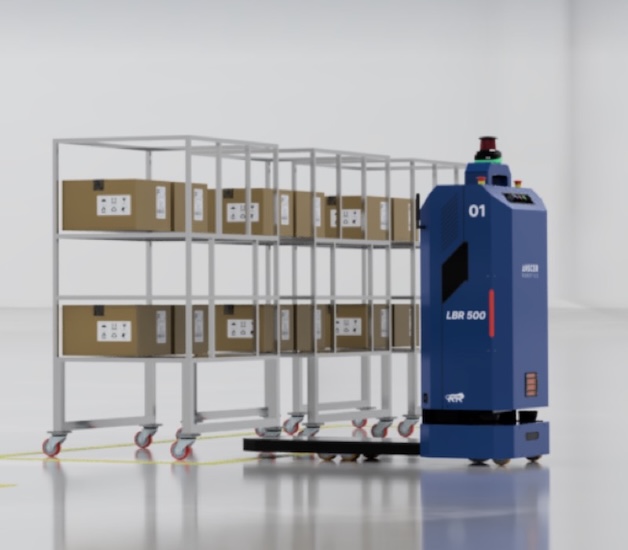
Customers can use the LBR 500 to accommodate different cart sizes and navigate tight storage paths. Image used courtesy of AR
Targeting Dynamism and Adaptability
Autonomous mobile robot systems in warehousing, logistics, and manufacturing environments use a variety of dedicated sensors, cameras, artificial intelligence-led machine vision, and LiDAR (light detection and ranging) technologies to detect, map, and navigate their surroundings without the need for guidance strips or drastic, costly changes to existing infrastructure. Such AMR systems are also evolving to incorporate automated coupling and decoupling mechanisms, eliminating the need for workers to maneuver and deposit carts. Handling carts can lead to injury and waste valuable time that could be devoted to more skilled/higher value tasks, ultimately contributing to improved productivity and employee satisfaction.
Conventional warehouse forklift vehicles provide several safety hazards, mostly due to human oversight. These include speeding, crashes, and low visibility, which is frequently exacerbated by blind spots and a lack of situational awareness. Driver exhaustion or distraction can also increase accident risk, particularly in confined, congested areas. Modern AMR technologies operate on the go and are not susceptible to fatigue or exertion from high physical demand, though maintenance is necessary throughout their use.
Traditional cart moving technologies include the forklift and other bulky, cumbersome vehicles that are not dynamic enough to avoid obstructions and adapt to changing load demands or facility pathways. This is what AR’s newly launched LBR 500 AMR was designed to solve.
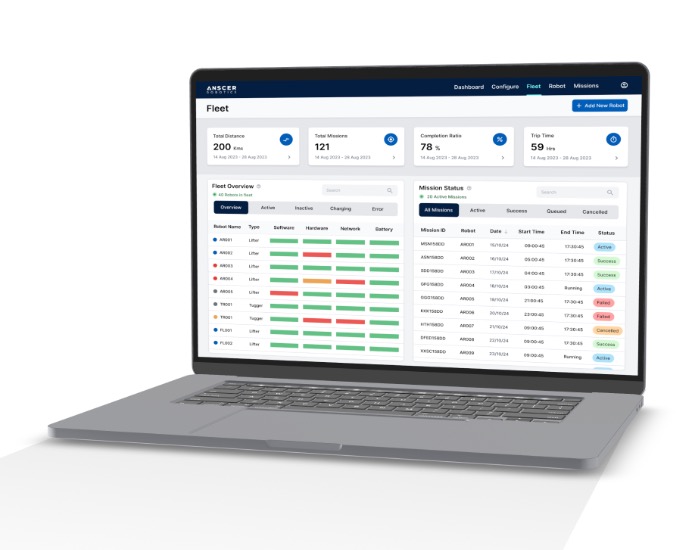
Anscer also offers its fleet management software for real-time monitoring and orchestration of multiple autonomous bot fleets. Image used courtesy of AR
Anscer’s LBR 500
The LBR 500 features a max speed of 1.5 m/s, an eight-hour run time, and ample bandwidth 5GHz WiFi communication. The bot provides customers with a 2150 mm turning radius, a loading fork length of 1260 mm from base to tip, and a two-hour charging time. The LBR 500’s onboard sensory and navigation system incorporates 2D and 3D LiDAR technology and two 3D cameras.
The LBR 500 is built to adapt to different cart sizes to suit different warehouse/logistics environment workflow requirements, and a lower set lift platform and omnidirectional motion enable the bot to weave in and out of narrow storage aisles, something that bulky, traditional forklift technologies would not be able to achieve across structurally varied warehouse/logistics facilities. Customers also benefit from four emergency stop buttons to help avoid collision and unwanted worker-machine contact, perspective 360 LED (light-emitting diode) lighting, and a docking accuracy of ±1.5 cm (X, Y) and ±3o (Yaw).
Conclusion
Innovative AMR technologies such as the LBR 500 offer adaptive, safety-enhancing, and diverse load form capabilities that can help adopters of automation technologies balance the initial upfront cost of robot investment with increased savings and output. Ultimately, the LBR 500 is intended to boost adaptability, cut unnecessary and time-consuming labor, reduce costs, enhance safety, and improve productivity in busy warehouse/logistics settings.
Related Content