Facebook
 Google
 GitHub
 Linkedin
Banner Puts Text-Enabled, Multicolor Programmable Beacon on Display
The new K100 programmable display beacon features 14 colors, as well as the ability to display 32 scrolling or 12 static characters to communicate machine status to operators.
Banner Engineering has released its newest display beacon: the K100. The K100 features a programmable light, an LED array for displaying short status messages, and an audible alarm for notifying technicians of problems. Because all of these indicators are controlled via programming, there is no need for a large tower stack of lights, saving operators space and simplifying machine design.
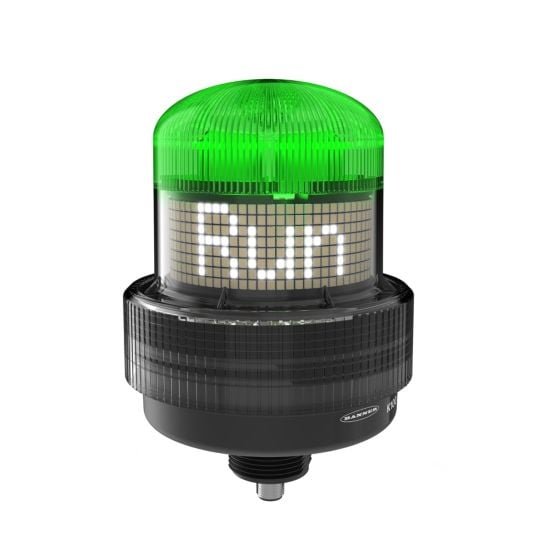
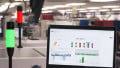
Banner’s K100 programmable text beacon uses colors, sounds, and text to communicate machine and system status to operators. Image used courtesy of Banner Engineering
Lighting, Indication, and Display
Oftentimes, technicians need to be able to check tool status at a glance. Rather than walking to every machine and checking the operation, judicious use of display beacons can save technician steps and time.
A good display beacon will be visible 360 degrees around the device. They should be color-coded whenever possible to indicate some of the more common statuses of the device. For example, green could indicate the machine is healthy, yellow may indicate that technician service is required, and red could mean the machine is out of production altogether.
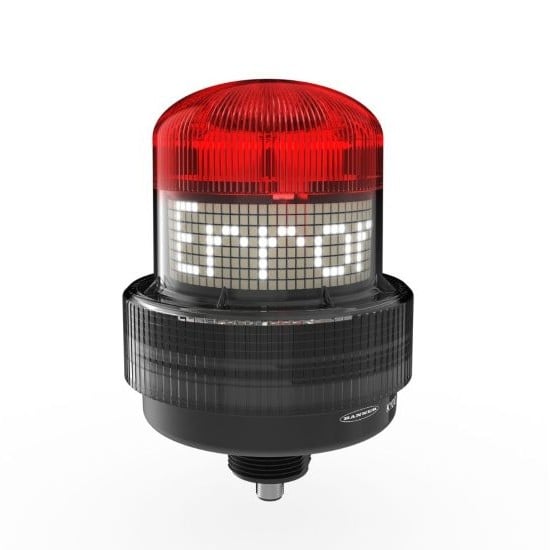
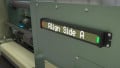
The Banner K100 programmable beacon can display up to 14 colors and 12 static or 32 scrolling text characters. Image used courtesy of Banner Engineering
K100 Programmable Display Beacon
The K100 display beacon features a programmable light with up to 14 configurable color options. The beacon takes up significantly less space than a standard tower beacon, where colors must be stacked and illuminated individually. Underneath the programmable light is an LED array where messages can be displayed. The 8 pixel high x 77 pixel long display can show 12 static or 32 scrolling alphanumeric characters, all adjustable through programming. Banner says this is visible from up to 10 meters away, giving technicians another advantage when identifying machine status from afar.
All K100 beacons are programmable through Banner’s Pro Editor software. There are several K100 models, making it possible to use Modbus, IO-Link, and a host of standard connectors. Depending on the specific configuration, the beacons run on either 12-30 V DC or 18-30 V DC. All are made from polycarbonate and are rated for IP66/IP69K, making them suitable for dusty industrial environments. Some models are available with an audible alarm (93-106 dB).
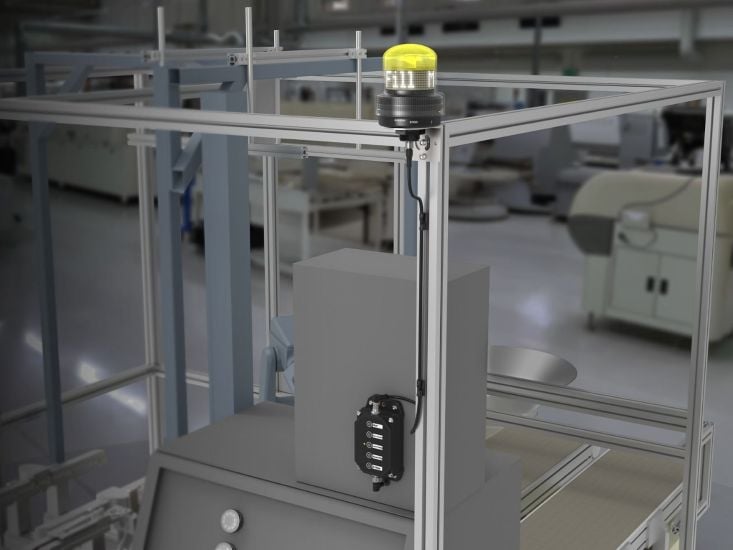
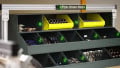
Using text and color, the K100 programmable display beacon can communicate to operators what parts need to be refilled at what cells for assembly. Image used courtesy of Banner Engineering
Communicating Machine Status
The ability to program a beacon to change color and status message, as well as produce an audible alarm, can drastically speed up troubleshooting efforts. For example, in the semiconductor industry, there may be a bay of twenty identical machines. Rather than having to check the status on each one, the technician can simply look down the bay at all of the display beacons and pinpoint which machines need maintenance. With programmable messages, the technician can know a little more about why maintenance is required. It’s the difference between seeing an engine light in a car and having a built-in code reader to tell the driver the problem.
The K100 can be used in new machine construction. Machine builders will find its compact size and ease of integration a welcome addition to their final design. It can also be used to retrofit existing machines, simplifying the task of interpreting error codes and adding features, such as an audible alarm or multicolor display capabilities, to existing equipment.