Facebook
 Google
 GitHub
 Linkedin
Beckhoff ED Series Refreshes EtherCAT I/O Hardware
The ED series EtherCAT terminals from Beckhoff Automation feature push-in wiring and integrated diagnostics for easier installation and maintenance.
Beckhoff’s new ED series EtherCAT terminals introduce practical updates to distributed I/O without disrupting existing system architectures. Designed to improve installation, diagnostics, and day-to-day usability, the terminals feature push-in wiring, mobile app-based diagnostics, and refined hardware handling. While maintaining compatibility with existing EL-series modules and TwinCAT 3 environments, the ED series enables incremental modernization. The result is a more accessible, service-friendly I/O platform tailored to evolving industrial automation needs.
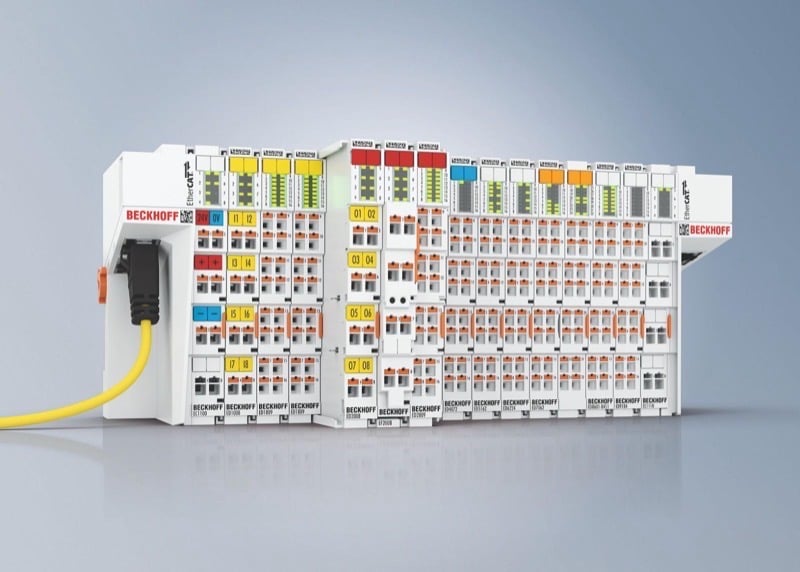
The ED series EtherCAT terminals from Beckhoff Automation feature push-in wiring and integrated diagnostics for easier installation and maintenance. Image used courtesy of Beckhoff
Rather than changing the EtherCAT architecture, the updated ED series will focus on practical improvements. Push-in wiring replaces cage-clamp connections, diagnostics are accessible through a mobile app, and the hardware itself has been adjusted to make handling and replacement easier in real systems.
Hardware Changes and Installation
The ED series will still be mounted via DIN rail. They will maintain the same overall footprint as the EL series, as well as the current part numbering structure, so it lines up with existing hardware and documentation. The wiring method has changed from the EL’s cage-clamp to new push-in connections. A test point has now been added to the terminal for checking signals during commissioning or troubleshooting. The release handle has also been increased in size, making it easier to remove modules from the DIN rail.
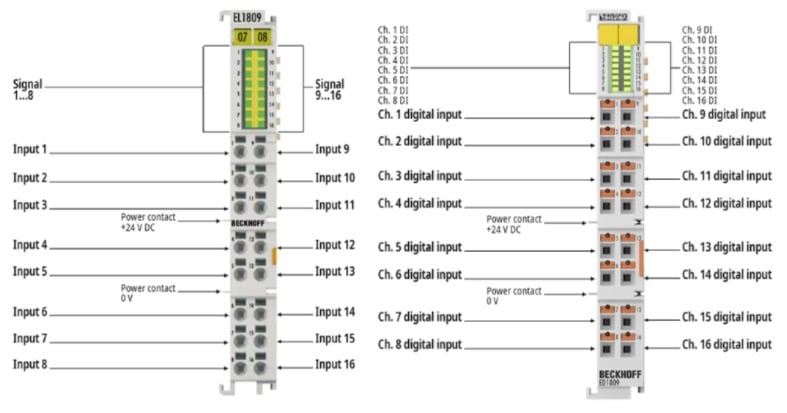
Comparison of the EL1809 (left) to the new ED1809 (right) models. Image used courtesy of Beckhoff
Diagnostics and Integration
The new ED series terminals will include a front-facing data matrix code that can be scanned using Beckhoff’s Bluetooth communication module and mobile app. This provides direct access to diagnostic data without connecting a laptop, and the system is read-only to avoid introducing control or security risks.
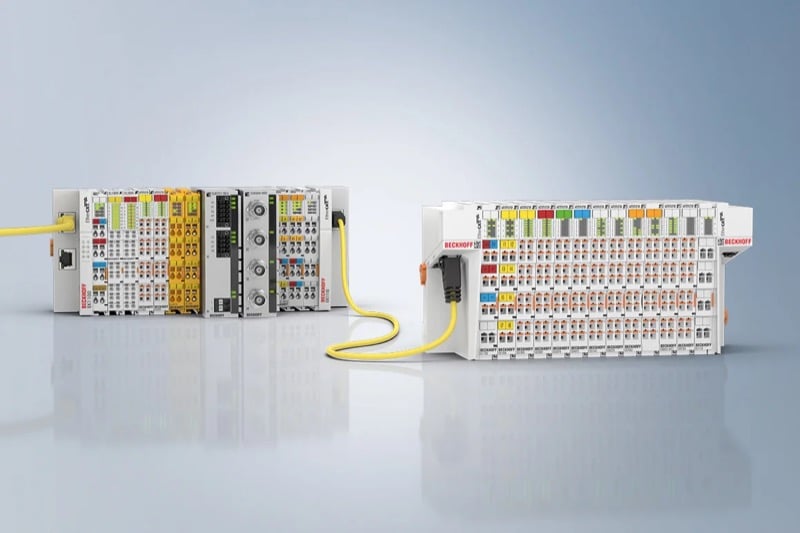
The new ED terminals are compatible with older EtherCAT networks and can be used with existing EL Modules. Image used courtesy of Beckhoff
The ED terminals are also compatible with TwinCAT 3 and can be used alongside existing EL series modules within the same EtherCAT network. However, they are not a true drop-in replacement at the software level. The updated functionality requires new ESI files, so integrating ED modules into an existing system may require program updates.
Platform Direction and Practical Impact
The ED series was intended to build on and update the existing EtherCAT terminal platform rather than replace it. The EL series remains active, and both generations can be used together, allowing systems to be updated incrementally rather than fully replaced.
The changes are focused on usability rather than performance. Push-in wiring reduces installation time, the test point simplifies signal verification, and the updated hardware makes modules easier to handle. The data matrix code also supports traceability for maintenance and spare parts management, while Beckhoff’s multi-source approach helps maintain product availability.
The ED series EtherCAT terminals update Beckhoff’s I/O platform with push-in wiring, app-based diagnostics, and revised hardware while staying compatible with existing EtherCAT systems. Beckhoff’s ED series terminals were designed to simplify installation and troubleshooting while still working alongside the older EL series modules in TwinCAT 3 environments, giving users some flexibility to adopt the new hardware without completely replacing their entire I/O setup.