Facebook
 Google
 GitHub
 Linkedin
Gill Instruments Offers Modbus Communication for WindSonic Line
WindSonic, Gill Instruments’ two-axis ultrasonic wind sensor line, can now be more easily integrated with existing industrial hardware thanks to the addition of Modbus.
Gill Instruments has made data from its WindSonic sensors accessible to more industrial equipment. The WindSonic 60 and WindSonic 75 ultrasonic wind sensors are now Modbus capable on all new models from the factory and on older models with a firmware update. The Modbus capability means easier integration with PLCs, SCADA interfaces, and other such devices, making these sensors useful in larger, more complex systems.
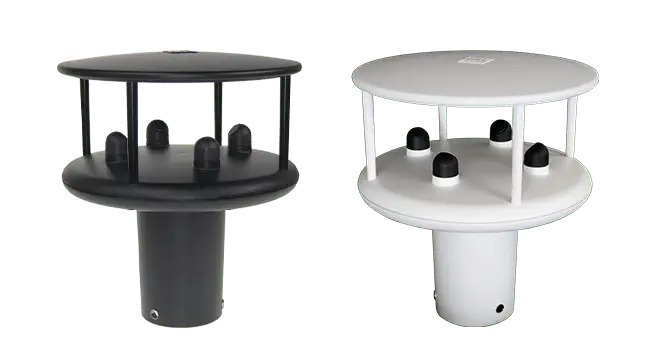
Gill Instruments’ ultrasonic wind sensors now include Modbus capabilities for integration into larger systems. Image used courtesy of Gill Instruments
What Are Wind Sensors?
Wind sensors are used in numerous industrial, infrastructure, and energy-related markets. A good wind sensor determines both the magnitude and direction of the wind, tracking gusts using the region’s standards (10 seconds, 45 seconds, etc).
For the chemical process industry, the ability to monitor the wind direction and speed can help determine the effects of an accidental release of pollutants. ALOHA, a commonly used chemical and environmental modeling package, relies on user inputs of wind speed and direction. Because most people only think of wind in qualitative terms (breezy, from the southwest) and only at the ground level, these inputs are often inaccurate. Wind sensors, on the other hand, provide accurate measurements and can be mounted at the height of potential release, making modeling data more useful.
In infrastructure projects, monitoring the wind can ensure the safety of construction projects. Through proper monitoring of the wind, cranes can be operated much more safely. If the winds are too strong, the crane could topple, so the ability to access both historical (in the past few hours) wind data and real-time wind data can determine safe load limits and boom heights for crane operation. Furthermore, when placed on existing structures, such as tall buildings and bridges, the data can be used to correlate the stress and strain data of the structure to wind loading. Under extreme conditions, the structure can be closed, and the data can also be used to better model wind loading for future projects.
For power generation, the ability to monitor the wind leads to more accurate yawing of wind turbines. Wind turbines can turn to face the wind, making them a more reliable source of power generation. The wind measurements are also used to stop the blades should the wind become too strong for safe operation.

Burj Khalifa, the world’s tallest building in Dubai, already uses Gill Instruments’ WindSonic sensors to ensure the safety of the people inside. Image used courtesy of Adobe Stock
WindSonic Ultrasonic Wind Sensors
Unlike cup anemometers, which are prone to freezing, water loading, and maintenance due to dust and debris, Gill Instruments’ WindSonic line is made up of ultrasonic sensors that do not rely on moving parts. This makes them ideal for hard-to-access areas, such as the tops of wind turbines, flare towers, smokestacks, the roofs of tall buildings, and other locations.
They operate using a Time-of-Flight (TOF) principle. An ultrasonic transducer generates a wave, and the time it takes to reach the receiver is proportional to the wind speed. By measuring this in two axes, as both the WindSonic 60 and WindSonic 75 do, a compass direction can be determined.
The WindSonic 60 can measure speeds up to 60 m/s, and the WindSonic 75 can measure up to 75 m/s. These wind sensors are well known in the wind monitoring sphere and have already been deployed in high-profile projects, such as the Burj Khalifa. The addition of Modbus output to the sensor’s capabilities will make them more desirable in a larger market.
Easier System Integration
Wind sensors, such as the WindSonic line, will continue to be important for numerous industrial purposes. The WindSonic’s upgrade to include Modbus will allow these sensors to be much more easily integrated with existing hardware. Gill Instruments expects energy projects and environmental monitoring to be two of the largest markets that will benefit from the added Modbus capabilities.