Facebook
 Google
 GitHub
 Linkedin
HIWIN Welding Robots Deliver Precision and Ease of Use
HIWIN’s welding robot systems include hardware and software designed to bring high levels of precision, long-term durability, and simple setup and operation to industrial welding applications.
In high-throughput manufacturing environments, even a minor flaw in a weld path can lead to rework, structural issues, or product rejection. Manual welders bring experience and adaptability to projects and will always be needed. However, fatigue, variability, and skill gaps can pose long-term challenges, especially when scaling production. For industries that rely on repeatable, high-quality welds, achieving consistency without compromise has become the focal point.
HIWIN’s welding robot system has been developed to meet the challenges of welding head-on. The robot integrates HIWIN’s in-house components and combines them with intuitive software and flexible welding interfaces. It’s a full-system solution designed not just to weld, but to weld with precision, speed, and minimal oversight.
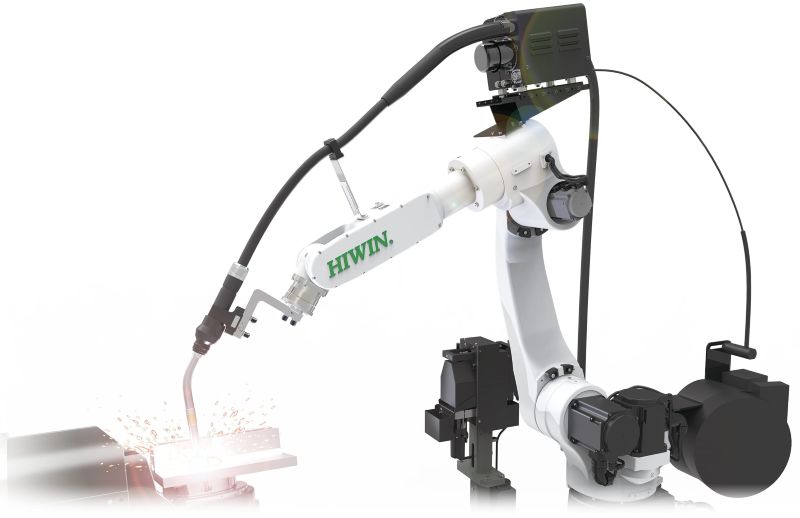
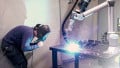
HIWIN’s robot welding system includes hardware and software focused on delivering precise and user-friendly operation. Image used courtesy of HIWIN
HIWIN Welding Robots
At the core of the HIWIN welding robot system is its ability to maintain a repeatable weld path with an absolute accuracy of ±0.05 mm. That’s a critical margin in sectors like automotive or semiconductor manufacturing, where even a millimeter of deviation can throw off assembly tolerances.
HIWIN’s control software, included at no additional license fees, makes setup and operation fairly straightforward. The teach pendant interface enables technicians to control the robot, external axes, and welding power supply from a single point. Optional laser seam tracking and touch sensor features handle irregular seams and unpredictable part placement by automatically detecting and adjusting the weld path to ensure precise results. These tools help compensate for deviations caused by part tolerances, machining errors, or operator setup. HIWIN’s real-time monitoring system backs all of this with a visual data display, logging all weld parameters and alerting users to errors or stoppages the moment they occur.
Reduced Downtime and Maintenance
One-off collisions, tip wear, or torch drift often trigger downtime in robotic welding. HIWIN addressed these common issues with a built-in tool center point (TCP) auto recovery feature. If the welding torch experiences an abnormal stop or misalignment, it will automatically correct itself and resume welding with minimal interruption. This reduces idle time and helps prevent scrap from partially welded workpieces.
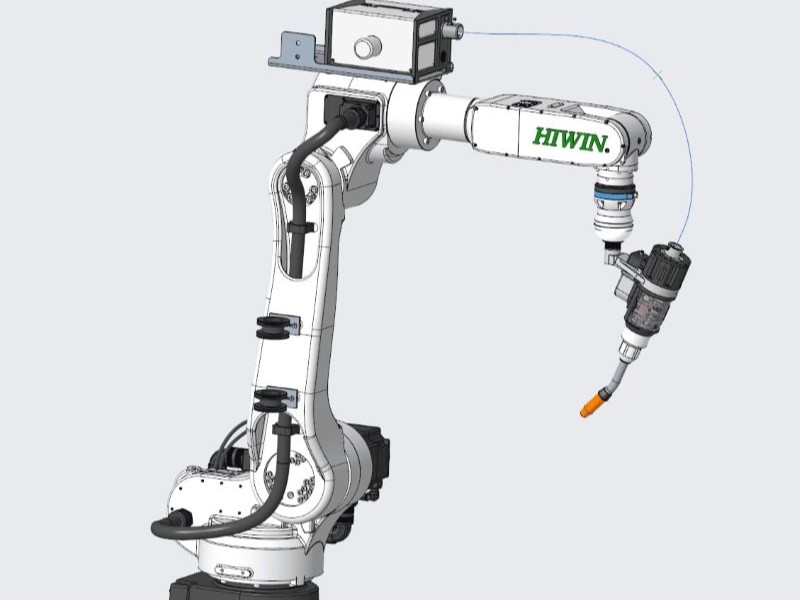
HIWIN’s robot welding system features TCP auto recovery to ensure minimal welding errors and downtime. Image used courtesy of HIWIN
Durability is another pillar of HIWIN’s approach. Because the robot is assembled using HIWIN’s components, the team controls every aspect of the mechanical and drive systems. That translates into longer maintenance intervals and less variability in performance over time. Whether operating on a single cell or integrated into a multi-axis robotic line, the robot is built for repetitive motion in harsh conditions.
User-Friendly Software and Integration
HIWIN’s robot welding system features a welding software interface called Smart-Weld. This software allows users to tweak weld settings directly through the robot’s control system, eliminating the need to toggle between machines. Features like side-to-side weaving help fill gaps along the weld seam, while onboard data visualization gives operators insight into process trends. HIWIN has designed its software to be a unified platform that adapts to the job, rather than forcing the job to adapt to the robot.
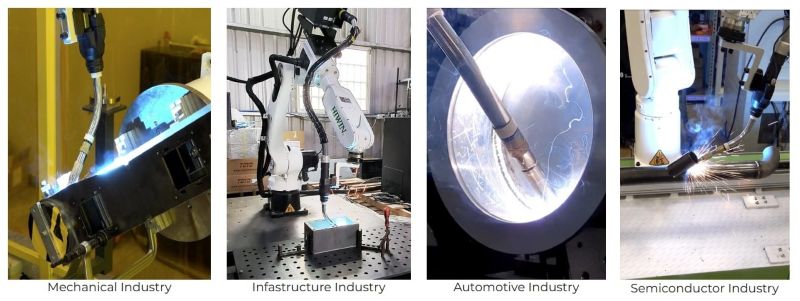
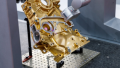
HIWIN’s robot welding system brings precision to industrial welding applications in a wide range of industries, including automotive and semiconductor. Image used courtesy of HIWIN
When it comes to integration, no two welding operations are exactly alike. That’s why HIWIN has made flexibility a design priority. The robot system easily connects with welding power supplies from major brands, including Lincoln Electric, Fronius, SKS, and Miller. HIWIN’s system also supports integration with seventh-axis robot transport units to work on bigger parts. It can be paired with servo positioning tables from HIWIN or third-party suppliers.
Precise Automated Welding
Even as welding becomes increasingly automated, many manufacturers continue to struggle with the balance between precision, uptime, and cost. HIWIN has developed its welding robot system to answer that challenge with a platform that’s accurate, tough, and ready to integrate, without locking users into a rigid ecosystem or overcomplicating setup. It’s built for real-world production, not just lab specs.