Facebook
 Google
 GitHub
 Linkedin
Honeywell and Chevron Partner to Improve AI Process Excursion Response
A recent industry partnership hopes to prove that AI can speed up the training and increase the response and accuracy rate of new technicians, enhancing safety and profitability.
Honeywell and Chevron have announced a unique partnership in which they will work together to develop artificial intelligence (AI) solutions centered around improving refinery operations. This AI system is geared towards helping operators, particularly new or inexperienced operators, make the best process control decisions in a timely manner.
Improvements to Process Profitability
A generation ago, sensors and data were expensive, incomplete, and not readily available. Between manual inspection and logging of gauges on data sheets, limited selection of measurements, and other such reasons, process control decisions were anything but timely. As the world became digitized, data was more readily available, but only highly-trained engineers could make sense of the data. Now, sensors of all sorts are available and affordable, and even the most highly-trained, specialized engineers cannot possibly examine all the data points.
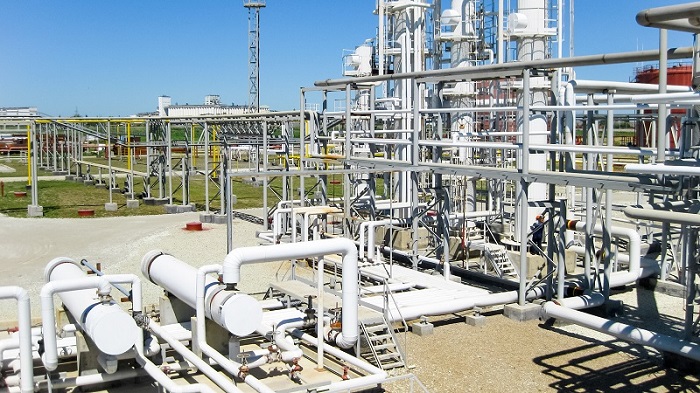
There are thousands of sensors, all generating real-time data, in this Baton Rouge refinery. Image used courtesy of Adobe Stock
This is where Honeywell and Chevron’s partnership will benefit both organizations. By leveraging AI to analyze the data, it can report important trends and identify hidden signals that would take months to detect. From there, technicians can better respond to soft, production-related alarms. For example, AI may detect a subtle trend in fluid flow through a heat exchanger and suggest that preventative maintenance be performed in the next month. Then, the technician can meet with their team and determine when to actually perform the maintenance.
Enhanced Process Safety
Any modern piece of process equipment generates a seemingly endless quantity of data. Data that can impact worker safety is no different; there are numerous data sources that can indicate problems and potential hazards to personnel. Unfortunately, some of these signals can be lost in the noise of continuous streams of data, especially when there are false “nuisance” alarms.
The human mind is used to classifying sights and sounds, sorting them according to a perceived ‘threat’ level. However, when an alarm sounds, but the threat is not imminent, humans naturally begin to classify this as unimportant, and so it moves lower on the internal threat classification.
Even the youngest elementary students know what to do when the fire alarm sounds. After so many practices, they begin to think of it as a “fire drill,” not a potential fire. The same thing happens with industrial alarms: eventually, technicians tune out the ones that they deem unimportant, even if they might lead to disastrous consequences.

Much to their dismay, these students all know that this is only a fire drill and not a real fire; they will soon return to English class. Image used courtesy of Wikipedia
By leveraging AI against these types of conditioned responses, AI can begin to track “nuisance alarms” and help operators work to minimize them. The AI response can guide them through the appropriate steps to track down an alarm and determine whether it is real or a nuisance. If it is a nuisance alarm, it can guide them through how to fix the condition. Ultimately, this means better emergency responses and fewer false alarms.
Consider a machine interlock that sometimes wobbles loose during operation. The temptation is to restart the machine anyhow, which could be dangerous, but 99.99% of the time, there is no consequence. Eventually, an entire generation of operators are trained to restart the machine and ignore this alarm. With AI guidance, they can go investigate WHY the interlock is rattling loose, rather than ignoring it.
The Future of AI Collaborative Projects
While Honeywell and Chevron have drafted one of the first such collaborative projects, it certainly will not be the last. As the possibilities of AI enhancements become better understood, more companies will enter similar agreements to increase throughput, optimize power usage, minimize carbon footprint, and other similar business goals.