 Facebook
 Google
 GitHub
 Linkedin
Hot off the Press: New Sensors on the Control Automation Market
Check out a few of the most recent releases from leading manufacturers in the control system world, including vision, optical, magnetostrictive, and rotary position sensing.
I would argue that sensing is the most important part of a modern control system. The logic, the processing, the visualization, the actuators—these are all very important, but without sensors, there can be no understanding of the process and no feedback from the ‘black box’ of the manufacturing line.
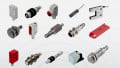
Because of this opinion, I love studying the underlying technology of sensors and keeping a close eye on the evolving technology. Recently, several companies have announced new sensor products, including the BTL Entry Profile-Style linear position sensor from Balluff, the EI and ES/EM series encoders from Leuze, the VeriSens vision system from Baumer, and the washdown-rated QM26-2 optical sensor from Banner.
Linear Position Sensing From Balluff
Magnetostrictive technology is a sensing method that uses a pulsed current and an interaction with a magnetic field to determine a precise linear position. It does not rely on any physical interaction, which means it’s great for long-lasting applications, especially in hydraulic systems where the fluid must remain separated from any electronics.
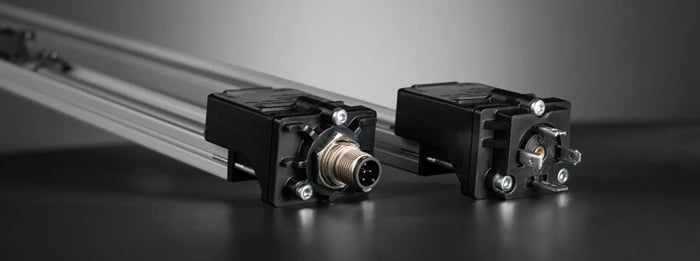
Balluff’s linear position sensors. Image used courtesy of Balluff
Balluff’s new BTL Entry Profile-Style sensor mounts externally to linear motion systems, and it’s particularly designed for low-cost, basic sensing tasks. The sensor series provides repeatability down to ±20 μm along a range of up to 1.2 m in sensing length. Electrically, it supplies analog voltage and current outputs and connections for both M12 and DIN-standard connectors.
Rotary Encoding From Leuze
Machines don’t always move in straight lines. In fact, rotary motion is far more common than linear, so position sensing must cover both realms. Encoders can sense a motor’s rotation to provide position and velocity feedback for advanced motion control.
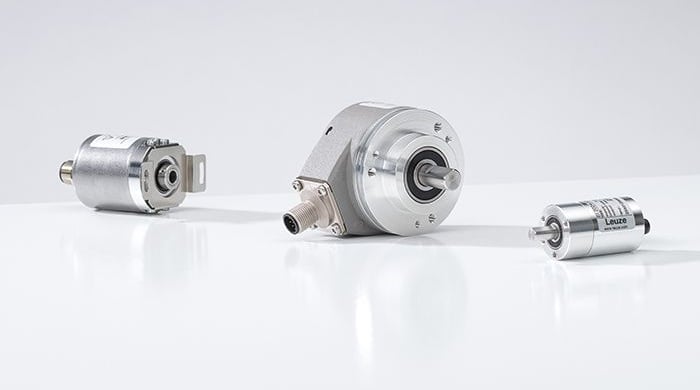
Leuze’s new rotary encoders. Image used courtesy of Leuze
Leuze’s new EI series incremental encoders and ES/EM series absolute encoders provide a variety of options in voltage output, shaft diameter, and mounting styles for all kinds of motor applications. Encoders, by nature, provide extremely rapid output signals, usually at a logic-level voltage, and special input modules are required for control systems to monitor the changes.
Vision Sensing From Baumer
Sensing isn’t limited to PNP/NPN, analog, or TTL voltage outputs. Sensors collect all kinds of data from the world around them, and this certainly includes cameras. Vision sensors are usually optimized to detect a particular kind of visual property, like barcodes or certain features that can approve a product inspection process.
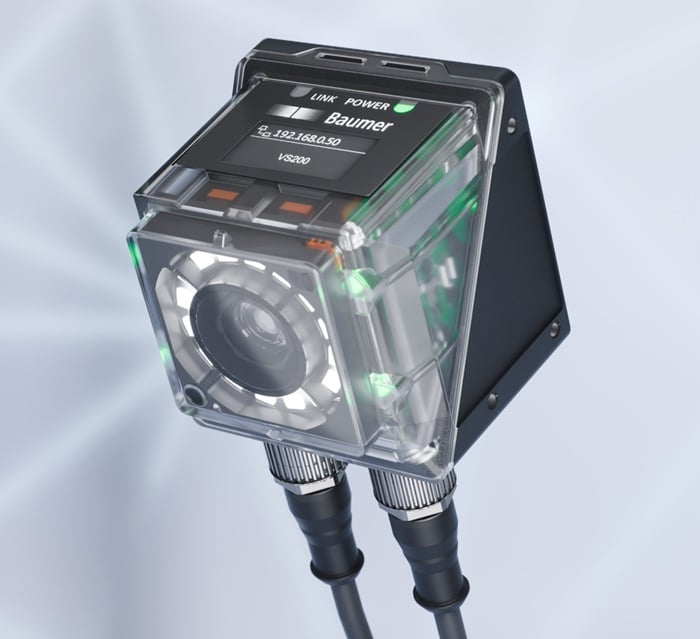
Baumer’s new vision sensor. Image used courtesy of Baumer
Baumer’s VeriSens AI vision sensor is targeted at inspection tasks, so it includes not only the software to perform the inspections but also a simple method of training the software to detect good/bad indicators with only a few sample images. The camera can perform up to 40 scans per second, and it provides several output types to integrate with a wide variety of control systems.
Washdown Proximity Sensing From Banner
Even simple sensing must be optimized for demanding environments. Washdown designs, often carrying IP67, IP68, and IP69K ratings, use stainless steel enclosures, so generic plastic housings cannot be used. This limits the number of options available for food, beverage, and medical production environments.
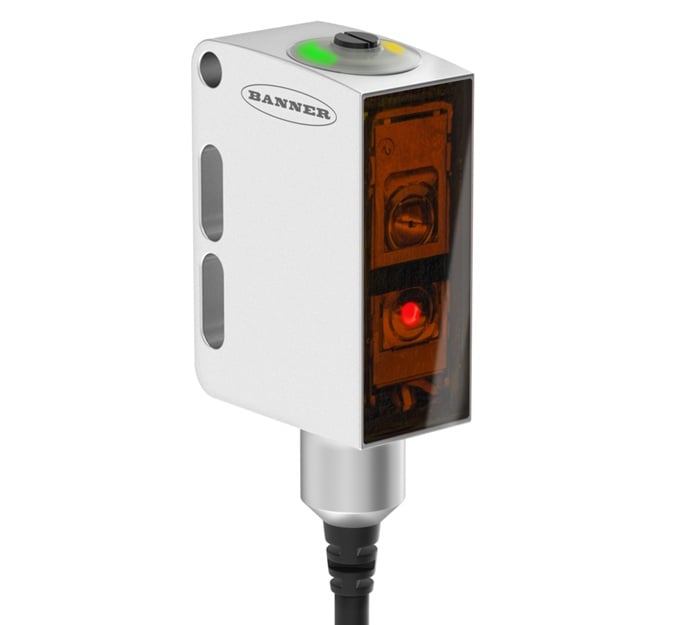
Banner’s new optical washdown-rated sensor. Image used courtesy of Banner
Banner Engineering’s QM26-2 washdown sensor not only has an outer casing that meets the demanding environmental needs but also has internal electronics to accommodate more flexible integration requirements. IO-Link communication has been added to the sensor, along with push-pull outputs and several sensing modes, including emitter-receiver opposed pairs, polarized lenses, and adjustable background suppression.
Sensing the Outside World
Sensors are very important, as previously established, but they aren’t the only part of a control system. The wide range of new and existing sensors allows engineers to verify the specs and reliably design them into all kinds of control systems, each model optimized for a specific use in a particular application.