Facebook
 Google
 GitHub
 Linkedin
Kawasaki Reveals New CL Cobot Series, Tech Demos at IMTS
Kawasaki Robotics and other key industry players collaborated to bring interactive demonstrations focusing on advanced robotics to attendees at the International Manufacturing Technology Show.
Kawasaki Robotics revealed the latest additions to the well-known robotics innovation lineup, the CL series of collaborative robots, at the recent International Manufacturing and Technology Show (IMTS) in Chicago.
The robot business division of Kawasaki showcased the capabilities of its new CL Series family of cobots, developed in collaboration with Neura Robotics, by highlighting particular demonstrations including cobot machine tending of an upgraded Wauseon 1004EL Electric End Forming Machine and an interactive display to provide IMTS attendees with first-hand experience of the CL Series Zero-G mode. Other notable technologies on show at IMTS include a robotic machine tending shelf system, arc-welding robots, Robofin, K-Positioners, and K-Tracks.

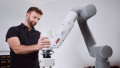
Kawasaki’s CL110 cobot features an IP66 rating, a 10 kg payload, and a 1000 mm reach. Image used courtesy of NEURA Robotics GmbH
Kawasaki’s Interactive CL Series Showcase
The CL110N has a 10 kg payload with a 1000 mm reach and flexible mounting positions. Other attractive features of the CL110N cobot include a speed of 200 °/s and a repeatability of ± 0.02 mm (which extends to all CL Series models). Cables are integrated to streamline the design for maximum maneuverability and enable an ingress protection rating of IP66 to provide a hardy barrier against high-pressure water jets.
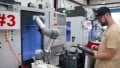
At Kawasaki’s IMTS booth, attendees were able to learn more about the CL Series of cobots and watch the CL110 machine tend an upgraded Wauseon 1004EL Electric End Forming Machine. Automotive, aerospace, and construction sectors employ this end-forming tool to reshape tubes or pipe ends. It uses electricity to run (as opposed to pneumatic and hydraulic setups) to form ends into shapes like reductions, flares, or beads.
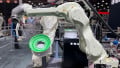
IMTS attendees were offered the opportunity to use the CL Series Zero-G mode with the CL108 cobot as part of an interactive display, hand-guiding the bot with a light touch and recording programs. The ability to log settings and parameters helps customers to reduce set-up times and workflow errors.
Other Kawasaki Technology Highlights
Another demonstration at IMTS featured a no-code robotic machine tending (RMT) solution comprising 16 workpieces (of which, four are adhered to pallets and the remaining 12 are fixed in position by in 5th Axis LiteVises), a Kawasaki RS013N robot, and a Hurco VM15Di CNC machine. Hurco has over 50 years of experience manufacturing and supplying CNC machining solutions and equipment for mills and part production. The RMT solution is designed to accommodate varying part sizes and volumes, concentrating on low-volume, heterogeneous production of parts while minimizing robot programming.
Jointly developed by AMT (Association for Manufacturing Technology) and NEFF Automation, the Robofin material removal solution provides manufacturers with material-agnostic finishing, deburring, polishing, and grinding. One notable feature of the Robofin is its ability to extend the lifespan of abrasives three-fold, which provides the benefit of reducing tool changes and lowering material costs.

Kawasaki’s BA Series of arc welding robots feature a single-cable connection between the welding equipment and the robot to save time on installation. Image used courtesy of Kawasaki Robotics
Modern welding robots (such as the BA013N and BA013L models) are also a key technology being showcased at IMTS. These robot models have cognitive systems that allow real-time path modification and versatile arc welding. The robots may modify their welding pathways automatically in response to changes in the material being worked on or its environment, ensuring a consistent weld. These advancements make it easier for businesses to meet production goals, reduce errors, and attain higher levels of precision.
IMTS attendees were also able to witness the latest in K-Positioners and K-Track technologies. K-Positioners preserve process times and rework by automating workpiece positioning and guaranteeing optimal torch setup for more accurate, high-quality welds. K-Tracks ease manufacturing line modifications by enabling a single robot to work with numerous parts, hence lowering the number of robots required. These technologies provide businesses with increased flexibility, reduced equipment costs, and quicker reaction times to shifting market demands.