Facebook
 Google
 GitHub
 Linkedin
Know Your Place: Balluff Debuts Linear Position Monitoring System
Have you ever needed to know the position of a hydraulic cylinder at any given point? Balluff’s new BTL K sensor uses magnetostrictive technology to provide constant, accurate positioning.
Recently, global sensor innovation company Balluff announced the release of a magnetostrictive sensor, a device that can be mounted radially within a hydraulic cylinder that provides a precise and accurate position that aids in calculating the solution to motion control design challenges. The sensor series, all with a 500 mm stroke length, can provide outputs of analog voltage or current, or an IO-Link digital signal.
Hydraulic Cylinder Positioning
Hydraulics tend to be the go-to power source when a lot of force is required for motion. These cylinders are found throughout construction sites, mining industries, and road resurfacing locations, in addition to all kinds of manufacturing processes. When an application involves constant, precision position monitoring, special sensors are added to the cylinder that provide the operator or control system with an accurate picture of exactly where the cylinder is at all times.
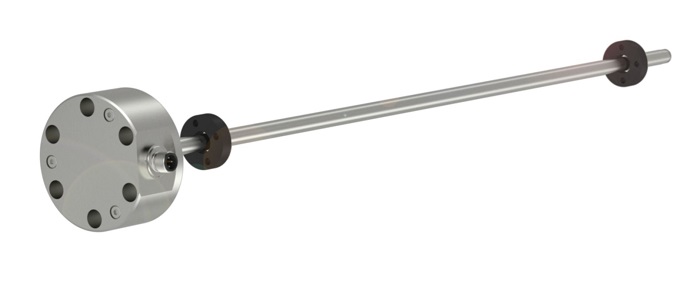
The BTL K positioning sensor from Balluff. Image used courtesy of Balluff
BTL K Magnetostrictive Linear Position Sensor
The most basic form of linear position sensing is done with a reed switch mounted on the outside of the cylinder. As the cylinder head passes over the reed switch, the contacts inside close, allowing a discrete electrical signal to pass through to the control system.
If you only need to know the start and end position of the cylinder, this style of sensing works very well, but if you need to know the position continually, much like a linear servo axis, then you will need to investigate a sensor solution like the new BTL K from Balluff.
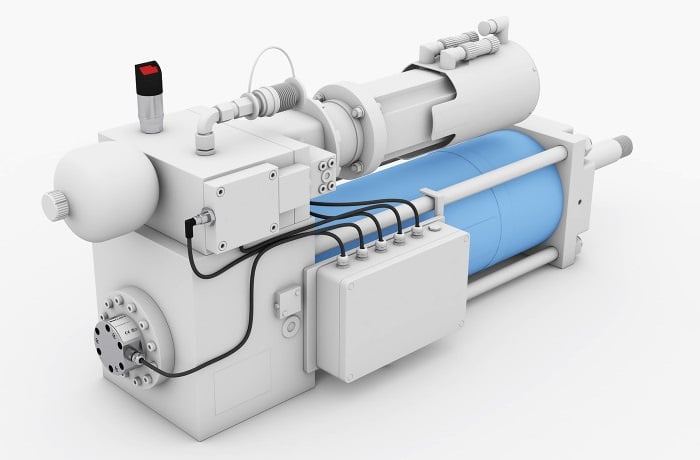
Monitoring a compact hydraulic pump, reservoir, accumulator, and cylinder using the BTL K sensor. Image used courtesy of Balluff
This sensor consists of a rod with waveguide, magnet, and mounting flange, and provides accurate positioning over IO-Link or through an analog signal of either 0-10 v or 4-20 mA. The construction of the BTL K sensor is of stainless steel to provide a robust housing and to prevent corrosion.
The BTL K comes in three variations, analog voltage, analog current, or IO-Link, all of which have the same 500 mm measuring range, C1 performance class, and operate with a supply of 10-30 VDC. The mounting flange is a six-hole bolt pattern with a rod diameter of 10.2 mm and an O-ring to prevent leakage.
The advantage of this sensor is the ability to mount it horizontally within the cylinder, making it an excellent choice for many position-measuring applications. With the sensor making use of magnetostrictive technology, the sensing is done in a contact-free manner, meaning less wear on the sensor itself and less downtime for equipment.
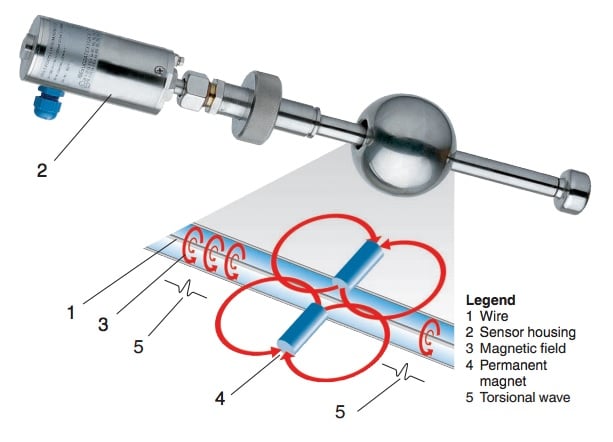
Description of a magnetostrictive system using a level sensor as an example. Image used courtesy of Wika
Magnetostrictive Sensing
A magnetostrictive sensor uses an electrical pulse and a waveguide to detect the position of a permanent magnet along the waveguide. This technology can be found in level sensors or constant positioning sensors such as the BTL K sensor from Balluff.
When the sensor applies an electrical pulse through the waveguide, an ultrasonic pulse is generated at the location of the permanent magnet. This pulse or ultrasonic wave travels back to the sensor electronics at a specific speed, with the sensor then calculating the distance between the magnet and the sensor head. The BTL K sensor from Balluff uses this technology to constantly measure the position of a hydraulic cylinder. The permanent magnet is mounted in the piston of the cylinder, while the waveguide is mounted inside the sensor rod. As the cylinder moves the magnet along the rod, the position is constantly updated through an analog or IO-Link signal.
Hydraulic Position Sensing
Motion control has evolved far beyond simple on/off operation that can be achieved with end-stop limit or reed switches, or even more simple open-loop controls, where cylinders simply slam to the hard-stop ends of travel.
For more complex scenarios where motion is carefully tracked and controlled down to sub-millimeter precision, we must rely on advanced position sensors to provide real-time data to the controller to continue producing and processing the endless variety of products used around the world.