Facebook
 Google
 GitHub
 Linkedin
Kurabo and Flexiv Merge Technologies, Create Adaptive Robot
Kurabo has combined its 3D vision sensors with Flexiv’s robots to create the all-new KURAVIZON adaptive robot system. The new system aims for precision and adaptability in laboratory and factory automation.
An innovative partnership between Kurabo and Flexiv is focused on enhancing the speed, precision, and perception of collaborative robots. The two companies have combined their respective technologies to create the KURAVIZON adaptive robot that can handle the flexibility, budget, and efficiency required for demanding and high-precision applications across automation in laboratories and factories.
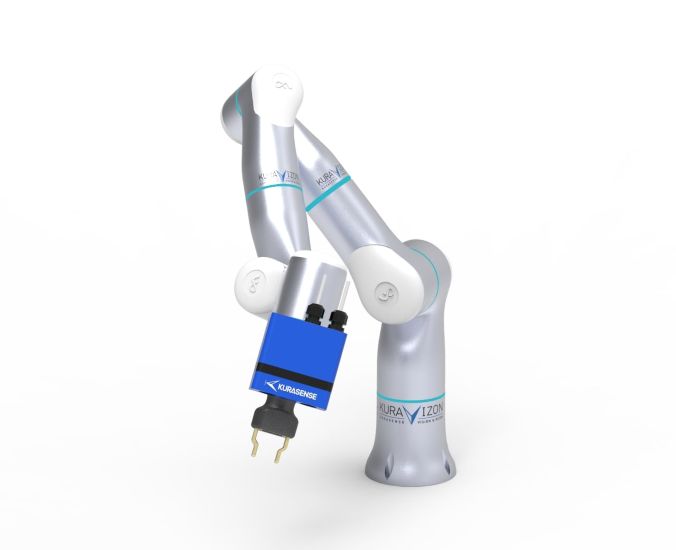
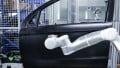
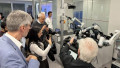
The KURAVIZON robot combines sensitive industrial force control from Flexiv’s cobots with Kurabo’s 3D vision sensor technology. Image used courtesy of Flexiv
KURAVIZON Adaptive Robot System
Robots undertaking delicate assembly tasks are challenged with moderating force and using spatial input to align parts carefully and correctly to avoid damage and operational costs. Robots are combined with sensor technology and integrated vision systems to overcome difficulties in dexterity, force control sensitivity, part identification, and positioning. Advanced vision systems provide a more efficient means of locating parts and allowing robotic technologies to pick and place, move, and assemble them in line with appropriate workflow time frames, maintaining productivity.
Kurabo and Flexiv’s new KURAVIZON adaptive robot system combines Kurabo’s Kurasense advanced 3D vision sensor technology with Flexiv’s Rizon robots to handle delicate tasks with precision.
Flexiv Rizon Robots
Flexiv’s Rizon collaborative robot series includes three models. The lightest model is the 4 kg payload Rizon 4 with an 876 mm reach that supports material handling, machine tending, and assembly applications. The Rizon 4S offers enhanced performance, an extended reach of 919 mm, a tool center point force (TCP) of 150 N, and a TCP linear speed of 1.0 m/s. Rizon 10 caters to heavier applications with a payload capacity of 10 kg, a max TCP force of 350 N, and a 941 mm reach. The Rizon 4, 4S, and 10's force sensing accuracy is 0.1, 0.03, and 0.2 N, respectively.
The Rizon series stands apart due to several important characteristics. The robots can detect and react to their surroundings in real time thanks to adaptive force control, which makes careful manipulation and accurate force application possible. Hand-eye coordination is made possible by optional vision systems, which increase the automation potential to cover jobs like bin picking, assembly, and inspection. Crucially, these robots' sophisticated safety features — like force limitation and collision detection — allow for safe human-robot cooperation minus the need for conventional safety barriers.
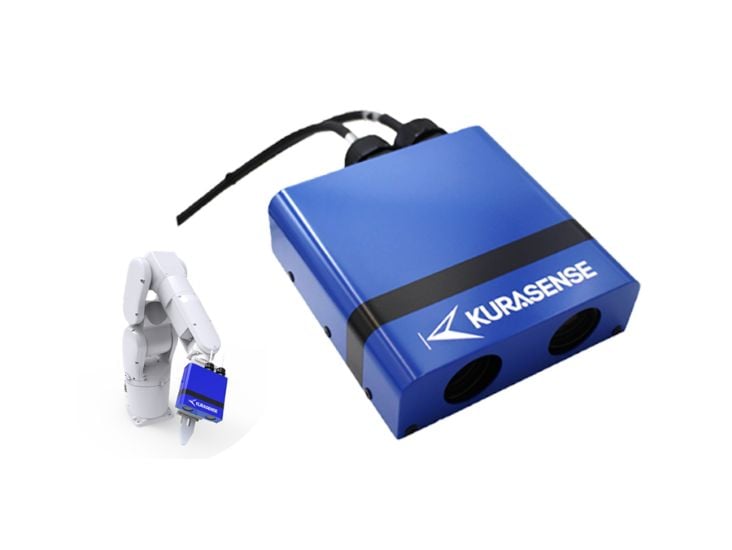
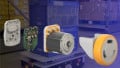
Kurabo’s Kurasense-C100FX high-speed 3D vision sensor fitted to a robot. Image used courtesy of Kurabo
Kurasense 3D Vision Sensors
The KURAVIZON robot combines Flexiv’s Rizon robots with Kurabo’s 3D vision technology to take precise, robot-guided automated tasks to the next level.
First up, Kurabo’s Kurasense 3D vision sensor technology comprises three individual and task-specific sensor technologies for object identification and handling. The Kurasense-C100FX sensor is one of three high-speed, 3D vision sensors with a separate controller and sensor head (weighing 0.8 kg). The Kurasense-C100FX can identify extremely slim/small wires and fit various connectors and cables to larger components such as transmissions and vehicle engines. The Z accuracy of the Kurasense-C100FX is ±0.1 mm. Other sensor targets include electric wire, flat flexible cable/flexible printed circuit (FFC/FPC), copper wire, and connectors.
The Kurasense-C100 3.0 kg 3D vision sensor is built for robots that can swiftly grip and position cables, flat wires, and other linear objects that typical sensors are unable to identify. It uses high-speed 3D scanning and recognition tech to combine the sensor and controller into one module. With a working distance of 500 mm, it can recognize targets such as wires, cables, FFC/FPC, and connections in 0.1 seconds (based on the recognition function).
An overview of the features and capabilities of Kurabo’s Kurasense technology. Video used courtesy of kuraboEL
The Kurasense-A100 is lightweight and features a small form factor. It allows robot hands to detect changes in positioning in 3D and part/component presence and can double cables in 0.7 seconds (depending on function). The head unit and processor have a work distance of 300 mm. The Kurasense-A100 is designed to improve precision, quality assurance, and anomaly detection in tasks such as assembly, cable handling, and component alignment, optimizing manufacturing workflows.
Robotic Automation Solutions
Together, Flexiv and Kurabo aim to evolve the nature of precision in automated robotics solutions, expanding robots’ flexibility and capacity to take on complex, intricate tasks that require the highest standards of execution to meet quality standards. By combining Kurabo's sensor technology with Flexiv's advanced force sensing and control robotics systems, the two companies have created a solution focused on precision and adaptability in industrial automation.