Facebook
 Google
 GitHub
 Linkedin
Lenze Introduces IE5/IE6 Motor Drive System With i650 Motec Inverter
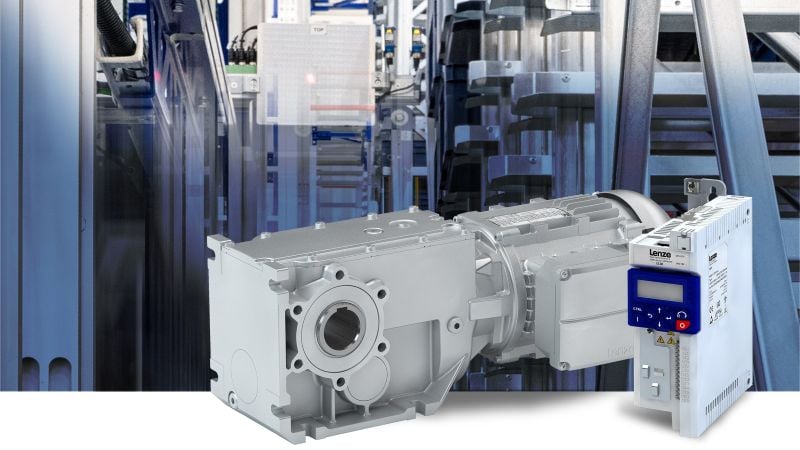
Lenze’s IE5/IE6 motor drive system pairs the i650 motec inverter drive with the m550/m650 synchronous motor to deliver high energy efficiency, encoderless positioning, and up to 300% starting torque.
If you’ve ever watched a conveyor try to start under load, you know why so many drives get oversized. It keeps production moving, sure, but it also leaves plants with gear that’s bulkier, hungrier, and harder to integrate than it needs to be.
Lenze’s new IE5/IE6 motor drive system aims to dial back that complexity by pairing the i650 motec inverter with the m550 and m650 synchronous motor families. The combination provides high starting torque, integrated logic, and encoderless positioning in a package engineered for decentralized architectures.
Lenze debuted the system at SPS 2025, where it framed the update as a shift toward more efficient, self-sufficient motion nodes.
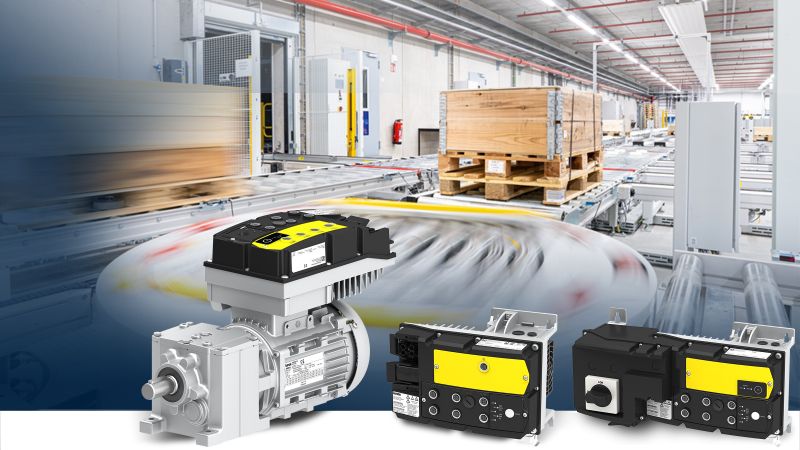
Lenze’s new IE5/IE6 motor drive system pairs the i650 motec inverter drive with the m550/m650 synchronous motor. Image used courtesy of Lenze
A Drive System Built for Heavy Starts
According to Lenze, the IE5/IE6 motor drive system delivers up to 300 percent starting torque from a standstill without requiring motor feedback. For applications that routinely start under load, such as conveyors with product already on the belt, winding stations at full tension, or pump systems with back pressure, that level of torque gives designers room to size motors for the continuous duty cycle machines. Lenze notes that this approach trims overspecification and reduces energy consumption while still hitting the required acceleration profile.
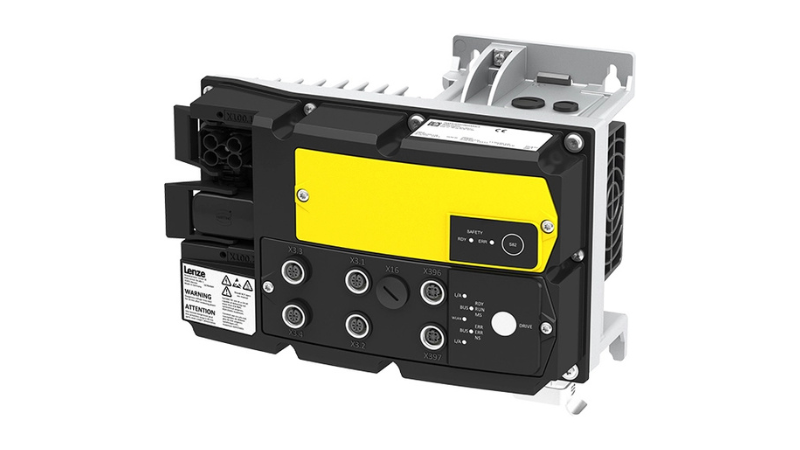
Lenze’s i650 motec frequency inverter features a built-in Logic PLC based on CODESYS. Image used courtesy of Lenze
Integrated Control, Encoderless Positioning
The i650 Motec itself includes a Logic PLC and built-in positioning capability, allowing it to execute local moves even if a higher-level controller is unavailable. When paired with the m550/m650 synchronous motors, the inverter can perform encoderless positioning and maintain repeatability through precise model-based control.
Safety functions for motion systems such as safe torque off (STO) and CIP-based STO are already supported, and future additions will extend encoderless safety with modes like SLS and protocol support for PROFISAFE and FSoE.
Motor Range and Mechanical Options
Lenze’s m550 motors can cover between 0.25 and 11 kW, while the m650 range spans 0.75 to 22 kW for more dynamic motion. Both motor series were designed to interface cleanly with Lenze’s gearbox families, which include helical, angular, and bevel gears. Early test users relied on Lenze’s web-based EASY System Designer to size components and estimate energy consumption, which helped them tune the motor-gearbox-drive combination more precisely for efficiency rather than brute force.
Lenze’s m650 motor features 0.75 - 22 kW power ratings for use in dynamic applications. Image used courtesy of Lenze
Energy Recovery and System Transparency
The IE5/IE6 motor drive system’s sustainability features are equally notable. According to Lenze, motor losses can drop by as much as 60 percent depending on the configuration. The i650 Motec includes an energy-recovery stage that returns excess energy to the mains without external hardware. IO-Link connectivity supplies additional diagnostics to operators, giving them access to data that would normally require extra sensing hardware. Removing the need for feedback devices, special cabling, and brake resistors also trims installation time and material cost.
Lenze’s IE5/IE6 motor drive system blends high starting torque, encoderless positioning, and built-in energy recovery into a compact decentralized package. It gives machine builders a way to size drives more accurately, streamline installation, and improve efficiency without layering on external components.